Andrew Bayliss Wonders Why the Chinese Leader Keeps Bringing Up the “Thucydides Trap”?
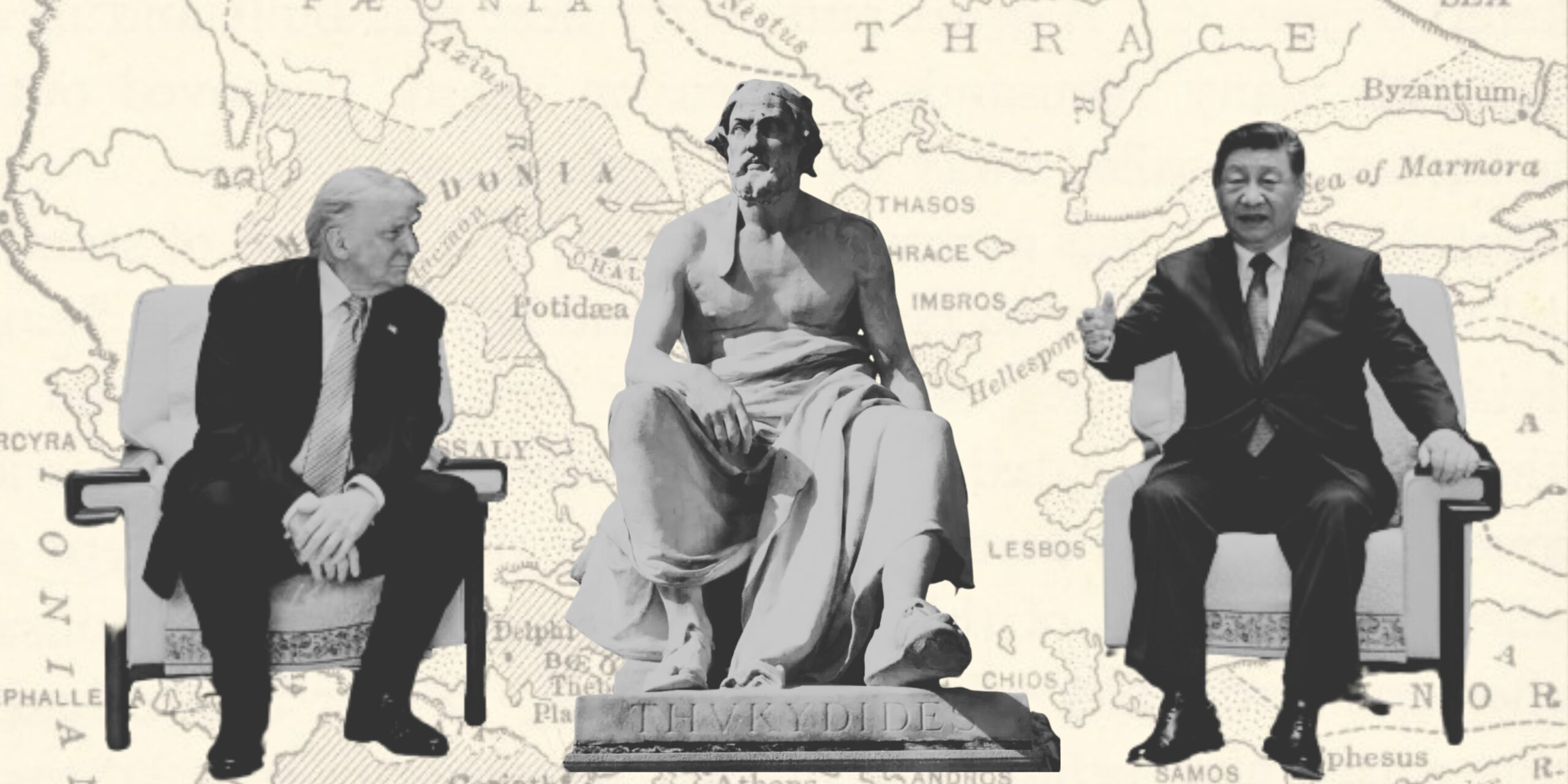
At his recent meeting with the US President Donald Trump, the Chinese leader Xi Jinping asked: “Can China and the United States transcend the so-called ‘Thucydides Trap’ and forge a new paradigm for major-power relations?”
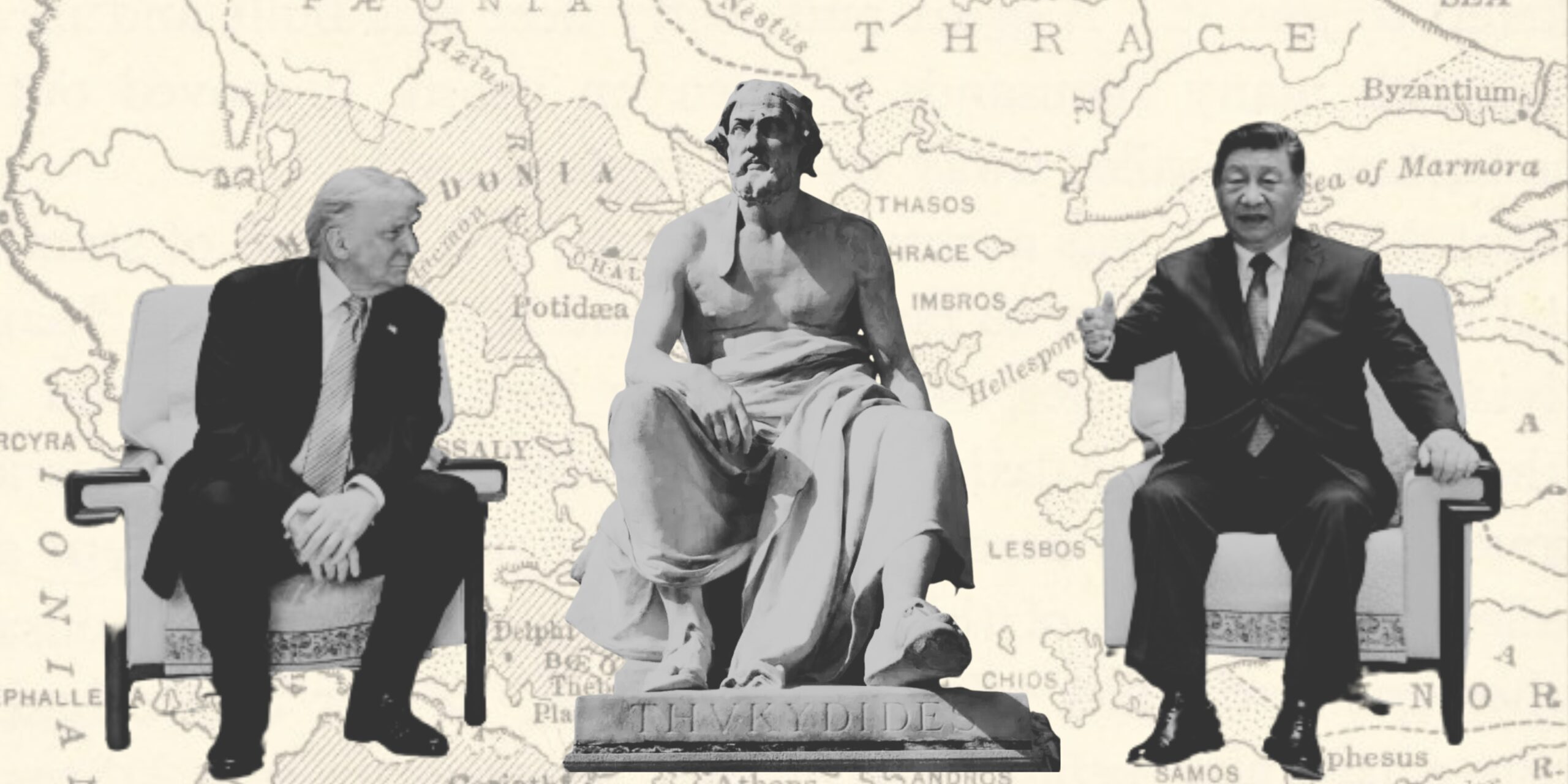
While it might come as a surprise for many to hear the Chinese President reference a Greek historian from 2,500 years ago, who wrote an account of the Peloponnesian War between Athens and Sparta in the fifth-century BCE, it is not the first time Xi Jinping has dragged Thucydides into modern politics. As early as 2013 he warned that “we need to work together to avoid the Thucydides trap,” and in 2024 he used the term again when he told then President Joe Biden that the Thucydides Trap was “not a historical inevitability.”
Why Thucydides? It all dates back to around 2011, when the US political scientist Graham T. Allison coined the term “Thucydides Trap” to suggest that historical precedents showed that war between the USA and China is inevitable. The theory is based on Thucydides’ claim that “the truest cause” of the three-decade long war between Athens and Sparta was Sparta’s fear of Athenian power. As Allison sees it, when a dominant power like ancient Sparta or the USA today fears an emerging power like Athens or China, war will inevitably result.
Xi Jingpin’s reference to the Thucydides Trap would have come as no surprise to the US President and his team, as Professor Allison briefed the White House about his theory ahead of diplomatic talks with China in 2017. It is obvious that President Trump knew exactly what Xi Jinping was implying with his comments, because he responded that the Chinese leader had “very elegantly referred to the United States as perhaps being a declining nation.” President Trump clearly understood that his Chinese counterpart was casting the USA today in the role of Thucydides’ Sparta.
As an historian of ancient Sparta, I find the focus on the Thucydides Trap disconcerting.
As an historian of ancient Sparta, I find the focus on the Thucydides Trap disconcerting. First of all, it is frankly odd to see an authoritarian regime like today’s China identifying itself with fifth-century BCE Athens, a radical, direct-participatory democracy. Thucydides describes the Athenian statesman Pericles boasting that Athens was open to the whole world in which every man could live exactly as he pleased, a wealthy, elegant and vibrant hub into which “the fruits of the whole earth flowed.” This was because Athens used its massive navy to control a maritime empire that covered much of the eastern Mediterranean. During the Cold War era, Classicists studying the Peloponnesian War tended to identify Athens with the free-market West, and the landlubber Spartans with the Soviet Bloc.
Secondly, the theory rests on sixteen cherry-picked case studies—from the sixteenth century CE to the present day—when war broke out after an emerging power threatened to displace a great power, which Allison claims not only bear out Thucydides’ assessment of the inevitability of the war between Sparta and Athens, but also “prove” that war between the USA and China is inevitable. But there are some big leaps of imagination there, especially given that four of the examples Allison chooses did not lead to actual war.
Thirdly, Allison’s theory relies on a misreading of what Thucydides actually says. The British Classicist Professor Neville Morley has pointed out in a recent academic journal article that Thucydides “does not say that war was inevitable; rather, the dynamic between Athens and Sparta ‘compelled to war,’ leaving it open whether this relates to the Spartans or to the whole situation.”
In my recent book, Sparta: the Rise and Fall of an Ancient Superpower, I argue that the Thucydides trap has the protagonists in the wrong roles. It was Athens, not Sparta, that was the dominant force in the middle of the fifth century BCE. Sparta had not yet ruled the Greeks. It was only by defeating the Athenians in the Peloponnesian War that the Spartans became the dominant power in Greece. Thucydides’ observation that what he considered to be the true cause of the war was also “one least spoken about” reveals that few would have agreed with him at the time. Thucydides’ narrative actually makes Sparta seem motivated more by fear of the break-up of its alliance system known as the “Peloponnesian League” than by fear of Athens. Besides, the war itself was triggered not by Athens or Sparta, but by Sparta’s ally Thebes attacking Athens’ ally Plataea.
Finally, Xi Jinping’s hope that China and the USA can “forge a new paradigm for major-power relations” reveals another flaw in the analogy: Athens and Sparta were not really major powers like China and the USA today. They were big fish in a small pond. The real global superpower at the time was Persia, an empire covering 3.5 million square miles stretching from Europe to the Subcontinent, populated by 5,500,000 people. The Sparta state was just 5,000 square miles, and even the Athenian maritime empire was only 15,000 square miles in extent. None of the Greek states were genuine global superpowers until Alexander the Great conquered Persia in the fourth century BCE. When Alexander learned that his regent Antipater had defeated an uprising led by the Spartans in 331 BCE, he dismissively remarked, “It would seem that while we were conquering the Persians here, there has been a battle of mice there.” But if invoking the Thucydides Trap can help prevent a war that no one wants, let’s not let the facts distract from the potential for peace.
________________________
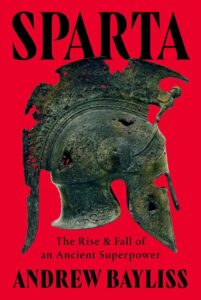
Andrew Bayliss’ Sparta: the Rise and Fall of an Ancient Superpower is available now from W. W. Norton.