Larry Williams’ strategy starts with one hard truth. A price move means little until the pressure behind it is clear. His five core signals, Williams %R, volatility breakouts, Oops patterns, COT positioning and seasonality, help separate genuine force from late crowd reaction, but each one breaks down when treated as a standalone rule.

Key Takeaways
-
Williams %R maps closes inside a 0 to -100 range, but extreme readings can persist when trend pressure remains strong.
-
Volatility breakouts need follow-through, since a level break without range expansion often becomes a false signal.
-
The Oops pattern tracks failed-opening confidence, but clean gap setups are less common in near-continuous markets.
-
COT data adds positioning context, though its weekly delay makes it a confirmation tool rather than an intraday trigger.
-
Seasonality improves timing only when other signals agree, because calendar patterns can fail under macro pressure.
Who Larry Williams Is and Why His 1987 Record Changed Trading

Larry Williams is a futures trader, market researcher, and trading author best known for the Williams %R, volatility breakout methods, COT analysis, seasonality research, and the Oops pattern.
His 1987 World Cup Championship of Futures Trading result turned those ideas into a public benchmark. Williams posted an 11,376% net return in the year-long futures competition, giving his trading method rare visibility because the result was attached to live performance rather than theory.
The record changed the conversation around trading systems. It showed how structured signals, aggressive futures exposure and disciplined execution could produce extraordinary results, while also showing how quickly performance can be misunderstood when risk is ignored.
Futures amplify both edge and damage. The useful lesson is not the return itself, but the gap between having a signal and surviving the leverage behind it.
The 5 Core Signals Behind Larry Williams’ Trading Method
Larry Williams’ strategy is broader than Williams %R. Each signal answers a different question, which is why one reading alone is never enough.
The table gives the fastest map of the method. The strongest setups are not built from a single row but from several rows pointing toward the same pressure.
| Signal | What It Shows | Where It Breaks Down |
|---|---|---|
| Williams %R | Price is closing near the edge of its recent range | Strong trends keep readings extreme longer than expected |
| Volatility breakout | A move is expanding beyond the prior range | Price clears a level but follow-through disappears |
| Oops pattern | Early confidence has failed | Near-continuous trading reduces clean gap setups |
| COT positioning | Futures exposure is crowded or stretched | Weekly data arrives after positioning has already shifted |
| Seasonality | Timing may support or weaken a setup | Macro shocks override historical calendar patterns |
COT positioning carries the most overlooked insight. Simple indicators show what price has done. COT data shows where exposure already sits when the next move begins.
1) Williams %R Shows Where Price Pressure Is Building
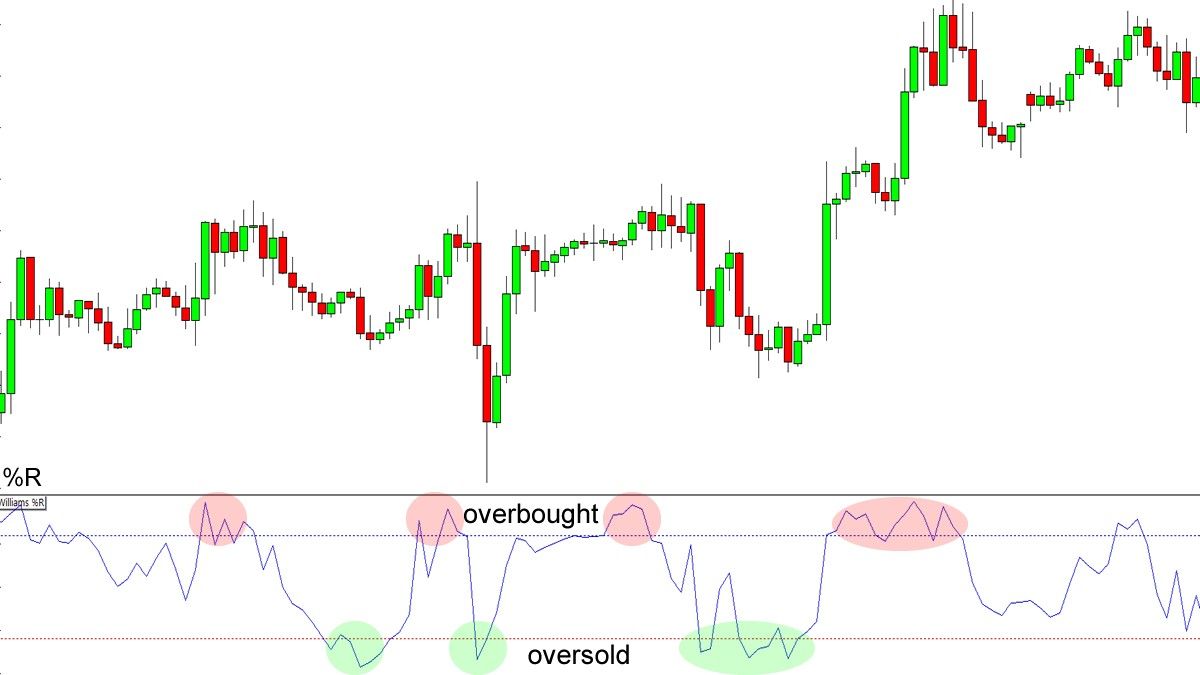
Image Source: Babypips
Williams %R measures where the latest close sits within a recent high-low range. The indicator runs from 0 to -100, with 0 to -20 commonly read as overbought and -80 to -100 as oversold.
The common mistake is treating those zones as reversal commands. Extreme readings indicate location inside the range, not a guaranteed turning point.
The signal breaks down when an extreme reading is mistaken for exhaustion. A strong market can stay overbought because buying keeps the close near the top of the range. A weak market can stay oversold because selling keeps forcing closes near the bottom.
2) Volatility Breakouts Reveal Whether a Move Has Force
A breakout without volatility is only price crossing a line. Williams’ breakout logic looks for range expansion because real moves usually need more than a minor drift beyond yesterday’s level.
One popular Larry Williams volatility breakout version uses the prior day’s range to create upside and downside trigger zones from the current open. Range expansion separates a minor price breach from a move that has attracted participation.
The signal breaks down when price clears a level without commitment behind it. A breakout with no follow-through is not strength. It turns late buyers or sellers into liquidity for the other side.
3) The Oops Pattern Turns Failed Confidence Into a Signal
The Oops pattern captures a failed opening move. Price opens beyond the previous range, draws in late conviction, then reverses back into the old range.
The pattern captures the moment confidence turns into forced reversal. The emotional hook is simple, the market punishes confidence that cannot hold beyond the opening move.
Near-continuous trading in equity index futures and other liquid markets reduces the frequency of clean gap setups, making the Oops pattern less mechanical than it was in older session-based markets.
Cleaner gaps are rarer. Failed urgency still leaves a mark.
4) COT Data Shows Where Exposure Is Already Crowded
The Commitment of Traders report gives Williams’ method its positioning layer. CFTC reports are generally released on Friday at 3:30 p.m. Eastern Time and usually include data from the previous Tuesday.
The delay changes how COT data should be used. It is not an intraday trigger. It shows where futures exposure was already concentrated before the next move developed.
Williams helped popularise COT analysis and the Commercials Index, with his own materials tracing that work back to the 1970s.
The signal breaks down when weekly data is treated as live positioning. COT shows where exposure was concentrated, not where every position sits now.
Crowded trades rarely unwind politely. When one side is overloaded, price pressure can turn positioning into fuel.
5) Seasonality Adds Timing Before the Signal Appears
Seasonality adds a timing layer before price confirms the signal. Williams’ official materials describe his 1973 work on seasonal indexes as a major contribution to commodity trading research.
Seasonal pressure comes from recurring forces such as harvest cycles, inventories, weather, demand patterns, tax effects and institutional flows. The signal works best when calendar pressure supports behaviour already forming on the chart.
The signal breaks down when calendar tendency is treated as a forecast. A seasonal window is only a timing bias. It gains value when momentum, volatility or positioning agrees.
When the Signals Agree, the Method Gets Stronger
Larry Williams’ method becomes clearer when the five signals stop competing with each other.
Williams %R may show a close near the edge of the range. A volatility breakout may confirm expansion. The Oops pattern may reveal failed urgency. COT data may show crowded exposure. Seasonality may support the timing.
The strongest reading comes when several signals point to the same pressure. The weakest reading comes when one signal looks attractive while the others refuse to confirm it.
A single signal creates attention. Agreement creates evidence.
Where the Larry Williams Strategy Breaks Down
The Larry Williams strategy breaks when one signal becomes the whole argument.
Williams %R, breakouts, Oops patterns, COT data and seasonality all measure different forms of pressure. None can prove the trade alone.
The method weakens when evidence conflicts. A setup may look clean on the chart while positioning is crowded, timing is poor or volatility refuses to expand.
The most dangerous setup is not the one that fails immediately. It is the one that works just often enough to earn blind trust.
Frequently Asked Questions
What is the Larry Williams strategy?
The Larry Williams strategy is a trading framework built around momentum, volatility expansion, failed moves, positioning and seasonality. Its best-known tools include Williams %R, volatility breakout methods, Oops patterns, COT analysis and seasonal timing.
Is Williams %R the same as the Larry Williams strategy?
No. Williams %R is only one part of the method. It measures where price closes inside a recent range, while the broader strategy also studies volatility, positioning, failed opening moves and recurring timing patterns.
Does the Larry Williams strategy still work today?
The framework still helps organise market pressure, but mechanical copying is weaker. Faster markets, near-continuous trading and crowded technical signals make confirmation more important than any single indicator reading.
What is the biggest risk in using Larry Williams’ signals?
The biggest risk is treating a signal as a prediction. Williams %R can stay extreme, breakouts can fail, COT data arrives with a lag, and seasonal tendencies can break when macro pressure dominates.
The Real Lesson Is Evidence, Not Prediction
Larry Williams’ strategy still has value because it forces discipline around evidence.
A sharp move can look powerful while positioning is crowded, volatility is weak or timing is poor. A clean signal can also lose value when the surrounding market refuses to confirm it.
A price move earns trust only when the evidence behind it moves in the same direction.