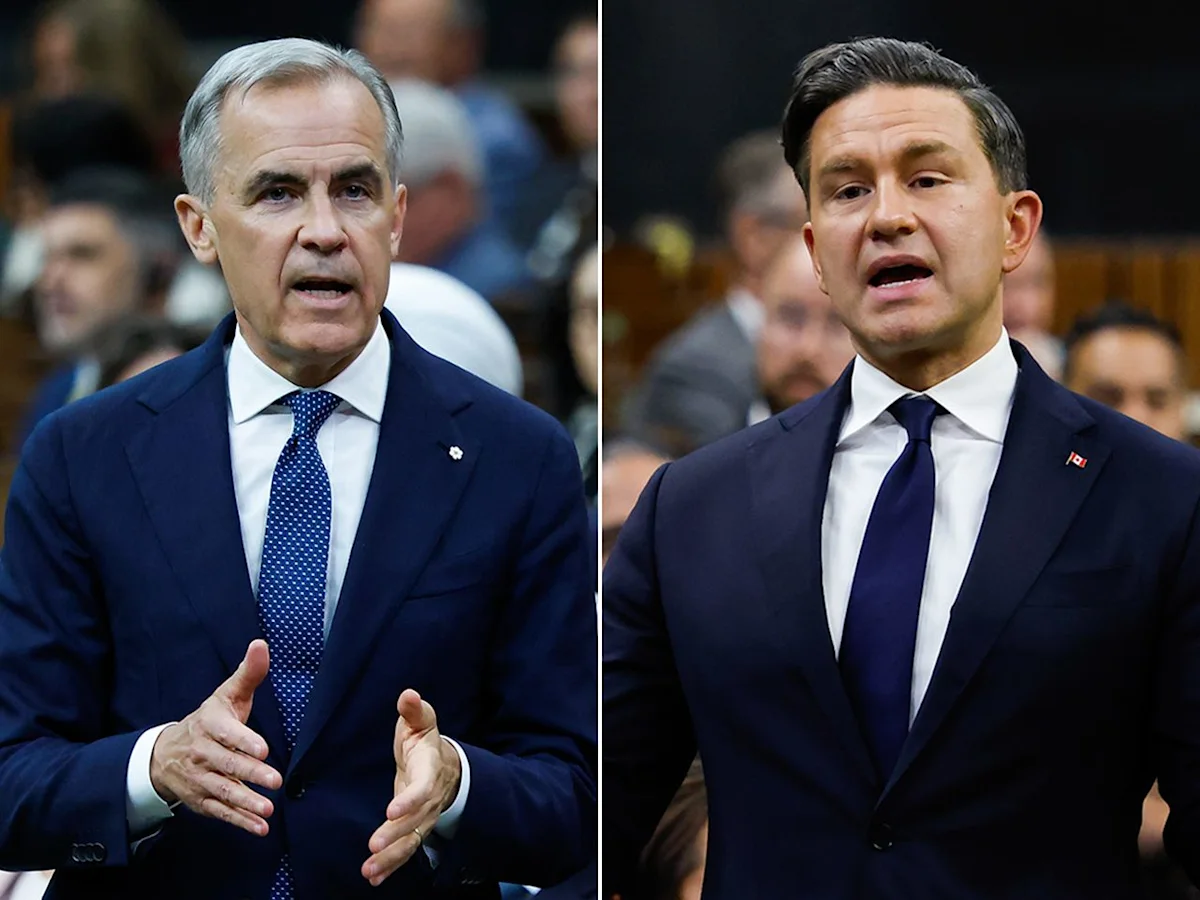
The daily question period in the House of Commons generally subtracts from the sum of human knowledge, and Tuesday’s episode was an absolute belter in terms of confusing anyone watching.
It kicked off with Opposition Leader Pierre Poilievre calling the “phantom” high-speed railway between Quebec City and Toronto “a boondoggle.” This from the Conservative party that has called on the government to fast-track infrastructure projects across the country.
Viewers were then at risk of whiplash as Poilievre and Prime Minister Mark Carney took it in turns to portray Canada as, alternately, an economic Mordor or the Elysian Fields.
The Opposition leader claimed Canada is the only G7 country in recession and pointed to a new report from the Office of the Superintendent of Bankruptcy that said there has been an eight per cent increase in consumer insolvencies. He said Canada has the second-highest unemployment rate in the G7, and referred to a new Equifax report that said fewer small businesses are launching.
“Current businesses are going bankrupt and new ones aren’t launching,” Poilievre said.
“Will (Carney) reverse these disastrous Liberal policies before more Canadians go bankrupt?”
The prime minister, not surprisingly, offered a more upbeat take on proceedings, claiming his government is building a more resilient, independent economy.
“Our plan is taking root,” he said, pointing to new employment numbers for April, which showed an unexpectedly high number of 88,000 new jobs.
He said more Canadians are in the workforce than Americans; that investment in machinery and equipment by businesses is up 10 per cent; that Canada is experiencing the highest levels of foreign direct investment in 20 years; and that the country has just recorded a healthy trade surplus.
Flushed with indignation at his grand plan being questioned, the prime minister was unusually improvident. “The leader of the Opposition doesn’t believe in Canada,” he said.
Poilievre feigned offence — “it is my patriotic duty to fight for those people who are suffering” — so much so, that he forgot to ask a follow-up question.
But you get the drift.
I found the exchange to be revealing about both men.
The leader of the Opposition’s job is to oppose, but it is not to mislead. This may be unfair, but my impression is that Poilievre prefers it when things are not working out (not an admirable trait for a man who would be prime minister) and I think many other Canadians feel the same way.
As the Bank of Canada governor, Tiff Macklem, said on Wednesday morning, the economy is weak but he would not call it a recession. “That’s not a word I’d use,” he said.
The Conservative leader’s use of statistics was, to be generous, selective. While consumer insolvencies were indeed up by eight per cent in April, year over year, business insolvencies were down by 7.3 per cent.
The Equifax report he quoted suggested fewer people are looking for loans to start businesses but the Small Business Health Index showed positive momentum, with business sentiment rising strongly, a fact Poilievre did not mention.
As Conservative support slides into the mid-30s, according to the latest Postmedia-Leger poll, it reflects badly on the leader, who is still seen as too negative and polarizing. People outside his base of true believers clearly don’t trust him to deliver them the straight goods.
Carney was having his own fun with numbers, boasting about job growth, even as Macklem pointed out that the volatility in labour markets means that employment in Canada has been little changed since the start of the year.
Carney claimed that labour force participation, particularly among women, is higher than in the U.S., which is correct, and that foreign direct investment in 2025 was the highest it has been in 20 years. But his claim that capital expenditure on machinery and equipment is up is not borne out by any of the statistics I could find.
Carney came into government with a deeply held conviction that Canada’s moribund GDP per capita was the result of regulatory sclerosis that made it difficult to build anything, anywhere.
The temptation for politicians is to use resources for immediate electoral gratification, rather than investing for after they have left office.
China has been spending five per cent of its GDP on roads, bridges and other infrastructure for years; Canada’s record was around 0.5 per cent.
To his credit, Carney has turned around a party that was hostage to its environmental wing, characterized by Steven Guilbeault, who as environment minister said Ottawa would stop investing in roads.
In government, Carney passed the Building Canada Act in 20 days and Guilbeault is now gone.
But there are early signs of Liberal kryptonite that, if it enters the body politic, would drain Carney of his hitherto superhuman invulnerability.
The conservative thinker, Thomas Sowell, in his 1995 book, The Vision of the Anointed, talked about a hubris among progressives who live in a “special state of grace” and believe that their vision is not merely factually correct but morally on a higher plane. Those who don’t buy into the vision are dismissed as uninformed, irresponsible or motivated by unworthy purposes.
It was a description that was particularly apt for the Trudeau Liberals, but it looks like it might also apply to the government’s newest iteration.
Carney has been accused of yelling at caucus members who don’t agree with him. Does he? Who cares? The stakes are high.
But in the epilogue of his own book, Value(s), Carney warns of the need to be humble. “However, grand you are today or may become tomorrow, you too will be forgotten,” he wrote
Questioning the patriotism of your opponents or telling your MPs you’re not interested in their grievances is a slippery slope that leads to a place where you start considering yourself to be anointed and your political adversaries to be not just in error, but in sin.
National Post