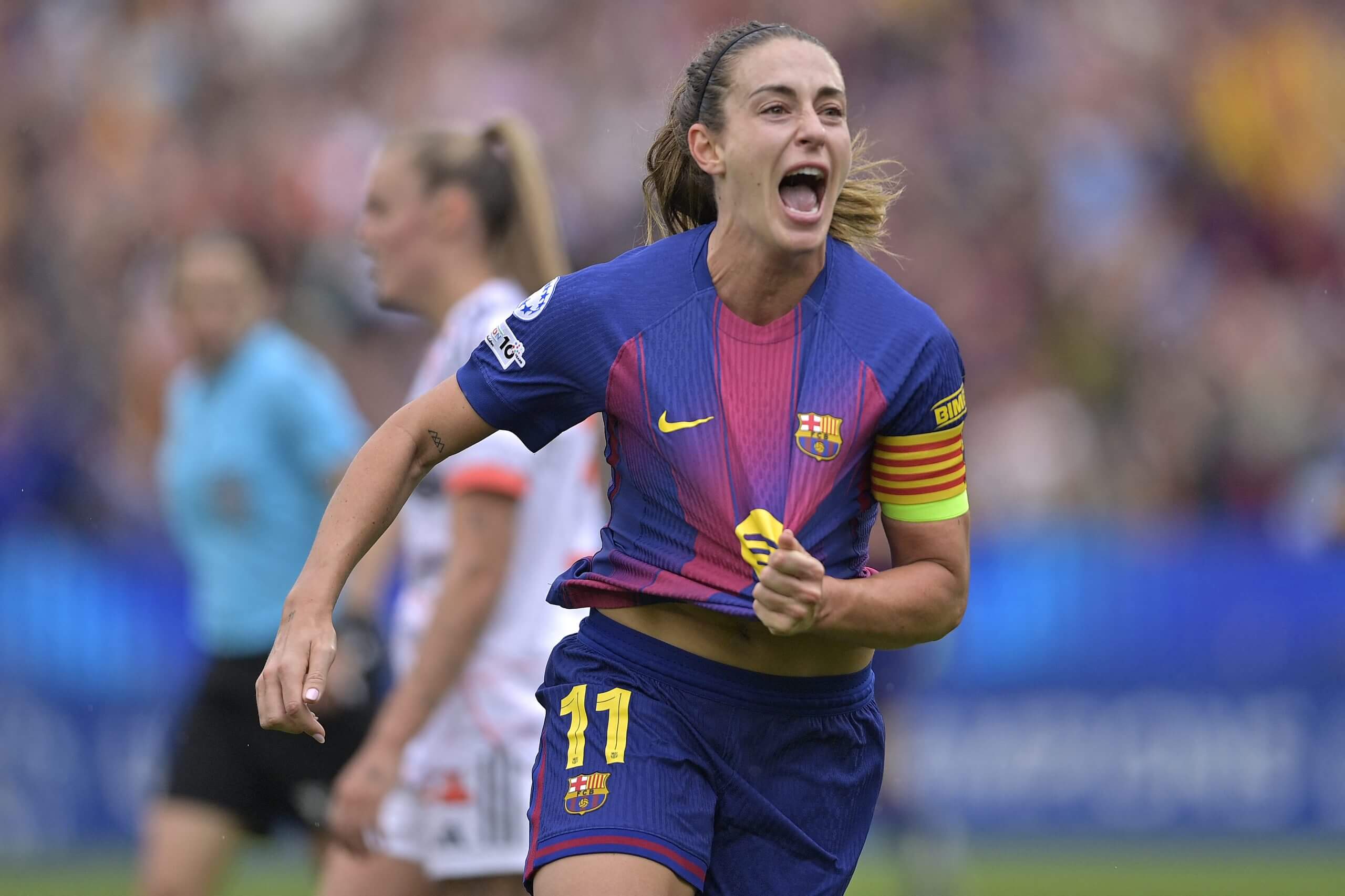
Rejoice, for David has won. Goliath is vanquished. Or at least, Ewa Pajor and Salma Paralluelo made Goliath really, really embarrassed with their 4-0 victory over OL Lyonnes in the Champions League final last weekend. How embarrassed owner Michele Kang must have felt to lose to the four-time Champions League-winning, multiple Ballon d’Or roster-boasting, global marketing behemoth David that is FC Barcelona Femení, forced to spend the time before handing her losing players and staff their runners’ up medals at the Ullevaal Stadium in Oslo, Norway, making heart gestures with her hands in their general direction.
“It’s not all about the money,” Barcelona goalkeeper Cata Coll quipped at full-time.
Turns out, after seeing the overwhelming commentary following the match, it’s a lot about the money. Specifically, it’s about Kang’s money, how she wields it in a multi-club ownership that now spans three countries and two continents in a manner that women’s football has historically never done. It’s not that women’s football doesn’t want money. It does. It’s how they want it, civilly. Humbly.
Don’t throw down $35 million to buy the Washington Spirit. Or make a compelling offer to Barcelona’s two-time Ballon d’Or winner Alexia Putellas to make the first club after her emotional departure from Barcelona, the club she has built in her image, one of the three clubs you are building in yours. Or any of the Barcelona champions, for that matter. Stop offering them things others won’t, tempting them to cash in on unprecedented checks. And for what? London City Lionesses? In Bromley? A team with 10 fans? A brass band at half-time?
Alexia Putellas had been synonymous with Barcelona for over a decade before announcing her departure. (Manure Quintero / Getty Images)
This is roughly the root of this week’s umbrage and vitriol toward Kang following Putellas’ announced departure from Barcelona and subsequent discussion on her next move. The antipathy towards multi-club ownership, the distrust of new money cascading in and gobbling up everything women’s football holds dear: heritage, competitive balance, accessibility and, apparently, not paying women’s footballers and staff copious amounts of money in a brazen attempt to lift silverware.
And perhaps this is the uncomfortable starting point for any conversation discussing investment, acknowledging the corrosive limbo in which women’s football seems to find itself: gripped by a fear of losing the soul of the game, its purity and accessibility, its distinct counterpoint to the disaster money and politics of men’s football, its hard-battled heritage; and the urge to grow, to thrive, to prosper, to pay women what they deserve.
Myriad arguments can be made against multi-club ownership. There’s the impact on competitive balance and jeopardy when the competitive levers are pulled by an increasingly isolated number of arms. Unregulated and extreme cash injections, as seen in men’s football, has created a startling barrier to entry that competitive, organically funded clubs simply cannot match. The result is a sterile carousel of clubs at the top.
Multi-club ownership also inevitably prioritises portfolios, often meaning the selection of a crown jewel while other clubs become multi-purpose service providers for its success. Spirit poaches Jonatan Giraldez from Barcelona before he eventually leaves Washington to join OL Lyonnes as manager. Lyonnes’ aging stars can be looked after at London City or Washington. But what are the assurances of safety when you are nothing more than a means to another club’s end? (Kang has denied that this is how her organization works and will continue to work.)
Multi-club ownership has become a topic of debate amongst key decision-makers. UEFA’s head of women’s football Nadine Kessler declared in the lead-up to Saturday’s final that no club operating under the same ownership could participate in the Champions League in the name of sporting integrity. Yet many decision-makers in UEFA are not convinced that women’s football should mimic the fiscal regulations of the men’s game when the sports are at disparate growth points.

Washington Spirit owner Michele Kang hired head coach Jonatan Giraldez from Barcelona. (Tim Nwachukwu / Getty Images)
Multi-club ownership proponents argue that multi-club ownership increasingly looks to be one of the main investors willing to back women’s football teams on a global scale, from Kang’s Kynisca to Kara Nortman’s Monarch Collective to Mercury13.
Those in favor cited the value of sharing knowledge, sponsorship opportunities and capital across multiple clubs to provide infrastructure and resources that women’s teams have historically lacked. Kang submitted a similar argument in June 2024. “(Multi-club ownership) is a necessity, not a luxury or greed,” she said after her acquisition of London City. “We need to invest to the level that the players deserve to deliver on the potential of the women’s game.”
Critics of Kang will consider those words warily. Kang is the founder and CEO of Cognosante, a health information technology company that provided critical IT and data solutions to U.S. Federal military and intelligence agencies. Before a chance invitation to Capitol Hill in 2019 to celebrate the USWNT’s World Cup triumph, Kang admittedly knew nothing of football. Lionel Messi didn’t exist. Putellas definitely didn’t. Romantics might call this fast fall love. Others call it opportunistic.
Women’s football should still feel empowered to question investment sources. FIFA were twice forced into about-faces over potential sponsorships with Saudi Aramco and Visit Saudi sponsorship due to the country’s historic anti-LGBTQ+ laws. Yet, the sense of cognitive dissonance that pervades this space can feel blindingly hypocritical.
Newcastle United’s rise into the WSL2 has been funded largely by the Saudi Arabia’s Public Investment Fund. Arsenal have recently announced a new sponsorship deal with Israeli-founded company Deel.
The Barca Foundation, the charitable arm of the club, has been accused of sportswashing for accepting funding from Gran Tierra Energy, an oil company blamed by Colombia’s indigenous population for multiple environmental abuses.
Manchester City, who just won their first WSL title in a decade, are owned by Abu Dhabi-backed City Football Group. At City’s 1-0 WSL win against West Ham United in November, City players wore black armbands to recognise the 45 lives lost from the destruction of Hurricane Melissa in Jamaica. Outside there were protests against Sheikh Mansour bin Zayed Al-Nahyan — owner of Manchester City and deputy prime minister of United Arab Emirates – over the UAE government’s alleged support of a paramilitary group accused of committing war crimes in Sudan.
Of course, that it’s Kang’s global sports organization, Kynisca, who served as the presenting partner of the inaugural FIFA Women’s Champions Cup naturally provokes questions of impartiality and fairness, as does the $25 million investment into US Soccer for development and health research and the eventual establishment of the Kang Women’s Institute. Where does the line of influence stop? Who is yoked to whom? At what point does a back have to be scratched?
What isn’t being asked is why has no one else stumped up the cash?
Finding a principled billionaire is admittedly hard to come by. In the same breath, there is something uncomfortably regressive about women’s fans scrambling over themselves to champion one’s comparative lack of investment, vilifying players for accepting payments that will protect them financially in a game that has historically failed to provide any fiscal assurance.

Michele Kang’s portfolio of teams includes OL Lyonnes in France, Washington Spirit in the U.S. and London City Lionesses in England. (Franck Fife / Getty Images)
Of course, the prospect of one of the greatest women’s footballers in history skittering around Bromley on a Saturday lunchtime in front of a smattering of fans inevitably inspires sneers. But this too can feel unfair. While history is a solid currency in men’s football, women’s football’s historic itinerancy means many teams don’t boast deep roots, pathways or identities. Many are built in the mirror image of their men’s teams. Others are simply still being built.
And it’s not as if Kang isn’t attempting to build something formative and stable. London City have been granted permission to build one of the most advanced women’s football training campuses in the world at Cobdown Park, one that will cater to the senior team but also the club’s academy and the local youth pathways in the Kent area.
In a European women’s football ecosystem that still relies predominantly on the beneficence of men’s football, Kang’s bullishness to put her money where her mouth is naturally entices.
The cautionary tales are bottomless, from Reading and Blackburn Rovers’ respective demotions in England two seasons ago to FC Girondins de Bordeaux and ASJ Soyaux in France, who this year were forced to collapse due to structural vulnerabilities.
Barcelona, too, suffered from the whims of their men’s financial state this season. Their opening day squad last September featured just 17 first-team players, with seven players forced to leave in the summer and only one player, Laia Aleixandri, arriving on a free transfer from Manchester City in order for Barcelona to fit within La Liga’s strict salary limit, which applies to the whole club.
The projected image of Barcelona as a financially malnourished minnow can be difficult to swallow. For one, Barcelona get really upset if anyone suggests that their three-time Ballon d’Or winner Aitana Bonmati isn’t the world’s highest-paid player (Bunny Shaw is now reportedly that player). Barcelona’s overall salary budget this season still sat at €14.75m, a mere €1m increase from the €13.75m (£11.9m) from the season prior, but a figure that places them third in the WSL budgets-wise, behind only Arsenal and Chelsea.
OL Lyonnes’ overall budget hovers just around €15m, compared to Barcelona. The difference is that the French side fails to boast the same revenue streams. According to Deloitte’s most recent Money League publication, Barcelona ranked third amongst the highest-generating women’s clubs (€22 million) behind only Arsenal (€25.6 million) and Chelsea (€25.4 million). (Money League does not feature NWSL clubs.)
OL Lyonnes, while carrying an estimated enterprise value of $54m, operates at a multi-million-dollar annual deficit.
Yet with the same breath many are castigating Kang, others are denouncing clubs such as Manchester United, Liverpool and Real Madrid for not investing more into their women’s team. Real Madrid have never played a match at the Bernabeu. Despite the women’s team figures at United asking for potential outside investment to help close the gap to the WSL’s top, decision-makers denied the request. Liverpool manager Gareth Taylor used his final three press conferences to make a public appeal to the ownership not to “let us fall away”.
But it’s far easier to have a self-evident villain than reckon with a complicated system.