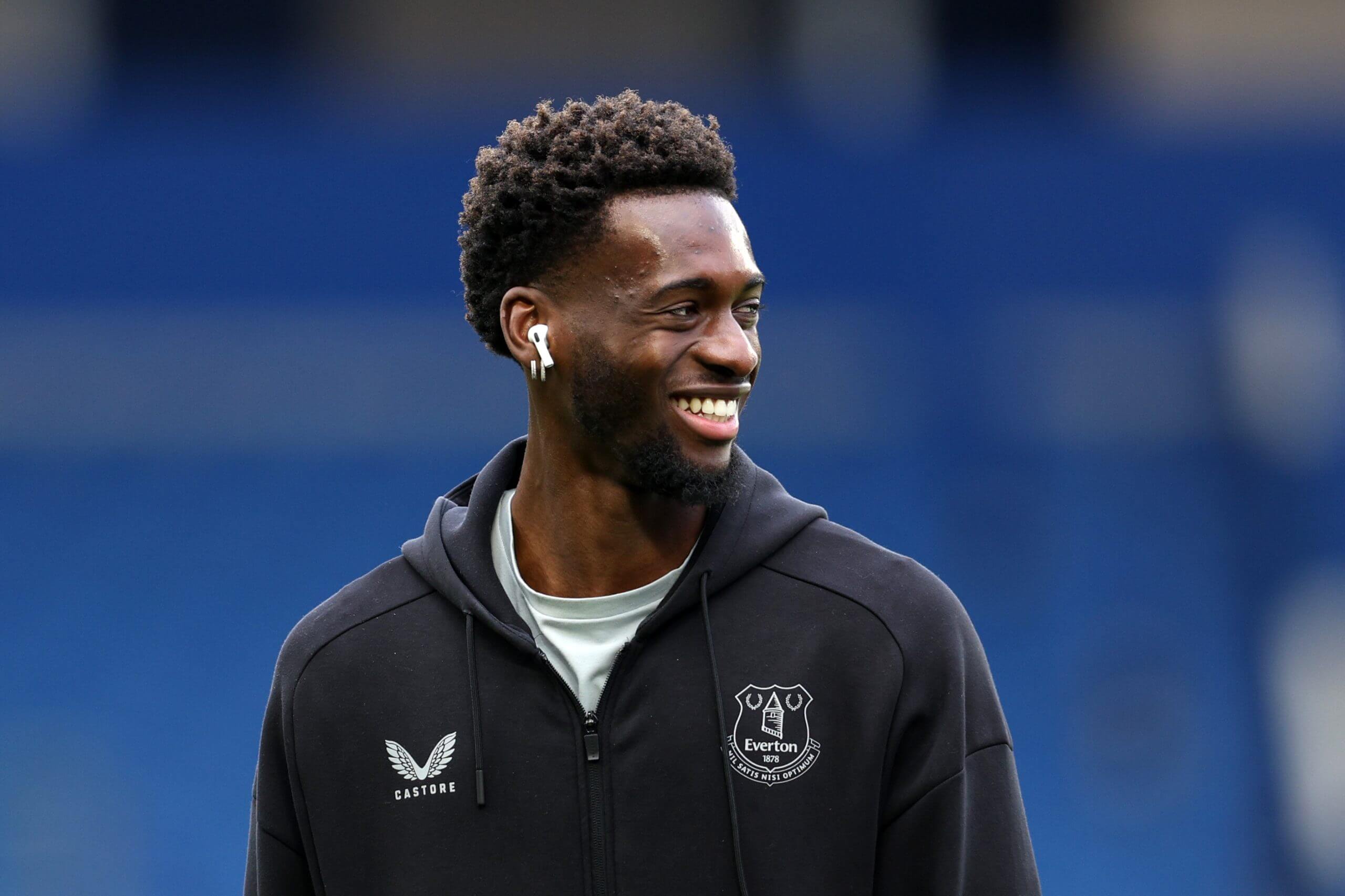
The final days of the January window were a waiting game for Tim Iroegbunam.
While Everton declined a significant enquiry from Championship side Ipswich Town at the start of that month, the impression given on all sides — even at a late stage — was that a move for the midfielder had not been entirely ruled out.
There were checks from Italy and Spain, some of which were enticing, but Everton’s valuation of the player, close to the £20million ($27m at current exchange rates) mark, deterred potential suitors.
The window passed with Iroegbunam still an Everton player. But that situation in January proved to be a fitting metaphor for his two years on Merseyside so far.
The 22-year-old has been — and still is — betwixt and between. He has not done enough to cement his place in David Moyes’ side, but has shown just enough promise that they have not been ready to cast him aside.
David Moyes has called Tim Iroegbunam an ‘interesting young player’ (Steve Bardens/Getty Images)
Iroegbunam’s situation has always been slightly unusual. A standout performer in West Bromwich Albion’s academy as a teenager, initially piquing the interest of Everton scouts in a 2021 FA Youth Cup win against his future employers, he earned a 2022 move to Aston Villa and England youth call-ups.
At Villa, he always seemed to be on the verge of a breakthrough that did not come, making 12 Premier League appearances and featuring for a combined 249 minutes before leaving for Everton in the summer of 2024.
Iroegbunam had been on Everton’s list as an unpolished diamond, but that near £10million deal and the one that took Lewis Dobbin from Merseyside to Villa for a similar amount helped both clubs navigate the Premier League’s profit and sustainability rules (PSR), with sales of academy graduates representing pure profit in accounting terms.
Everton saw an opportunity not only to resolve their own compliance issues and take advantage of Villa’s situation, but also to sign a player they felt had significant potential. They viewed Iroegbunam as someone with outstanding physical and defensive traits who needed to work on the technical side of his game. There was also early focus on ensuring he was fit enough to play for 90 minutes, rather than in short, sharp bursts.
Two years on, some progress has been made. Competition is fierce in the Everton midfield, but Iroegbunam has done enough to make himself Moyes’ go-to option when one of the first-choice duo of Idrissa Gueye and James Garner is unavailable.
Opportunity beckons, both now, with the veteran Gueye, 36, yet to resume training after an unspecified injury before the Manchester City game, and in the longer term, with the Senegal international’s deal set to expire at the end of the season. The club have an option to extend Gueye for a further year, but he will be 37 in September and cannot go on forever, even if he does remain this summer.

Idrissa Gueye’s contract is set to expire at the end of the season (Michael Regan/Getty Images)
Replacing Gueye’s industry and experience will be tough. Everton may still look to the market for a new No 6 this summer. But what Iroegbunam has now in his absence is an audition. His own deal expires at the end of next season, although that too contains a club option for another 12 months. This feels like the defining period of his Everton career.
The pair share some similar traits, even if Iroegbunam is much taller in stature and more mobile, while Gueye is slicker in possession. Only Tottenham Hotspur’s Joao Palhinha has made more tackles per 90 minutes in the league this season, while Iroegbunam ranks top of all central and defensive midfielders in Europe’s top five leagues for his ‘true’ tackle win rate (69.3 per cent) which assesses tackles attempted, tackles lost and fouls committed to get a measure of how successful a player is at winning back possession from challenges.
The below graphic, meanwhile, shows his impact screening the defence as well as wide and some more advanced areas.

Iroegbunam stands out most when striding forward with the ball or using his pace to track runners and recover possession.
But, in other areas, questions remain. He is not quite as positionally adept as Gueye, often relying on his speed to bail him out. His passing and decision-making can be hit and miss. He has a tendency to try and dribble out of situations, losing possession in dangerous areas, as he did before Jeremy Doku’s first goal in the 3-3 draw with City, or to run down blind alleys.
Iroegbunam is among the five per cent of Premier League players who are dispossessed the most times per 90 minutes and has a dribble success rate of 39 per cent (which puts him in the bottom 25 percentile). The one time he strode forward and struck at goal against Palace last weekend, his shot ended up near the corner flag. Both he and Garner struggled to stem the tide, as Palace pushed forward in the second half.
Everton have conceded an expected goals (xG) figure of 1.59 with him on the pitch, versus 1.33 with Gueye and 1.52 with Garner, although this may be because he is often on the pitch when games become stretched, or when his side are defending leads.
As a pure ball winner, there are few better than Iroegbunam. Should he take strides in other areas, he would almost certainly cement a regular place at Everton or elsewhere. The belief among some who have followed his career closely is that he has what it takes to make that step up, but that he will need regular playing time to do so.
“I think he’s an interesting young player,” Moyes said in a recent press conference, as quoted by the Liverpool Echo. “It could go either way for him. If he doesn’t get enough time, then we need to look at it differently, but at the moment I like what I’m seeing from him.”
Summer will be another critical point in Iroegbunam’s fledgling career. But the next few weeks offer him another vital chance to prove his worth to Everton.
Additional contributor: Thom Harris
