When a general election was called in the summer of 2024, the United Kingdom was ready for change. The Conservative government, torn apart by numerous scandals and internal divisions, faced a huge public backlash. All the polls pointed to a landslide victory for the Labour Party after 14 years in opposition.
Throughout a six-week election campaign, Keir Starmer, the Labour leader, was the embodiment of caution. Some of his bolder earlier pledges did not make the election manifesto and others were watered down. As his public pronouncements became ever more circumspect, political commentators likened his approach to that of someone carrying a Ming vase across a polished museum floor, fixated on nothing more and nothing less than the task of delivering it safely to its plinth.
Starmer’s strategy paid off. His campaign might not have won many hearts or minds, but he won Britain’s biggest parliamentary majority since Labour’s landslide victory in 1997 (in which the former Labour minister Roy Jenkins coined the “Ming vase” comparison in relation to Tony Blair).
For a party that has suffered its share of shocks at the ballot box, there was much to be said for playing it safe, avoiding risk.
There must be times, on his regular visits to the Emirates Stadium to watch Arsenal, when Starmer recognises something of that Ming vase strategy. The free-spirited football of their first two Premier League title challenges under Mikel Arteta, in 2022-23 and 2023-24, has given way to a more ruthless, serious, pragmatic approach: less adventurous, less creative, wearing opponents down, beating them on set pieces, winning matches by attrition — less interested in winning wider approval, just focused on chasing marginal gains like an electoral strategist chasing marginal seats.
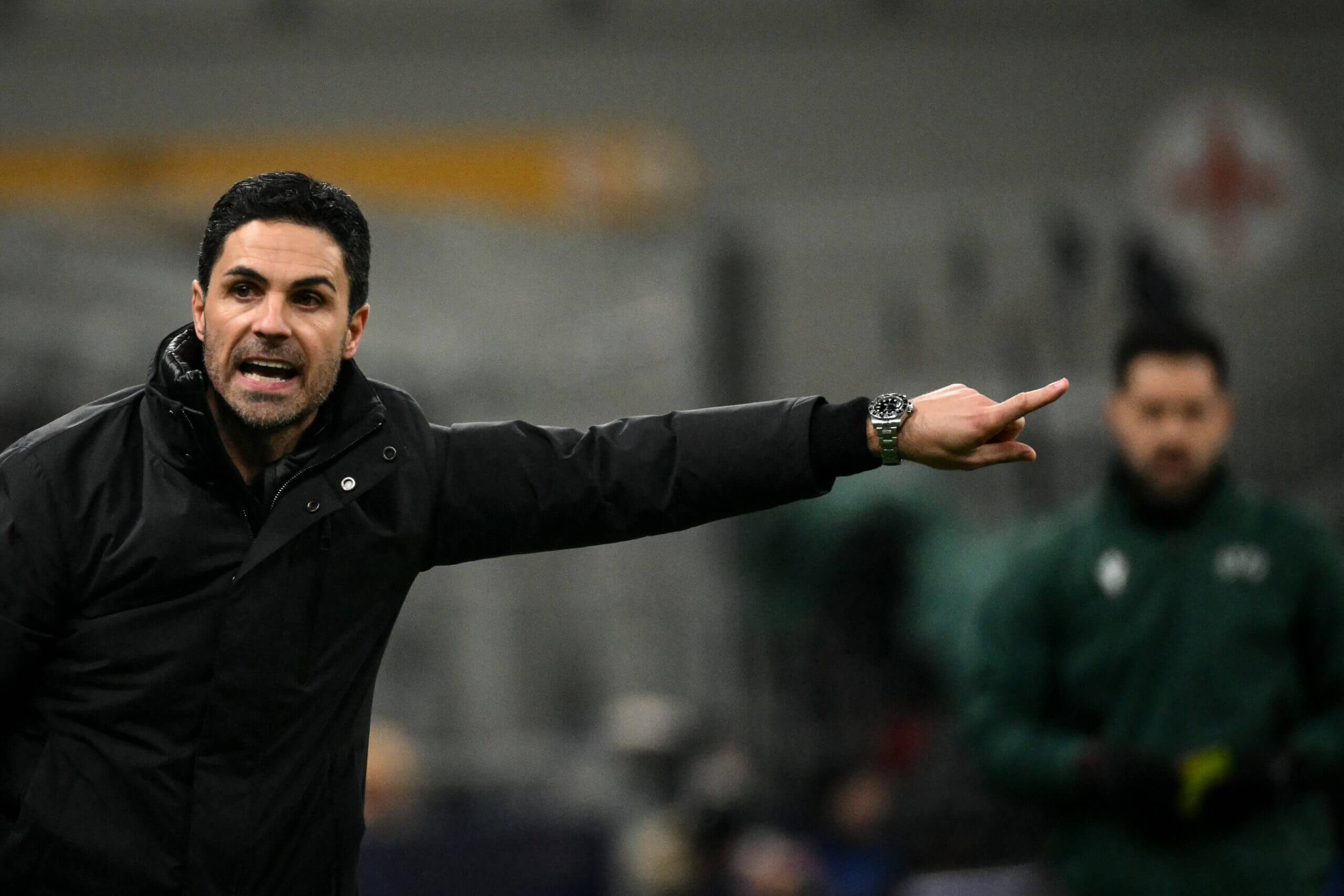
Mikel Arteta has overseen Arsenal’s pragmatic title challenge this term (Alberto Pizzoli/ AFP via Getty Images)
Everyone imagines that a title-winning season is like a magic-carpet ride — and just occasionally they are. But the reality, like a victorious electoral campaign, like getting a Ming vase across a slippery floor, is often more mundane. Find a way. Get the job done. Safely does it. No alarms and no surprises, please.
Arsene Wenger’s Arsenal team scaled great heights of performance at times in their unbeaten ‘Invincibles’ campaign of 2003-04, illuminated by the brilliance of Thierry Henry in particular, but for the most part they were defined that season by a machine-like ability to prevail in the tight games — or at least not lose them.
The same trait has defined the many title-winning teams in the two decades since — most obviously, Jose Mourinho’s Chelsea sides, but also some of Sir Alex Ferguson’s later Manchester United teams. Liverpool’s title-winning campaigns in 2019-20 and 2024-25 were studies in consistency rather than the “heavy metal football” that previously shaped their identity under Jurgen Klopp.
Even so, there have been times when, watching Arsenal over the past 18 months, it has felt as if austerity has taken hold. From scoring 88 and 91 goals in finishing runners-up to Manchester City in 2022-23 and 2023-24, they scored just 69 Premier League goals last season and were heavily reliant on dead-ball situations.
Anyone raising these concerns last season, when Arsenal finished in a distant second place, would be politely informed that the only curb on their creativity was the injuries that were hindering Martin Odegaard and Bukayo Saka. But here we are a year on and Arsenal, still just as reliant on set pieces, are on course to score precisely 69 goals again. The average for a title-winning team over the past nine years is 92.
They are also on course to win the Premier League. Could a team really win the Premier League while scoring less than two goals per game? Well, yes, it has happened before — most recently Leicester City in 2015-16, Chelsea in 2014-15, United in 2008-09 and Chelsea in 2005-06. Those were all low-scoring seasons across the Premier League and so is this one, with the scoring rate falling to 2.77 per game.
Much has been made this week of the fact that no Arsenal player has scored more Premier League goals this term than Viktor Gyokeres and Leandro Trossard (five each), but it is a campaign in which only three players — Manchester City’s Erling Haaland, Brentford’s Igor Thiago and Bournemouth’s (now City’s) Antoine Semenyo — have broken double figures. Only Manchester City have scored more goals than Arsenal. As for the Champions League, no team could match Arsenal’s total of 23 goals and eight wins from eight league-phase games.
Some of the criticism of Arsenal this week, since their 3-2 defeat against United, has been wild. Paul Scholes’ suggestion on his podcast, The Good, The Bad and The Football,
that they would be “the worst team to win the Premier League” was beyond fatuous — at a time when, unlike for much of his illustrious playing career at United, the league’s claims to be the strongest in the world are pretty much irrefutable — but he is at least consistent in his withering assessments.

Arsenal have leant heavily on set-piece prowess (Justin Setterfield/Getty Images)
A certain perception of Arsenal’s mental frailties persists, as if this is not just the same team that faltered in the final stages in 2022-23 but the same one that habitually cracked under pressure in the later years of Wenger’s tenure. Some of Wenger’s sides of that period played beautiful football but had a soft centre that always cost them: plenty of style, not enough substance. That does not sound like the Arsenal of 2026.
The valid question about this Arsenal side is not whether they are any good (they certainly are), or even whether they have the mental fortitude to finish the job, but whether the Ming vase approach has been taken too far. Watching that All or Nothing documentary series about Arsenal four seasons ago, and the way Arteta spoke to his players in the dressing room, there was a priority on giving Odegaard, Saka or Gabriel Martinelli the opportunity to create. Is there still the same emphasis? It has not looked that way.
Arsenal have recently looked stifled in a way that the creative department of a title-challenging team, high on its own output, should not. Yes, they were undone by one uncharacteristic error by Martin Zubimendi and two brilliant long-range shots in the defeat against United, but what really stuck out on second viewing was the way their approach changed shortly after taking the lead in the 29th minute. They had dominated to that point, but the moment their opponents started to threaten on the counter-attack, it was as if Arsenal applied the handbrake, to use a Wengerism.
This isn’t an electoral campaign. In football, minimising risk can have the opposite effect. Arsenal were at their best in that first half-hour against United — and in the first 20 minutes of the 0-0 draw with Liverpool a fortnight earlier — when forcing a high tempo, pushing their full-backs forward, getting the ball to Odegaard, Saka and Trossard, playing deep in opposition territory.
Both games were being played on Arsenal’s terms until they faced their first opponents’ first counter-attack, at which point Arteta’s team appeared to surrender the initiative, never truly to reclaim it.
There has been much discussion of the anxiety that can take hold of a team — and a crowd — in these moments. James McNicholas wrote an excellent piece on it here, proposing that the biggest threat to Arsenal’s title challenge is… Arsenal. There is much truth in that; title-race yips are very real. But at the same time, this is a group of players who coped admirably with the pressure of the title race two seasons ago, winning 16, drawing one and losing one of their final 18 Premier League matches, scoring 54 goals in the process.
It was their misfortune, like Liverpool’s in 2018-19 and 2021-22, to be up against a Manchester City team who ensured their rivals’ margin for error was wafer-thin.

Martin Odegaard was at the heart of an adventurous Arsenal side (Ben Stansall/AFP via Getty Images)
The strange thing is that, having come so close in 2023-24 with an approach built around the creativity of Odegaard and Saka, Arsenal have gone in such a different direction: less expansive, less willing to take risks, building up their set-piece threat to the extent that it is not just a useful weapon — as it should be for every side — but their most reliable one. It is rare to see a top team quite so proficient at set pieces, but it has also been rare in recent times to see a top team scoring so few goals from open play.
In some ways, it reflects the Zeitgeist of this Premier League season, in which goals are down and set pieces are being prioritised like never before. Defending in a low block is nothing new, but the sophistication and rigour of some of those out-of-possession plans look far greater than two years ago. It isn’t easy to break down defences and the league table tells you that Arsenal, whatever anyone else might say, are doing a pretty good job of it.
But are they maximising their chances when Odegaard, Saka, Trossard, Martinelli and Eberechi Eze and others all, to varying degrees, have looked stifled, whether by the system or by the prevailing mood around the team?
On Sunday, it reached the point where a set piece felt like their only way back into the game at 2-1 down. It was from a corner that Mikel Merino bundled home an equaliser after 83 minutes. But it was striking to see just how much time Arsenal ate up during those corner and free-kick routines while chasing the game: 46 seconds, 42 seconds, 62 seconds, 44 seconds, 38 seconds, 63 seconds, 36 seconds, 40 seconds, 51 seconds, 32 seconds, 35 seconds. Incidentally, Merino’s goal was from the corner that was taken in 32 seconds.
There was a marked difference in the way they treated throw-ins as the game progressed. Early on, they took two very quick throws to put their opponents on the back foot. In the closing stages, with fewer bursts of attacking intent, they lingered over throw-ins — substitute Ben White was a notable culprit — and the threat receded. As much as Arteta tapped his watch in the second half to highlight the time wasted by United goalkeeper Senne Lammens, it was a fraction of the time Arsenal spent on their set pieces.

Mikel Merino bundles Arsenal level late on against Manchester United (Ben Stansall/AFP via Getty Images)
The clock doesn’t stop in those circumstances. And as potent a weapon as corners and free kicks undoubtedly are for Arsenal, all those stoppages are not conducive to the type of high-energy football that teams chasing a goal — and teams chasing a league title — usually favour.
This isn’t about aesthetics. It is not about playing in a manner that would earn the approval of Scholes or anyone else among a generation of pundits who get misty-eyed when they recall a golden Premier League era in which goals were even more scarce and set-piece reliance even greater than this season. What matters is winning the title and while Arsenal have put themselves in a commanding position, the feeling persists that they will need to play with more freedom if they are to give themselves the best chance of seeing off whatever challenge might come from Manchester City and Aston Villa.
Arteta hinted at a change of emphasis at a news conference on Tuesday, saying he had told his players to “play with enjoyment” over the months ahead, that “this is going to be the mindset”, and telling the fans the journey is something to be enjoyed rather than endured.
It is easier said than done. Again, the image of the Ming vase comes to mind: one slip, one sudden, involuntary movement and it’s ruined.
But in elite-level sport, there is also a danger in dreading the consequences of making a mistake. Trying to win the Premier League is serious business, but there is a balance to be struck between risking too much and risking too little. Arsenal’s return to power is almost within their grasp, but they have to seize it decisively and confidently.