After being part of the guard of honour for Andy Robertson and Mohamed Salah, Arne Slot headed back towards the touchline.
Liverpool’s embattled head coach didn’t join the players on the traditional lap of appreciation following last Sunday’s 1-1 draw with Brentford.
As Robertson and Salah continued to accept the acclaim of Anfield, the Dutchman sat alone in the dugout. His desire to ensure the spotlight remained on two outgoing legends was understandable, but the contrast from 12 months earlier was stark.
Back then, Slot had been in the thick of the celebrations — his name chanted repeatedly by the Kop as he raised the Premier League trophy to the heavens. The transition from the Jurgen Klopp era had been seamless, with Slot becoming only the fourth Liverpool manager to lead the club to title glory in their debut season at the helm.
When the champions then embarked on the biggest transfer spending spree in their history last summer, the expectation was that the good times at Anfield would keep on rolling. However, from such dizzy heights, the fall from grace has been dramatic.
Liverpool limped home fifth in the Premier League — confirming Champions League qualification on the final day with just 60 points, their lowest tally for a decade and 24 fewer than in 2024-25.
Their total of 63 league goals scored was 23 down on last season and their worst since 2015-16. Defensively, 53 league goals conceded (compared to 41 in 2024-25) was the most they have ever shipped in a 38-game season in the Premier League era.
There were 19 morale-sapping defeats in all competitions (20 if you count the Community Shield). Since Liverpool were last promoted to the top flight in 1962, the only campaign in which they have lost more matches was in 1992-93 (20).
Slot, who was the target of boos and jeers at the penultimate home game against Chelsea, has lost plenty of support among the fanbase and a growing number are calling for him to be replaced.
The Athletic has spoken to a wide range of sources, many speaking on the condition of anonymity to protect relationships, to tell the inside story of a season like no other for Liverpool.
“Were we dealt a difficult hand? 100 per cent. Should we have played our hand better? Absolutely,” says one senior club official. “Nobody is under any illusions. There are mitigating factors but it hasn’t been good enough.”
It started with tragedy. On the morning of Thursday July 3, 2025, the news broke that Diogo Jota and his brother Andre Silva had died in a car accident in Spain. They had been en route to Santander to catch a ferry to England for the start of pre-season training when the Lamborghini they were travelling in careered off the road.
Jota had married his childhood sweetheart Rute Cardoso in their home city of Porto less than a fortnight earlier and they had three young children. Professionally, the 28-year-old had followed up clinching the Premier League title with Liverpool by helping Portugal win the Nations League. It was all so unimaginably cruel.
As the area behind Anfield’s Main Stand was transformed into a shrine with thousands of tributes, behind the scenes, sporting director Richard Hughes and Slot spearheaded the club’s response. The first wave of pre-season testing was cancelled and a flight was chartered for the following day for players and staff to attend the joint funeral.
“A friend to everyone,” was how Slot described Jota and that was a fitting summation of his universal popularity. When the squad reported back to Kirkby five days after his death, the training complex was a scene of utter devastation. The traditional six-minute race test, where players try to cover as much ground as possible within the allotted timeframe, was shelved. Having a competitive edge just didn’t feel right.
As well as turning to the club’s head of medicine and performance Jonathan Power and psychologist Lee Richardson, Liverpool brought in grief counsellors to ensure there was sufficient support.
“If you can’t, if it’s too much, there’s no pressure on anyone,” Slot told his players when training restarted. “My door is always open. You’ve got the doc and the psychologist too. Come and talk to us.” The message was “do it like Diogo” – be authentic. Grief hits people in different ways and no one would be judged. There would be empathy and compassion in abundance.
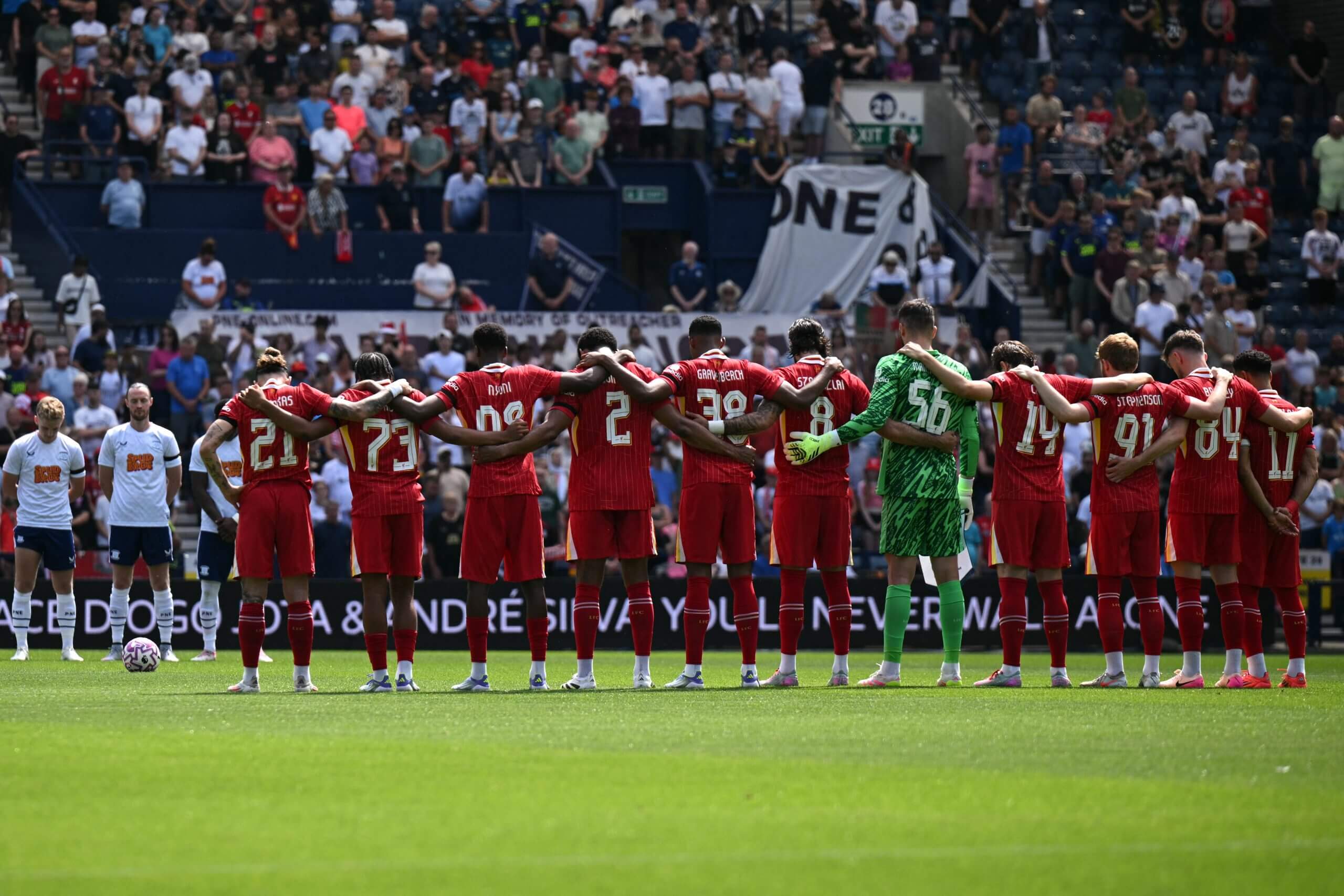
Liverpool line up for a friendly against Preston North End only 10 days after the death of Diogo Jota (OLI SCARFF/AFP via Getty Images)
The tears flowed on and off the pitch at the opening friendly against Preston North End. For seven minutes after the final whistle, players and staff stood on the edge of the penalty area applauding the Liverpool supporters amassed in the Bill Shankly Kop as the Jota song remained on loop.
Getting back out there became a place of refuge but pre-season remained incredibly difficult as the squad headed to Hong Kong, Japan and then Wembley for the Community Shield, which they lost on penalties to Crystal Palace.
Jota’s family returned to Anfield for an emotion-fuelled opening Premier League game against Bournemouth when there was the poignant sight of Salah breaking down in front of the Kop. With the empty locker in the dressing room and Jota’s song being chanted in the 20th minute of every match, he was never far from anyone’s thoughts.

Mo Salah was overcome with emotion after Liverpool’s Premier League game against Bournemouth (Paul ELLIS/AFP via Getty Images)
“What we went through last summer, I hope no other team will ever go through,” Robertson told reporters last week. “Football didn’t matter. We didn’t care about football for weeks. None of us wanted to train. That was the reality.”
Players had been reluctant to talk about it over the course of the season because they didn’t want to be accused of making excuses as the team’s fortunes nosedived. But one of the most heart-wrenching chapters in the club’s history is a factor, not an excuse.
“We lost one of our brothers — a big part of us,” midfielder Curtis Jones told LFCTV after the draw with Brentford. “He was unbelievable as a human being and unbelievable as a player. To lose him, I’m standing here now and I can feel it in me, I feel emotional when I speak about it.”
Towards the end of last season, Slot talked about needing to add “extra weapons” to his squad. It’s ironic, given how events transpired, but his vision involved them becoming more dominant and ruthless as an attacking force.
Twice, Liverpool shattered their transfer record last summer with the £100million purchase of Florian Wirtz from Bayer Leverkusen, potentially rising to £116m with add-ons, followed by the £125m deal for Alexander Isak from Newcastle United after an acrimonious summer-long saga. The club’s revamped attack also included the £79m arrival of Eintracht Frankfurt’s Hugo Ekitike.

Alexander Isak, Florian Wirtz and Hugo Ekitike were the “extra weapons” Liverpool added to complement Mo Salah this season (Matt McNulty/Getty Images)
With Giorgi Mamardashvili, Jeremie Frimpong, Milos Kerkez, Giovanni Leoni and Freddie Woodman also on board, Liverpool’s total outlay climbed to around £449m, including add-ons. No club in the Premier League era had ever splashed out more in a transfer window.
The spending was offset by generating around £220m from sales, with Trent Alexander-Arnold, Darwin Nunez, Luis Diaz, Caoimhin Kelleher, Jarell Quansah, Tyler Morton and Ben Doak among those to depart.
It was widely viewed as an exciting statement of ambition from the champions. The only frustration at the end of the summer window surrounded missing out on the signing of England defender Marc Guehi after Palace chairman Steve Parish U-turned at the 11th hour and blocked his £35m move to Anfield when he was midway through his medical.
When Palace did agree to sell Guehi for £20m in January, Liverpool opted not to rival Manchester City for his signature because of the overall cost of the transfer, including wages and agent fees. Instead, Liverpool bought Jeremy Jacquet from Rennes for £60m, with the France Under-21s defender staying in his homeland until this summer.
Liverpool’s defensive priority a year ago had always been to recruit a young centre-back, having previously shown interest in Levi Colwill, Leny Yoro and Dean Huijsen, and they were delighted to get Leoni from Parma. However, the Italian teenager suffered a season-ending anterior cruciate ligament injury on his debut against Southampton in the Carabao Cup in September.

Italian teenager Giovanni Leoni suffered a season-ending injury on his debut (PAUL ELLIS/AFP via Getty Images)
The impact of missing out on Guehi and then losing Leoni was accentuated by Joe Gomez’s fitness issues and Ibrahima Konate’s alarming downturn in form in the first half of the season. “He’s been a bit too much at the crime scene,” was Slot’s blunt assessment as Konate’s list of costly errors continued to mount. As well as the uncertainty of being in the final year of his contract, the France international also had to deal with the personal anguish of his father Hamady passing away in January.
With FSG’s CEO of football Michael Edwards responsible for how funds are allocated and sporting director Hughes tasked with negotiating deals, criticism regarding recruitment can’t be placed at Slot’s door.
Isak, the most expensive player in the history of British football, contributed just four goals in 22 appearances (13 starts). Having missed most of pre-season after going on strike to try to force the move, the Swedish striker was unfit and, as they tried to build him up, he broke down with a groin problem.
Just when Isak appeared to be regaining sharpness before Christmas, he fractured his ankle after a challenge from Tottenham’s Micky van de Ven. Another comeback followed in April but it didn’t last long. Remarkably, he still hasn’t completed 90 minutes in a Liverpool shirt.

Alexander Isak suffered another long-term injury after a challenge from Micky van de Ven (JUSTIN TALLIS / AFP via Getty Images)
Ekitike has been the only real success story among last summer’s arrivals — top-scoring with 17 goals before his season was cruelly ended by a ruptured Achilles in mid-April.
There’s a sense internally that Wirtz’s adaptation to English football was made tougher by his arrival at a time when the Premier League was becoming more physical, more direct and more about set-plays. But senior figures remain convinced that he will kick on and flourish in a more stable team environment next season.
Signed at a combined cost of £320m, Isak, Ekitike and Wirtz played just 118 minutes of football together all season. “For all the talk about how much we spent last summer, that talent just hasn’t been out on the field together often enough,” says one senior recruitment source.
As for the other signings, Mamardashvili has looked uncertain with the ball at his feet and Frimpong has struggled for both form and fitness, while Kerkez recovered after a torrid start but still has much to prove.
Not directly replacing Diaz on the left was based on the belief that Cody Gakpo would build on last season’s 18-goal haul and they also didn’t want to block the pathway for exciting teenager Rio Ngumoha. However, it didn’t work out as Gakpo’s output dwindled, with just nine goals in all competitions.
Despite calls for Slot to start Ngumoha more regularly, the club’s hierarchy believe he adopted the right approach by gradually increasing the 17-year-old’s workload rather than overburdening him. The dynamic young winger provided some much-needed light amid the gloom.

Rio Ngumoha has been one of few green shoots for Liverpool this season (ANDY BUCHANAN/AFP via Getty Images)
Liverpool effectively went from a double act of Diaz and Robertson on the left to Gakpo and Kerkez, which was much less effective. It was a similar story on the right where Salah, a pale shadow of the player who tormented top-flight defenders in 2024-25, sorely missed the creative influence of Alexander-Arnold behind him.
Conor Bradley was supposed to fill that void but he started just a dozen league games before a serious knee injury ended his season in January. Right-back was a massive headache, with midfielders Dominik Szoboszlai and Jones both played out of position there. Alisson also sat out nearly a third of Liverpool’s season with hamstring troubles.
After the final day stalemate with Brentford, Slot said: “If you asked me one word to describe this season, I would describe it with the word ‘injury’.”
Liverpool’s recruitment strategy had focused on quality rather than quantity. The problem was that when injuries started to bite, a lack of depth was laid bare. The situation wasn’t helped by Slot not trusting those on the fringes like Wataru Endo, Federico Chiesa or Gomez to start games as the same personnel were overworked and fatigue set in.
It seems hard to believe now but Liverpool actually started the campaign with seven successive wins in all competitions, including narrow victories over Arsenal and Atletico Madrid.
Results papered over the cracks as the performances were patchy. It wasn’t sustainable and when that run was ended by Eddie Nketiah’s stoppage-time winner for Palace at Selhurst Park in late September, the wheels came off.

Eddie Nketiah’s late winner put to bed Liverpool’s run of seven successive wins at the start of the season (Tom Dulat/Getty Images)
The same problems just kept on costing them. Nketiah scored after a long throw wasn’t dealt with and Liverpool’s set-piece woes continued, leading to the sacking of coach Aaron Briggs in December. Their total of 20 league goals conceded from set pieces (excluding penalties) across the season was their highest figure of the Premier League era.
The habit of shipping late goals (they conceded eight in the Premier League in the 90th minute or later) pointed to issues with both mentality and team structure. Far too often, when Liverpool were chasing a game, Slot’s substitutions smacked of desperation as they lost their shape.
It was alarming how easy they were to play through. So many duels were lost with Alexis Mac Allister, a model of consistency during the title-winning campaign, a glaring weak link in midfield.
They hit rock bottom in late November. A 3-0 home defeat to Nottingham Forest, after Manchester City had swept Liverpool aside by the same scoreline at the Etihad, meant they had lost successive league games by a margin of three goals for the first time since 1965.
“At the moment, it’s a mess,” admitted captain Virgil van Dijk post-match. “We’re definitely letting the manager down, but we’ve let ourselves down as well.”
Worse was to follow as they were routed 4-1 by PSV at Anfield in the Champions League — Liverpool’s ninth defeat in the space of 12 matches. Boos rained down from the stands with Slot facing the first crisis of his tenure. Jones told Irish broadcaster RTE: “We’re in the s*** and it needs to change.”
In a bid to make Liverpool more compact out of possession, Slot responded by dropping Salah, who had previously started every league game under the Dutchman. The Egyptian was furious and after being left out for a third successive game, he gave an incendiary mixed-zone interview following a 3-3 draw with Leeds United at Elland Road.
Salah accused Liverpool of “throwing him under the bus” and making him a scapegoat for their struggles. He also said his relationship with Slot had broken down and claimed that “someone doesn’t want me in the club”.

Mo Salah had to work his way back in from the cold this season (Justin Setterfield/Getty Images)
If Salah thought he could trigger a managerial change, he was mistaken. Edwards and Hughes backed their head coach and informed Salah that he would be staying on Merseyside when the squad travelled to Italy to face Inter in the Champions League.
Their European exploits provided some welcome respite from their domestic woes with a 1-0 victory at San Siro coming a month after Xabi Alonso’s Real Madrid had been beaten at Anfield. Liverpool finished third in the league phase, with six wins out of eight.
However, the Salah sideshow continued to be a distraction. The club’s hierarchy believes Slot handled a difficult situation with dignity as he reintegrated Salah following his time away at the Africa Cup of Nations.
But friction remained and it was no surprise when it was announced in March that Salah would leave at the end of the season with Liverpool agreeing to his request to effectively rip up the final year of his contract.
Salah didn’t mention Slot in his social media post following the wretched 4-2 defeat at Aston Villa earlier this month, but the insinuation was clear as he bemoaned the absence of “heavy metal football”, a phrase synonymous with the Klopp era.
Salah scored just 12 goals in 2025-26, compared to 34 a year earlier.
A largely uninspiring 13-game unbeaten run in all competitions was ended when Liverpool conceded another last-gasp winner at Bournemouth in late January.
In making his team harder to beat, Slot also made them harder to watch. Their build-up play was far too slow and predictable. With the brand of football so stale, they rightly stood accused of being a team lacking identity.
The absence of a clinical edge at one end and being so porous at the other proved a toxic combination. Liverpool failed to win at home against any of the newly promoted sides for the first time since 1980-81. It was the first season both Manchester clubs had completed a league double over Liverpool since 1912-13.
The list of punishing setbacks just kept on growing. They lost away to lowly Wolverhampton Wanderers, drew at home to a Tottenham side in disarray under interim boss Igor Tudor, and were then humiliated 4-0 by Manchester City in the FA Cup. “You shouldn’t give up, and that’s maybe what happened at a certain point,” a crestfallen Van Dijk told reporters at the Etihad.
Szoboszlai, who became the first Liverpool midfielder to reach double figures for both goals and assists since Steven Gerrard in 2013-14, was undoubtedly their standout performer over the course of the season.
But the manner in which the Hungarian threw his arms up at disgruntled away fans at the Etihad underlined how much he’s still got to learn if he’s going to become a serious contender for the captaincy one day. Some of his social media content was also tone-deaf, given Liverpool’s plight.

Dominik Szoboszlai was Liverpool’s standout performer, but still has a lot to learn (Jack Thomas/Getty Images)
“In survival mode,” was how Slot described Liverpool after he set them up in what was effectively a five-man backline away to Paris Saint-Germain in the quarter-final of the Champions League. It was overly submissive and they were lucky to escape with a 2-0 loss. There was pride in defeat by the same scoreline in the return leg at Anfield when big moments went against them, but the gulf in class across the tie was unmistakable.
The boost provided by Van Dijk’s dramatic winner in the first Merseyside derby at the Hill Dickinson Stadium didn’t last. There was no late-season flourish to add weight to Slot’s bullish claims about the future being bright.
Both at Old Trafford and Villa Park during the run-in, they wilted under pressure. Sandwiched in between was a draw with Chelsea, which felt like a defeat with the mood inside Anfield so mutinous. That felt like the day when patience snapped with Slot as no Liverpool manager had faced that level of dissent on home turf since the final throes of Roy Hodgson’s tenure in late 2010.
A number of dressing room sources have detailed how the mood deteriorated and belief ebbed away over the course of the season.
The dynamic changed significantly last summer with the departure of established stars like Alexander-Arnold, Diaz, and Nunez. A lot of the new arrivals, such as Isak, Mamardashvili and Wirtz, are more quiet and reserved.
The challenge of trying to find their voice was made harder by the environment they entered last summer with their new team-mates grieving the loss of Jota.
Fostering a sense of unity and spirit in a revamped squad wasn’t easy, given the fact that so many individuals were soon wrestling with their own personal issues regarding either fitness, form or uncertainty over their futures.
So much rested on the shoulders of Van Dijk and there’s huge admiration internally for how he handled that responsibility. The Dutch defender, who turns 35 in July, became the oldest outfield player to play every minute of a Premier League season. Week after week, he tried to lift those around him and repeatedly fronted up to the media but eventually it took a toll. In recent weeks, he’s looked drained.
“Out of the other senior figures, you had Salah coming to terms with no longer being indispensable, Robertson not playing regularly for the first time in his Liverpool career and Alisson missing a lot of games due to injury,” says one dressing-room source. “It’s not easy to keep setting standards when you’re not out there performing at the top level every week.”
On top of that, Konate’s contract was running down, Szoboszlai wasn’t happy about having to fill in at right-back at times, and Jones was frustrated that he didn’t get the extended run of games in midfield that he craved. Mac Allister felt that he had been unfairly singled out for criticism.
Players were angered by a social media narrative that they had too much time off and didn’t train enough when the schedule was almost identical to a year earlier when they won the title. They felt the crux of the matter wasn’t a lack of fitness but a succession of injuries which left Slot picking from such a shallow pool of senior pros.
“You had all these tricky individual situations with the collective issues on top,” says another dressing-room source. “There was so much negativity, so much adversity and it’s been too much for a lot of players. How many times did we get back into games and then throw it away? It’s been blow after blow.”
Before the defeat to Villa, Slot said he had “every reason to believe” that he would keep his job this summer following recent discussions with Edwards and Hughes. He will hope that Champions League qualification convinces FSG to keep faith.
Plans are already in place to strengthen the squad this summer, with pace out wide and greater physicality in midfield the two glaring priorities in the market. But there’s also a confidence that those who arrived a year ago will make a much greater contribution next season.
Slot has undoubtedly been hampered by circumstances beyond his control this season, but he’s also failed to get the best out of the resources available to him.
Sources in the Netherlands expect Etienne Reijnen to join Slot’s backroom staff from Feyenoord, having initially been unable to make the move to Anfield two years ago as he couldn’t get a work permit.
His appointment would effectively confirm that Slot is staying put, but until there is any official confirmation, a degree of uncertainty remains. There’s much for the hierarchy to ponder after such a torrid campaign.
“It’s been draining from start to finish,” says another senior club source. “There’s just relief for all involved that it’s over.”