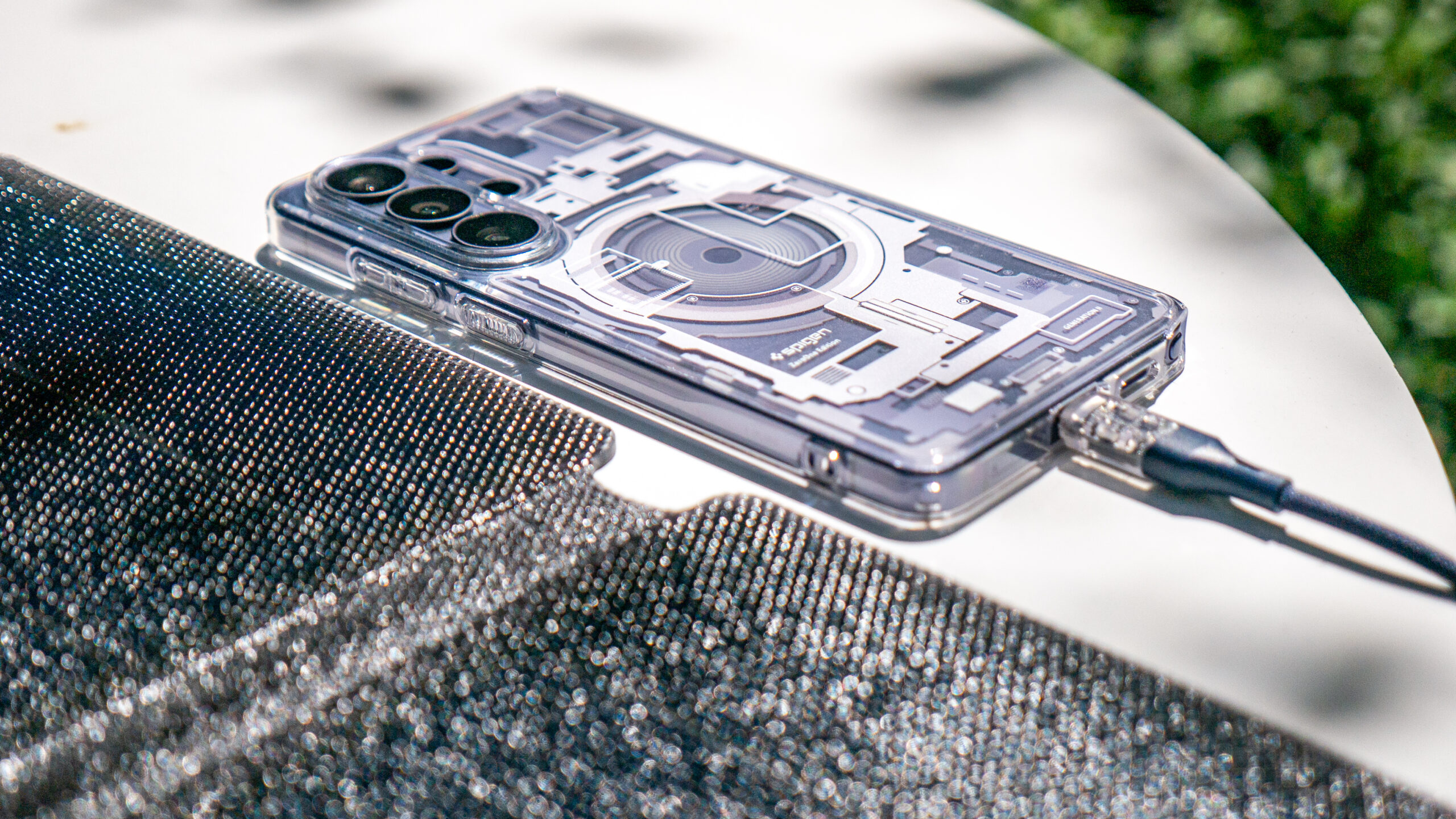
For the last year, I’ve had this portable solar panel lying around the office collecting dust — that is, until I finally took it outside to see how it charges my phone. In my previous attempt last year, I used the EcoFlow Power Hat while on the beach to do the same thing, but it’s not something I’d parade on top of my head around New York City.
Enter the Duracell M-Series Portable Solar Panel, which is compact enough to stow in my backpack, making travel convenient. Most people will outright dismiss the potential of solar charging, especially at this scale, but they might be surprised by the long-term value they offer. After using it to charge my Galaxy S26 Ultra, you might consider getting one for Earth Day. Here’s why.
Solar charging: What you need to know

First of all, you should know what I’m working with to get a better understanding of how solar charging works. The Galaxy S26 Ultra features a 5,000 mAh battery and supports up to 60W wired charging. In our lab testing using a 65W fast charger, it reached 41% capacity in 15 minutes — and then 77% in 30 minutes.
Article continues below
Meanwhile, the Duracell M-Series Portable Solar Panel features four monocrystalline panels that fold out to deliver up to 36W of power. Knowing that, it’s clear that it won’t be as speedy, so there’s simply no comparison between 36W and 60W. Essentially, the solar panel will charge at roughly half the speed of the wall outlet.
I asked Google Gemini how long it would take to charge the phone assuming the solar panel could somehow sustain a 36W charging speed the entire time. It would take approximately 40.1 minutes based on the following calculations:
- Calculate the phone’s capacity (Wh): Most phone batteries operate at a nominal voltage of 3.85V. You convert the 5,000 mAh capacity of the Galaxy S26 Ultra into Watt-hours so it matches the solar panel’s rating.
- Formula: (mAh x Voltage) / 1,000 = Wh
- Calculation: (5,000 x 3.85) / 1,000 = 19.25Wh
- Total energy needed (Wh): We stick with the same requirement of 24.06Wh (this accounts for the phone’s 19.25Wh battery plus the 20% loss for heat and voltage conversion).
- Charging time calculation:
- Formula: Total Energy Needed / Maximum Power Output = Time
- Calculation: 24.06Wh / 36W = 0.668 hours = 40.1 minutes
The test

For my test, I started charging my Galaxy S26 Ultra at around noon and recorded its battery life at 10-minute intervals. At the same time, I was using a specialty USB-C charging cable that showed me the active charging speed of a connected device. That way, I can see exactly what speed the solar panel is charging my phone.
Almost immediately, my drained Galaxy S26 Ultra jumped up to 14% in 10 minutes — while recording a maximum speed of up to 24W in that span. Eventually I saw its charging speed taper off to around 20W on average reaching 28% after 20 minutes, and finally to 41% by the time 30 minutes elapsed.
In all fairness, a 41% charged level isn’t too shabby knowing that wired charging got it to 77% in our labs testing. I could’ve stayed for another 30 minutes to get it to a higher level, but my point is that solar charging can still give you the convenience of adding a decent amount of charge in a short time. Plus, I don’t think the sun was at its full intensity at around the time I was testing it out — so it’s possible that it could charge even faster.
Convenience is the biggest selling point

I think a lot of people are under the impression that going solar will save them a significant amount of money in the long run. While that may be true for home solar installations, this specific application isn’t one of them. To break even on the $79 cost of the Duracell M-Series Portable Solar Panel, you would have to perform an astronomical amount of charging.
To put it in perspective, let’s look at how much it costs to charge the Galaxy S26 Ultra the conventional way, using the average residential electricity rate of 17.45 cents per kWh ($0.1745). Google Gemini broke it down with the following calculation:
- Energy required
- Battery capacity: 5,000 mAh x 3.85V = 19.25 Watt-hours (Wh).
- Charging efficiency: Chargers and phones aren’t 100% efficient due to heat. Using a standard 80% efficiency factor, the actual energy pulled from your wall outlet is:
- 19.25Wh / 0.80 = 24.06Wh (or 0.02406 kWh)
- The cost calculation
- Rate: 17.45 cents per kWh ($0.1745)
- Formula: Energy (kWh) x Rate
- Calculation: 0.02406 kWh x 17.45 cents = 0.42 cents (less than half a penny)
Yes, you read that right! The cost to charge the Galaxy S26 Ultra comes out to less than half a penny. If you charged it once a day for a full week, it would cost only 2.94 cents—totaling roughly $1.53 in electricity costs per year. Clearly, no amount of solar charging will offset the cost of the panel itself.
However, the true value of a solar panel of this caliber is the convenience it offers. If you’re somewhere remote for an extended period, you’d certainly want this in your kit. Even for a shorter stint, like a day trip to the beach, it’s incredibly helpful to keep your phone topped off while you’re soaking in the sun.
Ultimately, you aren’t paying for the electricity — you’re paying for the convenience.

Follow Tom’s Guide on Google News and add us as a preferred source to get our up-to-date news, analysis, and reviews in your feeds. Subscribe to Tom’s Guide on YouTube and follow us on TikTok.