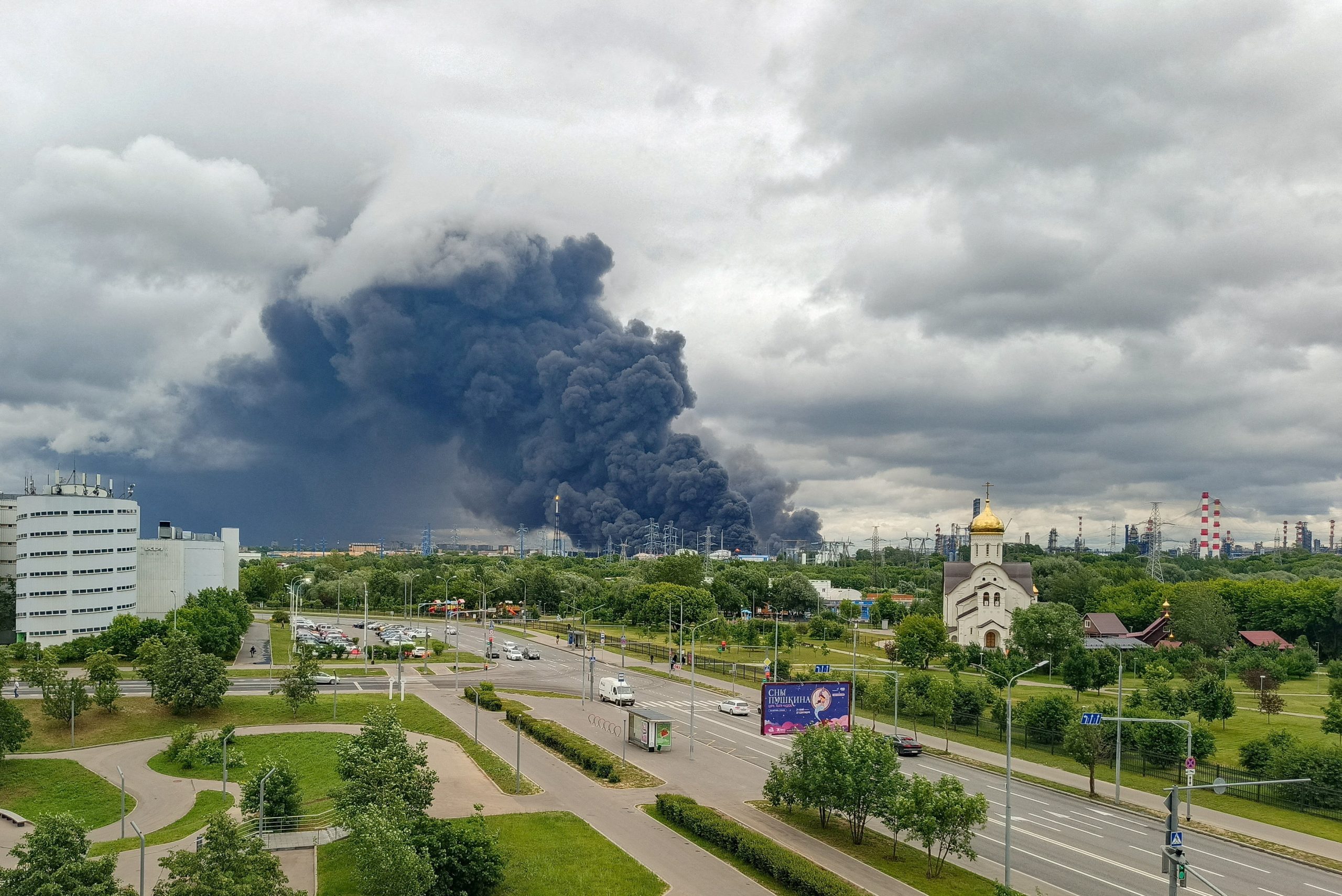
Energy security matters. Ukraine’s recent campaign against Russia’s oil infrastructure marks a visible and strategic shift in precisely how it is applying pressure on the Russian war economy. Through well-judged measures, the West can now join in.
Over the past few months, Ukrainian forces have repeatedly struck oil refineries, fuel depots, and storage facilities across Russia. More recently, Ukraine expanded this pressure to maritime logistics: since the beginning of July, Ukraine has substantially increased drone attacks against vessels linked to Russia’s shadow fleet in the Sea of Azov, disrupting fuel deliveries to occupied Crimea and forcing Russia to temporarily halt shipping through the Don-Azov Channel. Ukraine claimed to have struck 136 vessels in the 10 days to July 15. These operations not only disrupt Russia’s ability to process oil but also its ability to transport and monetize it. Wheat shipments have also been hit.
Oil exports are central to Russia’s ability to sustain the war. They finance military spending, fuel military operations, and underpin broader economic resilience. For this reason, the significance of Ukraine’s recent campaign lies not merely in the damage inflicted on individual facilities or vessels, but in exposing vulnerabilities across the entire oil value chain.
The cumulative impact of Ukraine’s concerted attacks on refineries is becoming increasingly difficult for Russia to ignore. According to Ukraine’s General Staff, cumulative strikes have temporarily disabled 42.7% of Russia’s designed refining capacity.
Regardless of the precise figure, Ukraine’s refinery campaign has contributed to widespread fuel shortages across Russia, in addition to rationing, repeated refinery shutdowns, the attempted use of alternative low-grade oil for domestic and transportation purposes, and emergency government measures to stabilize domestic fuel supplies.
At the same time, attacks against shadow-fleet tankers demonstrate that Ukraine is increasingly willing to target the underpinning transportation and transit logistics that enable Russian oil exports. These operations demonstrate that Ukraine is no longer content to target isolated military assets: it is applying sustained pressure across Russia’s oil supply chain, from refining and fuel production to maritime transport.
Much like sanctions, the challenge here is that disruption alone rarely produces lasting strategic effects. Damaged refineries and pipelines can be repaired. Oil exports can be rerouted. Tankers can be reflagged, renamed, or transferred to new owners. Ukraine has demonstrated where Russia’s vulnerabilities lie, but it needs some heavyweight support to really pile on the pain.
The task for Europe, the United States, and the United Kingdom is to identify these new vulnerable hot spots and ensure that they become progressively harder to overcome.
Russia’s refining sector entered the war with a substantial base of Western technology accumulated during two decades of refinery modernization. Before the full-scale invasion, American, European, and other international firms supplied the process technologies, specialized equipment, engineering expertise, and many of the industrial systems that remain embedded in many of Russia’s largest refineries.
The examples are telling. In early 2022, only weeks before Russia launched its full-scale invasion, Honeywell UOP agreed to supply Lukoil’s Perm refinery with process technologies, catalysts, engineering services, and key equipment for several major refining units. Honeywell had concluded a similar agreement with Lukoil’s Kstovo refinery the previous year.
Get the Latest
Sign up to receive regular emails and stay informed about CEPA’s work.
At Tuapse, one of Russia’s strategically important Black Sea refineries repeatedly targeted by Ukrainian drones, Siemens supplied six SGT-800 industrial gas turbines to generate electricity and steam as part of the refinery’s expansion. Meanwhile, Italy’s Maire Tecnimont supported the modernization of Kstovo by providing engineering, procurement, and construction (EPC) services for five major refinery process units, including diesel hydrotreating, hydrogen production, and sulfur recovery, further illustrating the extent to which Russia’s refinery modernization relied on Western engineering and industrial expertise.
These examples do not suggest that Western firms continue to supply Russia today. Instead, they illustrate a more important point: many of the systems that underpin Russian refining were designed around specialized technologies, proprietary components, and engineering expertise developed outside Russia.
While Moscow has invested heavily in import substitution since 2022, replacing or maintaining sophisticated refining infrastructure remains significantly more difficult than replacing conventional industrial equipment.
Every successful Ukrainian strike, therefore, creates a reciprocal demand for specialized repairs that — through targeted export controls and sanctions enforcement — ultimately can be made slower, more expensive, and more uncertain. The same logic applies to Russia’s shadow fleet.
Since early 2025, Western sanctions have evolved from targeting individual tankers to sanctioning ship owners, traders, registries, insurers, and maritime service providers. The European Union has tightened restrictions on tanker transfers and expanded listings of shadow-fleet vessels, while the United Kingdom recently carried out its first direct interdiction of a sanctioned tanker transiting British waters. These are important steps, but enforcement remains fragmented. Ships continue to change flags, ownership structures, and insurers faster than sanctions can often keep pace, while physical interdictions remain the exception rather than the rule.
Western policy should therefore focus on two complementary objectives: denying Russia’s ability to restore damaged refining capacity and making it progressively harder to transport and monetize the oil that continues to be produced.
First, governments should tighten export controls on the specialized equipment, catalysts, industrial software, and engineering support required to maintain and repair modern refineries. Rather than focusing exclusively on new sales, policymakers should pay greater attention to the aftermarket that supports legacy Western technologies still embedded across Russia’s refining sector. Every delay in obtaining compatible components or technical support extends the operational impact of Ukrainian strikes.
Second, sanctions on the shadow fleet should increasingly focus on enforcement rather than designation alone. Secondary sanctions should be expanded against facilitators of sanctions evasion, while closer coordination among allies should make it harder for shadow-fleet operators to evade restrictions through ship-to-ship transfers, frequent reflagging, opaque ownership structures, and alternative insurance arrangements. Physical interdiction, where legally justified, should become a credible enforcement tool, not an exceptional measure.
Sustaining this pressure will take more than sanctions and export controls in isolation. As the EU advances accession negotiations with Kyiv, opening a new cluster this month on foreign and security policy alignment, while simultaneously seeking to strengthen Europe’s own security architecture, the two agendas are becoming harder to treat separately. Sanctions, export controls, defense support, and Ukraine’s EU integration should be pursued as one coherent strategy, not a series of parallel initiatives.
Ukraine has shown where Russia’s weak points are. The next step is to ensure they remain weak.
Margaryta Khvostova is a PhD Candidate in Politics in the Department of Politics and International Relations at the University of Surrey, a PhD Fellow at the Centre for Britain and Europe (CBE), and Programmes Manager at the Centre for the Study of Global Power Competition (CGPC).
Professor Amelia Hadfield is Head of the Department of Politics, Founding Director of the Centre for Britain and Europe (CBE), and Associate Vice President of External Engagement at the University of Surrey.
Europe’s Edge is CEPA’s online journal covering critical topics on the foreign policy docket across Europe and North America. All opinions expressed on Europe’s Edge are those of the author alone and may not represent those of the institutions they represent or the Center for European Policy Analysis. CEPA maintains a strict intellectual independence policy across all its projects and publications.

Comprehensive Report
By CEPA International Leadership Council
Europe’s Edge
CEPA’s online journal covering critical topics on the foreign policy docket across Europe and North America.