Most Americans don’t realize they’re sitting on the biggest concentrated bet in the history of finance.
Pull up your 401(k) or brokerage statement.
If you own an S&P 500 Index fund… more than a third of your money sits in just seven stocks. If you own a Nasdaq 100 Index fund… that number jumps to roughly 40%.
And every two weeks when your paycheck hits, fresh money pours into those same names.
This is why warnings about the artificial intelligence (“AI”) bubble are growing louder…
More than a third of the market is concentrated in the seven largest technology companies, better known as the “Magnificent Seven.” And Goldman Sachs (GS) recently added up all AI-focused companies, and found they make up nearly half of the market’s total capitalization.
Michael Burry of The Big Short fame has loaded up on bearish options on AI stocks, particularly Nvidia (NVDA) and Palantir Technologies (PLTR). He recently said, “This, all of it, is the scene of the bloody car crash, minutes before it happens.”
And web searches for “AI bubble” recently hit an all-time high… even as search-engine giant Alphabet (GOOGL) says its “AI Mode” has been its biggest-ever upgrade to Google Search, with more than 1 billion monthly active users in just a year.
That’s the question every Main Street investor should be asking right now…
Because if you get the timing of the next few years wrong, you’ll potentially regret it forever.
Sell too early, and you’re doomed to sit on cash watching your neighbors get rich… But hold on too long, and you might watch half of your retirement disappear in weeks.
Dr. David “Doc” Eifrig and Brett Eversole answer that exact question in their latest research.
Doc spent a decade at some of Wall Street’s biggest firms before walking away to become a board-eligible eye surgeon. He now runs MarketWise (MKTW), one of the world’s largest networks of independent publishers, analysts, and technologists.
Brett has spent more than 15 years studying what his mentor Steve Sjuggerud named the “Melt Up”… the explosive final phase that has capped nearly every great bull market in history.
And today, they think the market looks a lot like 1999.
Not the dot-com crash itself… the year before the crash.
And they’ve built a quantitative signal designed to flag the exact moment the financial plumbing underneath the AI build-out starts to crack. They call it the Redline Signal.
We’re digging deep into their research, exploring what exactly the Redline Signal might mean for your portfolio, and why this proprietary signal will show – to the exact day – when the AI bull market will end.
Table of Contents
Being Right Doesn’t Matter If You’re Early
A lot of smart investors see bubbles coming…
Take famed value investor Jeremy Grantham. He was warning clients about the dot-com bubble way back in 1996.
He was right, of course. It was absolutely a bubble… and sure enough, it popped – in spectacular fashion – in March 2000.
The problem is… anyone who took Grantham’s advice in 1996 and sold their tech stocks missed the greatest run in stock market history. The Nasdaq climbed an incredible 376% over the next four years before it finally peaked. As Doc noted in his recent interview:
If you listened to Grantham and got out in 1996, you watched your neighbors get rich while you sat in cash earning 2% interest.
Maybe you kicked yourself watching it happen.
And then… when the crash finally came in March of 2000… you had been out of the market for fouryears.
You missed the entire Melt Up.
This same trap is happening right now in the market… and plenty of well-known investors are walking right into it.
Michael Burry, who became famous for predicting the housing collapse in 2008, revealed a bearish AI thesis last year… and has hammered it home in the months since.
In early May 2026, Michael Burry told his more than 200,000 Substack subscribers that “the market has jumped the shark” and that “the end of… this… is nigh.” He has also taken a significant leveraged short position, reportedly through January 2027 put options on the semiconductor [exchange-traded fund (“ETF”)] SOXX.
Stanley Druckenmiller, David Einhorn, and other big names have raised similar concerns.
Even an academic-style paper from London-based Man Group, the world’s largest publicly traded hedge fund, reads like a flashing warning sign:
The AI boom is real, but the financial structure built around it appears to be expanding more quickly than we believe any credible adoption curve can justify. This is not a new phenomenon. Across every major technological revolution – railroads, electrification, radio, fibre optics, and the dot‑com era – the technology itself has endured, but the financing cycle has broken, with expectations outpacing the industry’s ability to meet them. It increasingly appears to us a question of when, not if, the AI bubble bursts.
And to be clear, all these investors aren’t wrong to see these warning signs. I’ve certainly made my own fair share of warnings in the past nine months, but I’ve tried to consistently pair it with a note of optimism…
Last October, around the same time that Burry was opening up large bearish positions in Nvidia and Palantir, I warned in a piece about coming AI-related layoffs that, “AI is almost certainly a speculative bubble. But it can grow far more manic. And it likely will.” As I continued…
If you are an investor today, you must hold on to both of these contradictory ideas.
Frankly, this market right now – overheated or not – may be your last chance to cross the looming chasm between the “haves” and the “have nots” before its rickety bridge goes up in flames.
Doc and Brett have similar thoughts. They agree that the AI build-out has bubble characteristics. They simply believe getting the timing right is what matters most – and that the calendar still favors investors who own the right names.
Why? Because bubbles don’t end when stocks “look expensive.” They end when something specific breaks in the financial system.
Brett has spent more than a decade studying these patterns alongside his mentor Steve Sjuggerud, who popularized the term “Melt Up.” A Melt Up is the final, often parabolic, leg of a bull market when investors throw valuation discipline out the window and pile in for fear of missing out.
As Brett has described it, Melt Ups tend to be sparked by a “butterfly effect”… usually some macro shock that triggers an easy-money policy response from the Federal Reserve. In 1998, the Asian currency crisis pushed the Fed to cut rates, which lit the fuse for the dot-com explosion. Here’s what Brett wrote last October:
Easy money sets the stage for a market mania.
It happened in 1998 with the dot-com boom… It happened again during the COVID-19 pandemic…
And it appears to be happening again today, even without a crisis.
The historical pattern keeps repeating across markets and centuries.
- Japan’s Nikkei 225 Index in the late 1980s grew sixfold as the bubble built… then crashed 80% over the next two decades.
- During the Roaring Twenties, the Dow Jones Industrial Average rose from less than 100 to nearly 400 between 1922 and 1929, with most of those gains coming in the final 18 months before the Great Depression.
- Uranium prices crept from $10 to $30 a pound between 2003 and 2005, then exploded from $45 to $136 in a single year before collapsing in 2008.
- Cannabis darling Tilray went public at $17 a share in July 2018, ran to $300 by September, then fell to below $5 by 2020.
In each case, investors see a long, relatively steady climb… followed by a vertical surge that accounts for most of the gains in the final months or years… and finally a brutal collapse.
That vertical surge is what Brett and Doc call the Melt Up. And it’s where the biggest money is made… before the Melt Down comes.
So where are we today?
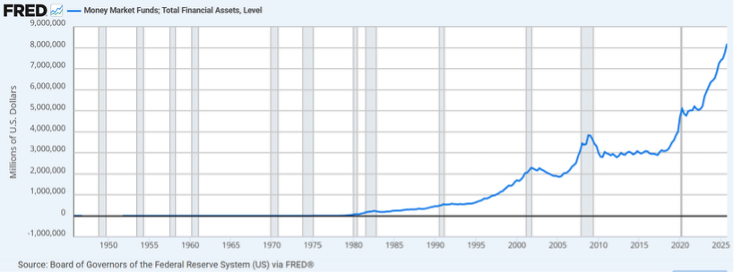
Well, one important “tell” is how much cash investors are sitting on in money-market funds. Today, data from the Federal Reserve shows that investors aren’t necessarily euphoric… they’re sitting on record levels of cash.
And historically, you don’t get a real Melt Up top until the last skeptic finally throws in the towel and buys.
For Doc, who lived through Black Monday in 1987 as a Goldman Sachs derivatives trader, this is the most important lesson investors need to internalize. Bull markets don’t die from old age. And they can keep going for a lot longer than most investors think… with the biggest gains of the entire cycle coming right toward the end.
An investor’s job isn’t to predict the bubble. It’s to figure out exactly when it will pop…
The Hidden AI Concentration in 161 Million Retirement Accounts
Do you know how much of your portfolio is in AI stocks?
A lot of folks will say, “not much,” or even, “I don’t own any AI stocks.”
But if you own a target-date fund, an S&P 500 index fund, or a basic Nasdaq ETF in your 401(k), that answer is almost certainly wrong.
The “Magnificent Seven” – Apple (AAPL), Amazon (AMZN), Alphabet, Meta Platforms (META), Microsoft (MSFT), Nvidia, and Tesla (TSLA) – have grown into a gigantic AI bet sitting at the top of nearly every passive index. As my colleague James Royal wrote this week:
The hyperscalers’ investments continue to rise quickly. Only months ago, the big four were estimating $650 billion in capital investment in 2026. The figure has since swollen to $725 billion, and Moody’s (MCO) thinks it could reach $785 billion, with $1 trillion in 2027.
And as these companies focus on building out AI, they make up more than a third of the entire S&P 500’s valuation. That level of concentration has a name. Torsten Sløk, the chief economist at Apollo Global Management, called it the “diversification illusion.” As he wrote:
The bottom line is that buying the S&P 500 gives the impression that you are buying 500 different stocks and diversifying your investments. But the reality is that the high and growing concentration in the S&P 500 continues to be a major problem.
And the market has only gotten less diversified since. As Doc noted in his interview:
When you buy a “diversified” index fund today…
You’re automatically putting around one-third of your money into these seven AI stocks.
And here’s the kicker:
This happens automatically.
It doesn’t matter if these companies are overvalued… or their stock prices make sense…
Every two weeks, when payroll hits, money flows into these seven stocks like clockwork.
Today, nearly half of American household financial assets are now in stocks… an all-time high. And as my colleague Dan Ferris has warned:
It’s the widespread idea of safety that invites these disasters.
And today, few assets enjoy the popularity of the S&P 500. When folks started saying “there is no alternative” a few years ago, they meant that there is no alternative to owning U.S. stocks… and that means the S&P 500.
Even Vanguard and Fidelity Investments, two of the world’s biggest investment-management companies, are starting to add disclosures to their funds, warning investors of “non-diversification” risk. Nothing about their funds have changed… they’re simply now tracking a market that no longer looks like a diversified bet.
When this AI bubble pops… it could be the biggest stock market wipeout in history. In part, because the damage won’t be limited to the AI sector. As the market starts declining and investors panic and sell their index funds, that drop will show up in practically every single stock on the market.
But while Doc acknowledges the concentration risk in the market right now, he isn’t telling his subscribers to dump their index funds today. Instead, he is recommending a “Melt Up Portfolio” that owns AI exposure through opportunities that profit from every dollar the hyperscalers spend, rather than betting only on the same Magnificent Seven names that everyone else already holds.
Think names like power suppliers, semiconductor toolmakers, data-center components, and cooling specialists… all of which sit further down the AI supply chain. If you’re interested in learning more, you can get immediate access to the Melt Up Portfolio by clicking here to go straight to the order form. (This link does not go to a long video.)
And even more important, Doc has a plan for folks to ride this bull market higher… and to get out at the right moment. And it relies on a specific signal that Doc and Brett have built…
The Redline Signal: How to Know When the Bubble Finally Pops
Markets don’t tend to give clear warnings right before a crash…
Just because folks are warning about a bubble, that doesn’t mean it’s about to burst. The trick for investors is finding the crash signal that actually matters.
That’s what Doc and Brett have been working on. And the result is their proprietary Redline Signal.
The basic idea is simple… every major bubble in history has ended in roughly the same way – with debt. Investors borrowed to chase the trade, suppliers extended credit to weak customers, and somewhere along the line, somebody’s cash flow couldn’t cover the loans. Then the dominoes fell. As Doc detailed in his latest interview:
The dot-com crash? Companies like Cisco and Lucent extended billions in financing to customers who couldn’t pay it back.
The 2008 financial crisis? Banks overleveraged on mortgage debt.
The 1929 crash? Investors borrowed 90% of their stock purchases – when prices fell, margin calls cascaded.
The pattern is always the same:
Debt fuels the Melt Up… then debt triggers the meltdown.
Today’s AI ecosystem is moving through the same financing pattern… but it isn’t there yet.
The hyperscalers, despite their massive capital expenditures, are still funding most of the build-out out of operating cash flow rather than debt. That’s a critical difference, and one that Brett laid out plainly last year:
The vast majority of these deals aren’t based on financing – that is, they’re not fueled by debt. Any investment in a business always has some risk. But companies like Nvidia aren’t going to go broke because of these deals, even in a worst-case scenario.
What’s more, the major hyperscalers (such as Amazon, Alphabet, Meta Platforms, and Microsoft) that are the biggest spenders in the AI build-out are cash-rich. They can afford all the spending they’re doing… and a lot more. And they’ve done nothing to hint that spending will break down anytime soon.
He went on to conclude: “It’s a spending boom. And until that changes, the market won’t go bust.”
Doc and Brett’s Redline Signal is built around that distinction…
The technical details are proprietary, but the idea is straightforward. Think of it like the tachometer’s redline in a sports car. You can rev a high-performance engine all day long… and as long as you stay below the redline, the car keeps accelerating. Cross the line, and you’re going to have major issues.
The Redline Signal monitors aggregate financial stress across the AI-infrastructure ecosystem in real time…
It tracks the capital structure of the hyperscalers and their suppliers. It looks at debt loads, financing arrangements, customer credit, and other indicators that have flashed warning signs at the top of previous bubbles. And when sustainable, cash-funded growth shifts into debt-funded growth, the line moves toward red.
Right now, by Doc and Brett’s measure, the signal is firmly green. The hyperscalers are operating well below the redline.
Newer entrants and smaller AI players, though, are stretching their balance sheets more aggressively, and that’s where the pressure is starting to build…
Brett explains it all in his latest special report, called “The Melt Up Portfolio and Redline Exit Plan“. As the Melt Up accelerates, the assets he recommends in this report should skyrocket along with it.
And most important, this is where he explains exactly how the Redline Signal works, what thresholds matter, and what it looks like when the needle moves from green to red. You’ll even learn how to monitor it yourself… so you can make data-driven investing decisions without depending on anyone else.
While the signal stays green, you can ride the Melt Up using AI exposure outside of the most overcrowded names. When the signal turns red, it’s time to take profits, rotate to safety, and let the storm pass.
In short, this report is a complete system that could help you ride the Melt Up all the way to the top with confidence… and know the exact day to get out.
With your subscription, you’ll get a clear, rules-based exit plan… paired with a specific portfolio designed to handle both Melt Up and Melt Down phases of the stock market.
Doc and Brett aren’t trying to predict the future. Instead, they’ve built a system intended to help investors stay in the trade while it works… and then walk away with their gains intact when it stops working.
Who Are Dr. David Eifrig and Brett Eversole?
Dr. David “Doc” Eifrig and Brett Eversole aren’t your typical finance guys…
Doc is currently CEO of MarketWise, where he publishes his Redline Signal, but he got his start on Wall Street.
He earned his bachelor’s degree at Carleton College in Minnesota, then a Master of Business Administration from Northwestern University’s Kellogg School of Management – graduating on the Dean’s List with a double major in finance and international business.
Then Goldman Sachs recruited him into one of the firm’s earliest derivatives trading desks. That put Doc in the room with Fischer Black, the economist who co-authored the Nobel-Prize-winning Black-Scholes options pricing model.
Doc spent the next decade trading at Goldman, Chase Manhattan Bank, and Yamaichi Securities in Tokyo. He lived through the Japanese asset bubble of the late 1980s. He worked through Black Monday in October 1987. By his early 30s, he had made senior vice president at Goldman.
That’s when he quit…
He’d seen enough of Wall Street’s culture… the greed, the conflicts of interest, and especially the way clients sometimes came second to the firm.
So he went back to school. He finished Columbia University’s postbaccalaureate premedicine program, earned his Doctor of Medicine from the University of North Carolina at Chapel Hill, and trained as a board-eligible ophthalmologist.
Along the way, he did a molecular-genetics research fellowship at Duke University and helped start a biotechnology firm called Mirus Bio. Roche bought Mirus for $125 million in 2008.
That same year, Doc joined Stansberry Research to launch his first newsletter, Retirement Millionaire. The premise was simple… Doc wanted to show Main Street investors how they could live like millionaires on far less money than Wall Street wanted them to believe – if they invested well and took care of their health.
Today, hundreds of thousands of folks read Doc’s work… and no surprise, given the number of big calls that Doc has gotten right over the years.
- He told readers to buy Microsoft around $27 after the 2008 financial crisis. Anyone who held has made north of 1,200%.
- He warned about inflation in 2021 while the Fed was still calling it “transitory.”
- He flagged the 2022 bear market before most analysts saw it coming.
- And in 2017, he was loud and bullish on housing, pointing to a structural supply shortage that has since pushed prices to record highs across most of the country.
Joining him with his Redline Signal warning is Brett Eversole…
Brett joined Stansberry Research in 2010, right out of college. His background is in applied mathematics and statistics, with an undergraduate degree in actuarial science. As an undergrad, he passed the first three exams to enter the Society of Actuaries before deciding finance was a better fit.
His first job was an apprenticeship under Steve Sjuggerud. Sjuggerud is the longtime Stansberry editor who popularized the term “Melt Up.” He wanted what he called “a numbers guy” to help build a quantitative-research platform… which drove many of the profitable recommendations and big calls that Brett has made over the years.
From timber, farmland, rare coins, Texas oil and gas royalties, and a long list of contrarian sector plays… Brett has seen triple-digit gains in commodities, financials, real estate, and AI-adjacent supplier names. All in, Brett has closed more than 300 winning recommendations over the past 15 years.
Brett’s quantitative, numbers-based platform crunches huge volumes of market data looking for low-risk setups with big upside. Brett starts looking for big macro trends with multiyear tailwinds. Then he zooms in on sectors that are cheap and unloved. Finally, he waits for momentum to confirm.
What Is MarketWise?
MarketWise is the parent company of one of the largest independent financial research and publishing platforms in the world.
From its launch in 1999 as a small newsletter business on a borrowed laptop at a kitchen table, the company now publishes well over 100 products with dozens of investing styles and themes… and serves a community of millions of readers globally.
What sets MarketWise apart from typical Wall Street firms is its business model… The company doesn’t manage money. It doesn’t take fees from the companies it recommends. And it doesn’t earn brokerage commissions.
Instead, the company’s focus is on individual subscribers who pay for research, which means MarketWise analysts only succeed if they recommend opportunities and make economic calls that subscribers find valuable. As a result, its research often takes an independent, contrarian view of the market.
MarketWise’s editorial roster includes a mix of Wall Street veterans, PhDs, certified public accountants, chartered financial analysts, and former hedge-fund managers.
For subscribers, the appeal is simple… Profitable recommendations and clear explanations of market moves from analysts who aren’t afraid to make contrarian calls, exactly like the Redline Signal warning we’ve discussed today.
What Investors Should Do Next
Most Americans today have far more AI exposure in their retirement accounts than they realize…
As we said at the beginning of this article, for a rough estimate of just how much AI concentration risk you’re taking on, just take a look at your latest 401(k) or brokerage statement…
Multiply the total value of any Nasdaq index fund you own by about 40%… every S&P 500 index fund by about 33%… any Dow index fund you own by about 25%… and every target-date fund you own by between 8% and 15%, depending on how near retirement you are.
The resulting amount is how much of your retirement nest egg is concentrated in just seven stocks. If you’re like most Americans, that number is probably bigger than you realized.
And if you also own any tech-focused growth funds… then that figure is going to be a lot bigger.
This is why Doc and Brett are focused on assets that can do well if AI keeps roaring – and survive if it doesn’t. Think AI power suppliers, semiconductor toolmakers, and data-center components. That’s the core insight from their Melt Up Portfolio research.
And finally, make sure you have an exit plan. That’s the whole point of Doc and Brett’s Redline Signal… to help investors know when to get their profits out. If you haven’t already seen it, you can hear Doc explain everything in his latest exclusive interview right here.
As long as the Redline Signal stays green, the Melt Up is still on, fueled by record cash on the sidelines, lower interest rates, and an AI-spending boom funded out of operating cash flow.
When the signal flips, the party’s over.
As soon as sustainable growth crosses into terminal instability… which we believe will indicate the exact day this bull market ends… Brett will send a Redline Signal alert to your email inbox with his analysis and specific, actionable steps on what to do next.
To make sure you’re on that list, you’ll need to be a subscriber. Learn how to get immediate access by clicking here to go straight to the order form. (This link does not go to a long video.)