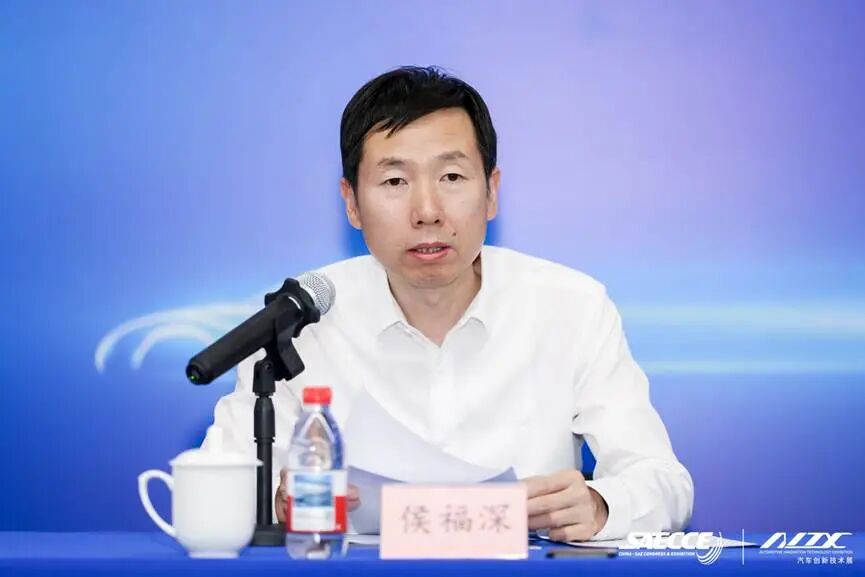
Gasgoo Munich- With 2026 marking the start of the 15th Five-Year Plan, China’s auto industry stands at a pivotal juncture in its shift from sheer scale to strength. At a June 3 press conference for the SAE-China Annual Meeting and the AITX Auto Innovation Technology Exhibition, Hou Fushen, vice president and secretary-general of the society, laid out a comprehensive vision for technological innovation over the next five years.

Image Source: SAE-China
Hou noted that the coming five years will bring a new landscape defined by electrification, intelligence, and globalization.
First, electrification technology is accelerating, with new energy vehicles set to dominate the market. Innovations like intrinsically wide-temperature, high-safety liquid batteries, solid-liquid hybrid batteries, all-solid-state batteries, and new materials and topologies for drive motors will significantly boost the competitiveness of NEVs. By 2030, NEVs are projected to account for more than 70% of new passenger car sales.
Second, AI-driven industrial transformation is gathering pace, as digital intelligence expands from individual products to the entire value chain. Fully end-to-end large models, vision-language-action models, and world models will see large-scale application over the next five years. This will drive the universal adoption of L2 combined assisted driving and push L3 and L4 autonomous driving from pilot programs to widespread deployment, with a penetration rate in new passenger cars exceeding 35%. “AI plus Auto” will extend from products to the full cycle of “R&D, production, supply, sales, and service,” fundamentally altering traditional manufacturing R&D paradigms, production methods, and business models, and reshaping the industrial ecosystem.
Third, the competitive landscape between Chinese and foreign automakers is being reshaped, making internationalization a critical growth engine. China is poised to become a global source of frontier automotive innovation and a key market for validating new technologies and models. The pull of overseas markets will become increasingly pronounced; by 2030, China’s auto exports are expected to reach nearly 10 million units, with roughly 40% coming from localized production and sales abroad.
Addressing these emerging trends, Hou argued that automotive innovation over the next five years should focus on three core missions.
First, strengthen basic research and frontier technological innovation. Automotive technology has entered the “deep waters” and “uncharted territory,” making original, forward-looking, and disruptive innovation more critical than ever. He emphasized that boosting the capacity for original innovation in basic research and frontier technology is the top priority for the next five years, while accurately grasping the direction of frontier trends is a prerequisite for high-level technological development.
Second, promote the deep integration of technological and industrial innovation. The industry must drive the fusion of innovation and industrial chains from the source of automotive technology. Through industry-academia collaboration, upstream-downstream coordination, and cross-sector innovation, the goal is to vertically integrate the entire chain—from key materials and components to system assemblies, manufacturing processes, and equipment—and to horizontally break through every link from R&D and pilot verification to technology transfer and application. This ensures that innovations truly serve industrial development and benefit the wider market.
Third, use artificial intelligence to deepen the paradigm shift in technological innovation. AI is reshaping the fundamental logic of automotive innovation with unprecedented speed, depth, and breadth, exerting a disruptive impact on traditional R&D models like “trial-and-error iteration” and “rule-based” approaches. Hou pointed out that integrating “AI for Science” (AI4S) into the automotive innovation system—thereby reshaping innovation paradigms and unlocking efficiency—has become a critical subject for the industry’s high-level development.