Champagne glass in hand, Nigel Farage grins broadly as he limbers up to the podium at Britain’s Cheltenham racecourse.
The political veteran has much to celebrate, with Reform UK, the right-wing populist party he leads, having secured a seismic electoral breakthrough at Thursday’s local elections.
Scores of town halls have turned Reform turquoise as millions of voters deserted the two traditional parties of Labour and the Conservatives to try something new.
“We’re the fun party,” Farage tells scores of Reform activists gathered to hear him speak.
“Imagine having a pint with Keir Starmer.”
The prime minister certainly cuts an isolated figure after this week, with a growing number of MPs demanding a timetable for his exit and one, Catherine West, insisting she could launch a leadership challenge if ministers fail to move against him.
Farage indeed has his eye on the prime minister’s job himself and, if Reform can sustain this level of support at a general election, the keys to Downing Street may fall to him.
The numbers speak for themselves.
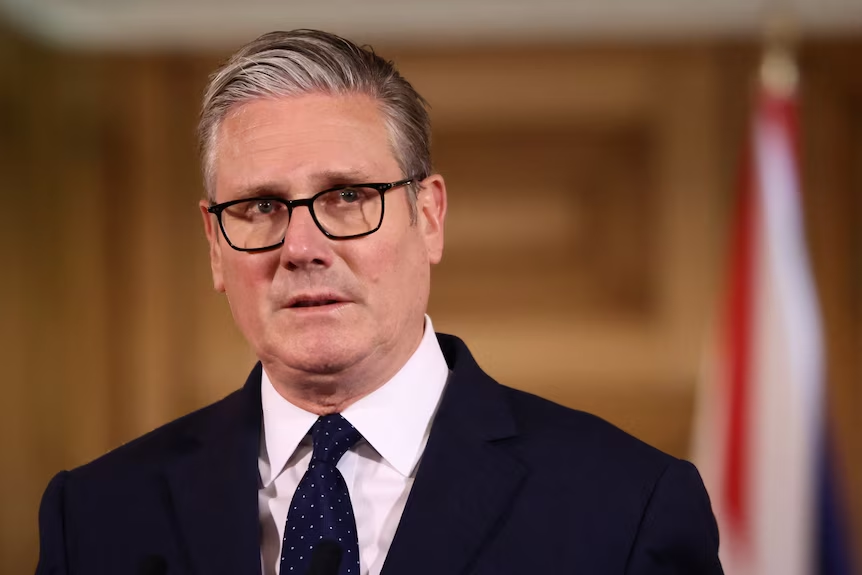
Keir Starmer is under pressure after the recent election. (Reuters: Jack Taylor)
Reform won about 1,450 council seats in total, taking in Labour strongholds such as Sunderland and Barnsley, Tory crowns such as Essex, and establishing itself as a major opposition party in the Scottish and Welsh parliaments.
The UK’s governing party, Labour, meanwhile, has lost almost the same number as Reform has gained, while also haemorrhaging support to smaller parties such as the Greens, the SNP and Plaid Cymru.
Though these are not elections for the green benches of Westminster, they indicate the sheer strength of support for Reform and will act as the perfect springboard for the “Farage for PM” campaign that will follow.
Former Nationals leader Barnaby Joyce previously likened One Nation to the Reform UK Party under Farage’s leadership. (Reuters: Phil Noble)
The 62-year-old characterises this set of elections as Reform’s “Becher’s Brook”, referring to the treacherously high fence in the famous Grand National steeplechase that can make or break a jockey’s race.
The truth is that, for Farage, it has been a long, slow march from championing fringe causes in the 1990s to dominating the national conversation today.
The former commodities trader began his political career as a Conservative, before quitting the party over its policy on the EU. He would go on to found the UK Independence Party (UKIP) and be elected to the European Parliament four times. He used that position to cement support for Euroscepticism back in the UK — something that came to fruition in 2016 when Britain backed Brexit.
Before losing the referendum and quitting as PM, David Cameron famously believed those in his party sympathetic to Farage’s anti-immigration rhetoric “swivel-eyed loons”.
Farage co-founded Reform UK, then the Brexit Party, in 2018. (Reuters: Clodagh Kilcoyne)
Farage, meanwhile, has thrived, carving out a profile as the radical right campaigner who, his supporters say, is despised by elites and has gumption enough to say what people are really thinking.
The Brexit wars that followed 2016 split the Tory Party, ousting Theresa May and propelling Boris Johnson to power.
While Farage failed to win a Westminster seat in this era, his influence over power holders was ubiquitous, as he regularly pulled MPs onto his turf when it came to issues like trans rights, culture wars and scepticism about climate policy.
The Conservatives, meanwhile, oversaw a sharp rise in immigration, and Liz Truss’s disastrous mini-budget led to the worst fall in living standards on record in the UK. This meant the ground was fertile for Reform’s populist movement to take hold at the 2024 election, an event that handed Farage the Westminster seat he had coveted for decades.
But it has been the Labour government’s numerous failings since taking office at the very same election that have handed Farage the advantage.
Starmer later admitted appointing Mandelson was a mistake. (AP: Carl Court)
Policy backflips, failed welfare reform, ministerial scandals and outrage over his decision to appoint Peter Mandelson as the UK’s ambassador to the US despite ties to Jeffrey Epstein have dogged his premiership.
Add to those a backdrop of continually high immigration levels and the grinding ongoing cost-of-living crisis Brits are enduring amid low economic growth, and it is easy to see why voters feel Starmer’s one-word election slogan “change” has so far failed to deliver.
The consequences for the UK and its governing party stretch beyond Reform’s success. In Wales, Labour was ousted by Plaid Cymru and in Scotland, the SNP has comfortably held power in the Scottish parliament. Given Sinn Fein is already the largest party in the Northern Ireland Assembly, it means all of the devolved bodies are dominated by separatist parties that wish to break up the UK.
So, what happens next?
A growing number of Labour MPs are going public with their concerns and admitting their leader is a deeply unpopular figure who they do not believe can lead them into the next election.
The group demanding his exit includes a former Cabinet minister, senior trade union officials and people once loyal.
Starmer, who enlisted the support of party big wigs Gordon Brown and Harriet Harman this weekend, has refused to countenance standing down.
When the depth of the losses became clear, he acknowledged the results were “tough” and there was “no sugarcoating it”, but told reporters: “I’m not going to walk away and plunge the country into chaos.”
Health Secretary Wes Streeting, former deputy PM Angela Rayner and Manchester Mayor Andy Burnham are among the figures talked about as potential successors.
Labour MP Catherine West warned she would challenge Starmer’s leadership if he did not step down. (Supplied: UK Parliament)
Australian-born Catherine West, a backbencher who once served as a minister in his government, has even said she would be prepared to mount her own leadership challenge if no action was taken.
She told Times Radio today: “I want to wake up the leadership to respond and to come out fighting and to say what is going to be done next and how we are actually going to take on the Reform threat and the various electoral challenges that face us, but all I can hear is a deafening silence and so I look forward to having that debate.”
Many MPs — and increasingly many voters — believe the writing is on the wall for Starmer.
Time will tell whether his exit will be orderly or whether his MPs quickly lose patience and a bunfight for the top job ensues in the coming weeks.
Farage, whose own campaign slogan was “Vote Reform, get Starmer out”, was of course asked his view.
He told Sky News: “He’ll be out by the summer.”