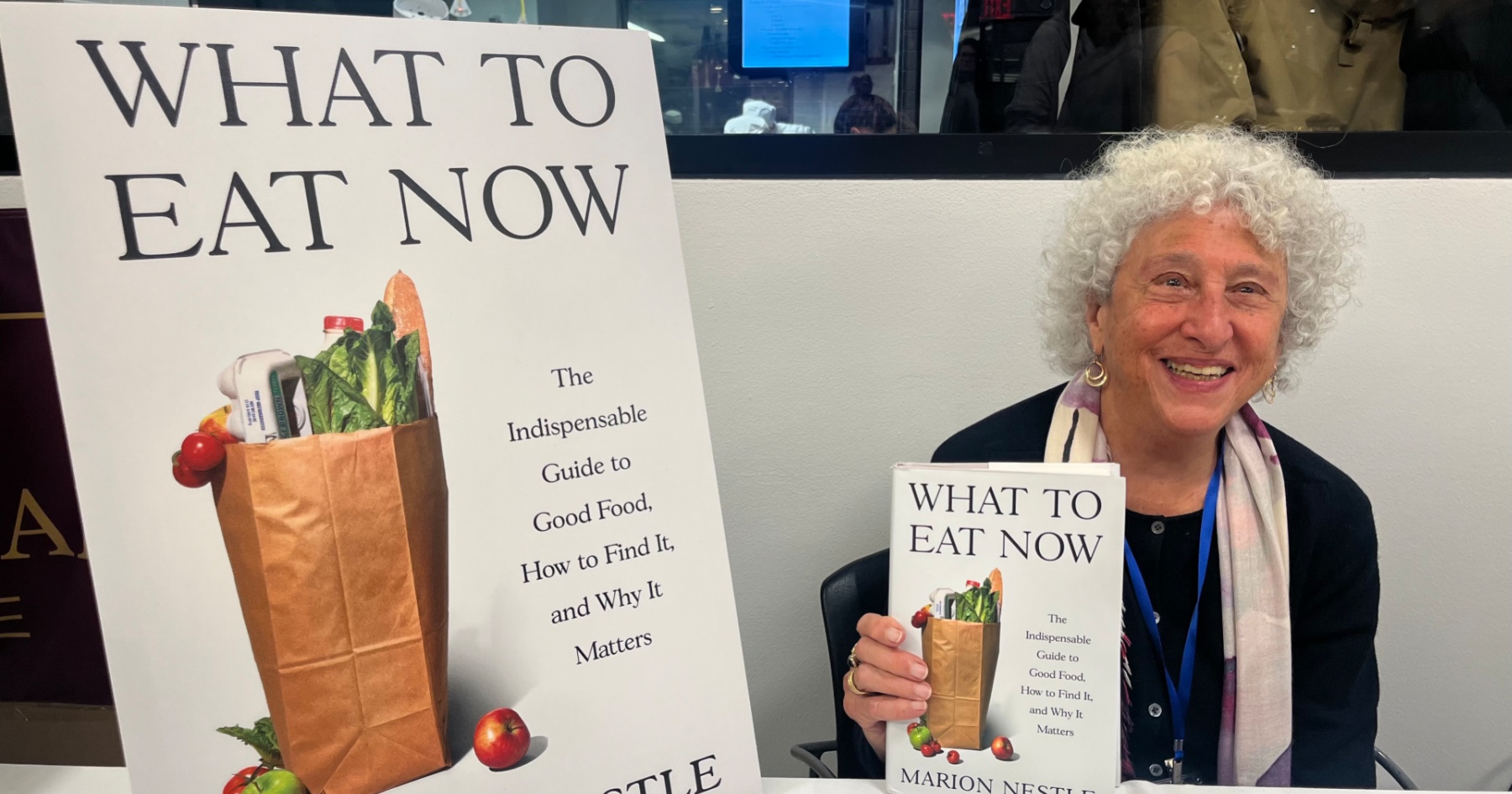
Author Marion Nestle updated her 2006 book, “What to Eat,” which published Tuesday with the title “What to Eat Now.” | Photo by Pat Cobe
The food products author Marion Nestle wrote about in the first edition of “What to Eat,” published in 2006, no longer exist on supermarket shelves. “Ultra-processed foods, plant-based foods, flavored waters—these are all new. Back then, foods were distinguished by nutrition content. Now it’s more the ‘no’s’ that are selling food.”
Nestle, a nutrition professor emerita at New York University and a public health advocate, spent the last four years updating the book, and it was just published this month with the title “What to Eat Now.” She and other experts shared their take on healthy eating at “The Next Big Bite—The Bite that Heals,” a conference hosted by Les Dames d’Escoffier New York on Monday.
The bottom line—“eat real food,” the panelists agreed. That was the best advice back in 2006 and it remains true today.
But we gathered some of the more specific takeaways from The Bite that Heals to see if and how healthy eating has evolved.
Take a food first approach. Ellie Krieger, a registered dietitian, author and television host, encourages eaters to take a broader view of food instead of focusing on minutiae like grams of protein. “There’s too much misinformation and fear mongering on social media,” she said, adding that she especially dislikes people “dissing” grains. Her ethos always goes back to choosing real or whole foods, eating seasonally and putting flavor first.
A happy gut makes for a happy, healthy body. Richard LaMarita, a chef and instructor at New York City’s Institute of Culinary Education, where the conference was held, has been a practitioner of Ayurveda for more than 40 years. Ayurvedic meals balance six tastes—sweet, sour, salty, pungent, bitter and astringent—and achieving that balance aids digestion and supports wellness. He noted that certain digestive spices and herbs contribute to a happy gut, including cumin, fennel, mint, coriander and basil, and these are used liberally in the Indian-based practice.
Good nutrition starts with good soil. Alix Daguin, project director of regenerative farm All One One All, believes “you can’t have a nutritious meal without healthy soil.” She encourages eaters to shop farmstands and farmers markets whenever possible, and have conversations with the farmers to find out how they are managing their crops and livestock; farming in a way that restores rather than depletes the land. “Do no harm” is the mantra of regenerative farming.
Food as medicine is a prescription for health. Dr. Robert Graham, an integrative medicine physician who founded FRESH Med, is a Certified Culinary Medicine Specialist—a relatively new field. He’s been an advocate of incorporating nutrition into healthcare way before it was required. And health insurance companies are getting on board. “I can now prescribe food as medicine, and Medicaid and Medicare Advantage plans will now cover it,” he said. Graham also teaches cooking to doctors and health professionals to forge the connection between food and health.
Practice positive nutrition. “It’s what you can add to your diet to eat better, not what you need to take away,” said Dr. Basma Faris, an OB/GYN and another Certified Culinary Medicine Specialist. Her patients range from those seeking fertility treatments to women with severe menopausal symptoms, but she always merges clinical care with a food first approach.
Peer support drives healthy eating. Lynn Fredericks, founder of FamilyCook Productions and a longtime culinary educator, sees the benefit of peer-to-peer interaction among preschoolers, adolescents and adults in fostering healthy eating habits. It starts with “real food,” of course, but peer support is what drives behavior change, she said.
Members help make our journalism possible. Become a Restaurant Business member today and unlock exclusive benefits, including unlimited access to all of our content. Sign up here.

