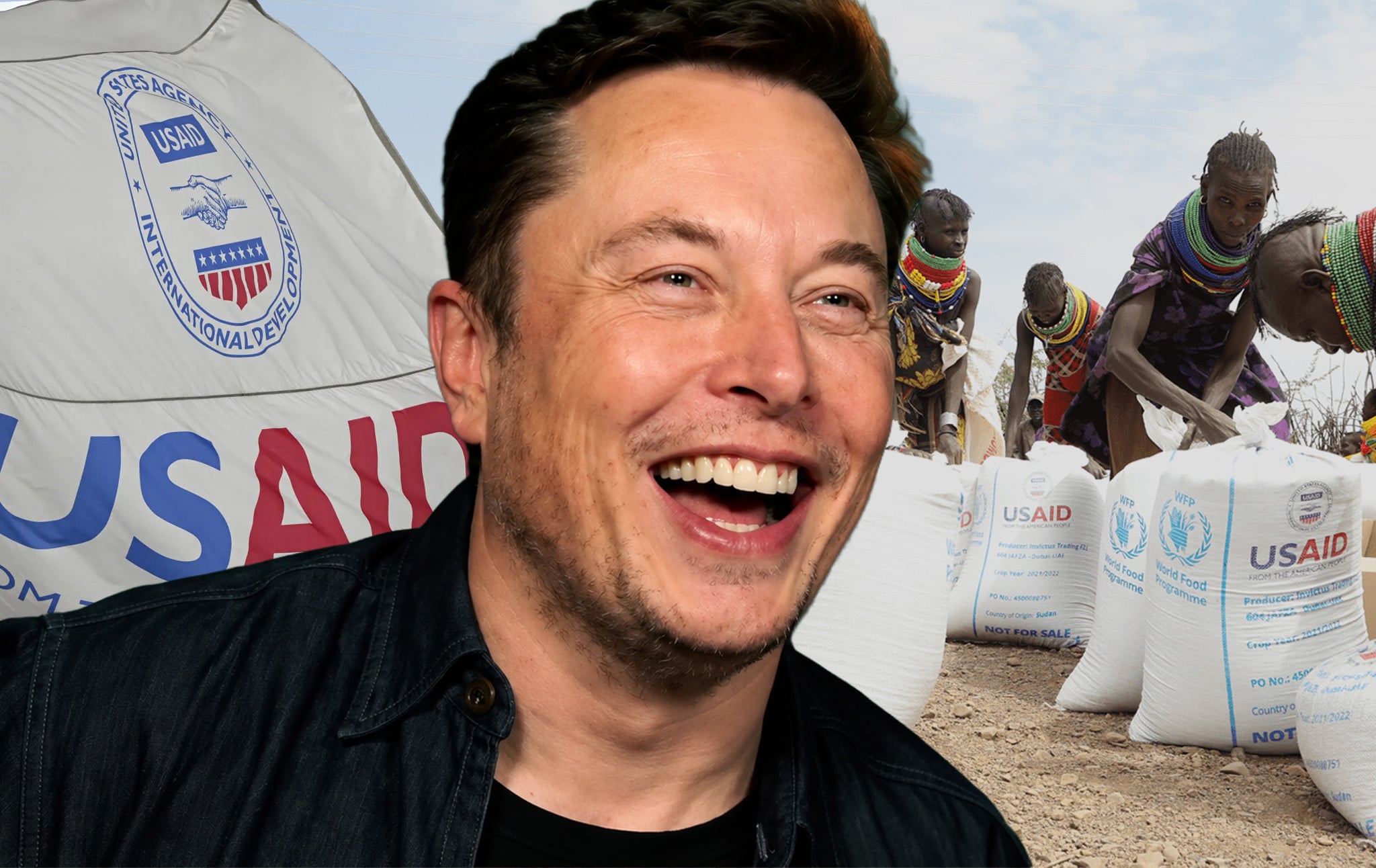
For more than 12 years, Nicholas Enrich worked at USAID, the United States Agency for International Development, rising to become one of the agency’s top global health officials. Then, in a matter of weeks, he watched as the Trump administration and Elon Musk’s “Department of Government Efficiency” (DOGE) dismantled the six-decade-old agency responsible for delivering American foreign aid around the world.
Enrich documented the experience in his book Into the Wood Chipper: A Whistleblower’s Account of How the Trump Administration Shredded USAID. He joined Current Affairs editor-in-chief Nathan J. Robinson to discuss what happened behind the scenes, and its devastating consequences.
NATHAN Robinson
Let’s start with the book’s title, Into the Wood Chipper. If people don’t remember the “wood chipper” and how your agency was fed into it, who’s it a quote from?
Nicholas Enrich
It’s Elon Musk. So, yeah, about two weeks into the Trump administration, Musk tweeted that he just spent the weekend feeding USAID into the wood chipper, and I was the top global health official at USAID at the time. So, I unfortunately had a front row seat to the destruction that that was happening to the agency at that point, and I wrote this book to hopefully give readers a look of what it actually felt like inside of that wood chipper.
Robinson
Okay, so how it felt inside the wood chipper, but first, before we get to the dismantlement, let’s have you lay out your personal background here. I mean, how did you get involved with USAID? How, what’s what brought you to this agency, and what did you do for it?
Enrich
Coming into the second Trump administration, I was the Director of Policy, Programs, and Planning for Global Health, which basically meant that my job was to ensure that we were using taxpayer dollars effectively to achieve our objectives of increasing global life expectancy and creating access to affordable and high-quality healthcare around the world, and keeping Americans safe from infectious diseases overseas.
My background is actually in law, which is unusual for the Global Health Bureau at USAID, where a large portion of the staff were experts in global health, specifically—so doctors, epidemiologists, public health specialists, etc. But, you know, it’s an agency that moves an incredible amount of money using complex financial instruments, and so that’s that was kind of where I fit in: trying to find very efficient and effective ways to do the things that the doctors and epidemiologists were trying to do, using our funding.
Robinson
I feel like one of the tragedies of this story is that so many Americans had no idea what they lost when they lost this agency. I mean, you point out that before the Trump administration had USAID in its sights, you used to have to explain to people where you worked, and they didn’t even know this agency existed.
And yet, for all of the horrors that come out of US action abroad on the military side, there’s a lot of goodness that has come out of what this agency has done over the years. So tell us a little bit about about what this agency managed to accomplish.
Enrich
So, USAID was the federal government’s branch to deliver foreign aid and international development assistance around the world to over 100 countries, and it succeeded in spades, using less than one percent of the budget. For example, we saved over 92 million lives within just the last 20 years alone. It was kind of the embodiment of American generosity overseas. We operated under a flag of people shaking hands that said “from the American people”, but it wasn’t just a charity organization. I think that that’s it’s really important.
It was an implement of national security. It kept Americans safe from infectious diseases. You know, we had developed a global early warning system, so that countries could detect and respond to infectious diseases before they could potentially threaten us. We built partnerships over decades with countries that enhanced stability and increased American soft power around the world, that really allowed for Americans to thrive in a stable world order for over 60 years.
Robinson
One of the remarkable things here is that—well, actually, first let me ask you this. You said that one of the things that you did was ensure efficiency, and obviously one of the right-wing critiques of government generally, and of this agency in particular, the phrase that is used is: waste, fraud, and abuse.
Is that taxpayer dollars are being squandered? Can you tell us some ways in which the agency ensured that the taxpayers’ money is actually being used effectively and efficiently to save human lives?
Enrich
USAID was actually widely recognized as one of the most efficient agencies across the government. As I said, 92 million lives it over the last two decades alone on less than one percent of the federal budget. And the reason was: because we were distributing foreign aid abroad, we were very carefully audited, and we were very carefully overseen by our congressional committees, so we had all kinds of standards in place.
So, for example, our payment system. We couldn’t just like distribute funds to a government and say, you know, I hope these go to good use. Any time that a payment, no matter how small, was distributed, we had our program managers ensuring with the technical experts that we had gotten exactly what we had asked for with that funding, and we we would not distribute a single dollar without making sure that we had got what we had asked for. These are exactly the kind of systems that were completely destroyed when DOGE came in. Ironically, in the name of eliminating “waste, fraud, and abuse,” they created so much and actually broke the system that we used to audit our payments and make sure that we were working efficiently and not creating wastewater abuse.
Robinson
Can you tell us a little bit more about the kind of bizarre picture of USAID that began to exist in the mind of people on the right, people like Elon Musk? I mean, I’m sure there was a certain early point where you began to realize something very strange is happening. They there seems to be a lot of conspiracies around what this agency does. Can you talk about how the agency was was spoken of in sort of right-wing online discourse?
Enrich
Yeah, I think it’s really important to understand what happened to USAID, in the context of the fact that the DOGE folks and the political appointees that came into the agency had no idea what the agency actually did. All they had learned about it was what they had read or seen on right-wing conspiracy theory.
So for example, Elon Musk, who had never once mentioned USAID in his long history of public comments, first started tweeting about it after a conspiracy theorist named Mike Benz went onto the Joe Rogan show and talked about how USAID was a front for the CIA and other such conspiracy theories. But like even the highest levels of the political appointees who came into the agency thought that—for example, the chief of staff of the agency, when I tried to explain all the work that we did in global health, told me that he had assumed that the only thing that USA did in global health was abortions. Which is really truly crazy, because we’re actually prohibited from providing or promoting abortions by federal law, and that’s exactly what we do not do.
But to think that that would be the only thing that USA did in global health was just insane, and we started to see in the early weeks of the Trump administration the way that they didn’t just come in expecting these things. They then continued to propagate fake stories about what was happening at USAID. So you get stories like that USAID is sending $50 million of condoms to Hamas in Gaza to be used as bombs. That was a sentence that came out of the mouth of the President of the United States. When we, like, dug in to figure out what it was he was possibly talking about, it turned out that he’d gotten the Gazas wrong—it was actually a reproductive health package, in support for a province that happened to be called Gaza, that’s actually in the country of Mozambique. It had nothing to do with the Gaza Strip, where Hamas is, at all.
Robinson
But also, it’s actually important to provide; one of the things that the USA has done is to stem the AIDS crisis in Africa. I mean, this is important work. I mean, a lot of the things that they think are waste are really life-saving things. It’s not just that they got the Gazas wrong, it’s also that the aid is important,
Enrich
Right? I think that, as hard as it is to believe, this is what the people that came into this agency truly did not understand, nor care about: the life-saving support that we provided. So it was very easy for them to sit there pushing buttons without any idea what they were doing even, and ignore the warnings of the experts that the impacts of the decisions was going to affect the lives of millions.
Robinson
Can I tell you, there’s something that strikes me as—I have to sort of resort to extreme adjectives like “evil” and “depraved” about literally the world’s richest man, who, by the way, let’s just say happens to be a white South African part of the Apartheid era. But just the spectacle of the world’s richest man, a white South African, cutting off lifesaving medical aid to millions of people in Sub-Saharan Africa, condemning people to death when such a small amount of money could save those lives.
And your title phrase Into the Wood Chipper is just so horrifying: that someone who, with his own personal fortune, could save millions of lives and chooses not to. But not only chooses not to, but personally goes into the government agency that, for a very small amount of money, saves those lives and decides that no, those people are going to die. I really, kind of run out of words. I mean, I’m sure you’ve had these kinds of feelings, knowing what the civil servants in your agency did every day.
Enrich
Yeah, no, I think that’s fair. It really was painful and infuriating to watch. And you know what made it worse, was watching him lie about it publicly. So, it’s one thing if he’s going to commit to celebrating cutting off aid for the world’s poorest children; it’s another to then stand in the White House and speak publicly about how he’s actually restored access to HIV and Ebola prevention activities, on the same day that his tech bros are sitting in our office at USAID and terminating the contracts that would be needed to provide those services.
Robinson
I mean, you mentioned there the lies, the misrepresentation of what they were actually doing. That was done not just by Musk, but by Trump and by Rubio—who, when they were criticized for cutting life-saving aid, put out a lot of messages that were saying no, no, we’re making sure that everything essential, everything that’s still valuable, still stays in place.
So, perhaps you could talk a little bit more about what was actually happening, and what the messaging coming out of the administration at the time was.
Enrich
Right. So this all started on January 20, when Trump issued an executive order that froze all foreign aid. And when I first read this, I thought it must be a mistake, because it really meant shuttering clinics and ongoing clinical trials, that’s going to end up in a massive catastrophe with enormous loss of life. And about a week later, Rubio did issue a waiver to pause for what he called “life-saving humanitarian assistance.” And this seemed to me to be my calling—when I was elevated to be to lead of Global Health, what I said was: my entire team needs to focus on nothing except for restarting these lifesaving activities under this waiver.
But the reality was, although they were speaking publicly about how they had created this exception to the pause on foreign aid to allow “life-saving activities” to continue, they stopped us at every step of the way. So they kept scaling back what they considered to be life-saving. They kept slashing the staff and the experts that we needed to provide those life-saving services. They broke the payment system, as I mentioned earlier, that would have allowed us to move the actual funds to be able to accomplish that, and then ultimately they terminated all the contracts that we would need to provide life-saving services—again, all while publicly stating that if life-saving activities weren’t happening, that was because the career civil service didn’t understand or was intentionally trying to make them look bad.
So honestly, that was when I finally realized that there was no way we were going to be able to do life-saving activities. That was when I realized my top priority is no longer trying to do that, it’s to bear witness to what’s happening here, and to let the world know how we’re being stopped from doing this. And to warn them of what the impacts of those decisions actually will have around the world.
Robinson
Tell us a little bit more about what’s going on in the agency at that point. So you said DOGE comes in, they put people in place who give orders, and you—the people who’ve already been there—what are you trying to do? What are the blocks that are getting in your way? Tell us a little bit more about what’s unolding inside the agency,
Enrich
Sure, I’ll give you an example. One of the scary things that happened during the same period as our programs were frozen was there was an Ebola outbreak in Uganda, and so obviously that’s a major health emergency that has US national security implications.
You know, if there’s anything that is going to get somebody’s attention in the global health space, it’s an Ebola outbreak. So, this is what we focused our attention on. How can we restart some of those Ebola activities? And so, we knew we couldn’t set up the robust response we normally would under normal times, because of the way that they had gotten rid of so much of our staff. But we needed to do certain things, like one of the things we really needed to do was to screen passengers in the airport to make sure that they weren’t getting onto international flights with symptoms of Ebola. Because those flights are potentially going onwards to the United States, and that’s how you get an international catastrophe. But even that, we were basically told absolutely not, we’re not going to move funding for this, and so no matter how hard we pushed on saying, look, these are the specific lives that are going to be risked if we don’t do this activity, we still could never convince them to actually allow us to restart our programs.
And this just happened time and time again with things that were true national security threats. I’ll give you another example: one of the things that was frozen when the freeze went into place, was they stopped clinical trials that were testing new drugs against drug-resistant tuberculosis. And not only, when you cut off treatment for drug-resistant TB, does it put the lives of those patients who are on those trials at risk—but it risks the mutation of the strains of the disease, so that they would no longer respond to even our new antibiotics of last resort. This is an airborne infectious disease that’s a national security threat.
We’re creating strains of that disease that are no longer treatable, and for what? Again, what was the reason? It was simply that they had no idea what we did; they broke our systems, they had no interest or know-how of how to turn those back on.
Robinson
And so what did the destruction of the agency result in on the ground? I mean, we know what’s going on inside the agency, but of course, most of the stuff is not actually in Washington.
Give us some snapshots around the world of the places that we don’t see, and that the American media doesn’t cover very quickly.
Enrich
Even by mid February, we started to get really harrowing reports of what the impacts were. And I think the first, as I recall, that we started to see were in Sudan, where the shuttering of our programs started to have life or death consequences.
So it was families that had spent all day walking to a clinic in Sudan—you know, with the USAID logo on it—expecting to get food and medical supplies, seeing that clinic ends up being shuttered and were then forced to go home and then make the heart-wrenching decision of which of their children to feed. And there were pregnant women who were unable to access emergency childbirth services because the ambulance service that provided them was cut off and they ended up perishing. These were just like the initial anecdotal experiences that we started to hear that have since expanded.
Now we’re seeing conservative estimates show that 750,000 people have already died, most of those are children, and that’s within the first year. And unfortunately, what we’re learning is that really this is just the tip of the iceberg. It’s what we’re going to see in the next few years, where new babies who are born are no longer getting the immunizations we used to provide, babies are being born with HIV at high rates in some clinics, where just a year ago those rates were near zero. The impacts of this are going to—we’re not going to see the full effects of them for four years. I mean, I honestly believe that when the dust settles on the Trump administration, his cuts to USAID will end up being a major part of his legacy, because of just how far-reaching those impacts really are.
Robinson
You said 700,000 of course, and that’s just deaths. I mean, there’s also the affliction of illness, disability, you know, these things that have lifelong consequences for people. All of which, as we say, could be traced back to the decisions of DOGE. And when you see Elon Musk going on Twitter, just sort of being gleeful about this, just being so delighted to have destroyed this.
I mean, it seems like what you’re saying there is, as he’s sending these tweets about “we put this in the wood chipper,” he’s talking about having personally ordered essentially the deaths of hundreds of 1000s of people.
Enrich
Yeah, I think that’s right. And what’s really upsetting is that it wasn’t done to make the agency more efficient, it wasn’t done to realign foreign aid with the president’s agenda, as they’re now claiming. The reality was it was done by uninformed and unqualified sycophants who knew nothing about the agency, and the reason was specifically to satisfy the ego of the world’s richest man.
Robinson
Can you tell us a little bit more about the people who came into the agency? I mean, who did you have interactions with, and what were their kind of mindset? Did you have frustrating conversations with people where you’re trying to explain, like, what you’re actually doing here?
Enrich
So many. I mean, this was the problem of what happens when you hollow out an agency of its expertise and replace it with people who really have no idea what these programs are. I mean, I was trying to describe the impacts of malaria, I believe, to one of our senior political appointees, and he said, “Whoa, whoa, slow down. Is there any way you can do this in, like, Barney-style slides, so so that we can understand, as non-health people?”
Robinson
Referring to the children’s, the dinosaur—
Nicholas Enrich
—that children’s dinosaur, to describe how malaria works and why it’s a danger. There was another political appointee who told me, when I was pushing to restart lifesaving Ebola activities, he told me just that Ebola is a scam.
Robinson
That’s..I never.. I haven’t, I haven’t actually heard that conspiracy before.
Enrich
Yeah, so I think part of it was—as an agency of experts, we were not really prepared to contend with people who so ready to to just forsake science and sometimes even logic. And you know, we were not prepared to defend, or to explain Ebola to somebody who believed that it was a scam. So that was sort of our challenge.
Robinson
No, I mean, if you haven’t even heard the argument before, you’re just so blindsided by it. Now I’m sure you’ve had time to reflect on—obviously, there’s not much you could have done differently in the time, like once this process started to unfold, and they started to feed it into wood chipper.
I mean, they have the power. But in the long run, surely you look back on things like the fact that the agency didn’t have much awareness among the general public. I’m sure it makes you think, maybe, that civil servants need to make the case for themselves more. What lessons have you learned about how maybe this could have been avoided, if at all?
Enrich
No, I think that’s exactly right. I mean, I do have regrets. I mean, it was about six weeks from when I was put in charge of Global Health, about one week into the Trump administration, to when I was kicked out for exposing the administration’s lies and the damage that they were causing. But I still think I wish I had acted sooner.
I honestly believe that, you know, I was not an activist. I was not an advocate. I was a civil servant, and I felt like my job was to figure out how to operate within the policies of the administration to do my job. And it took a really long time—several weeks —for me to realize that this was not, like, a normal administration. This was not a legal regime, this was just the illegitimate destruction of a congressionally authorized agency. And so it took me that time to realize thatI can’t save things, I can’t save programs; they’re not allowing me to basically do my job. So if I stay quiet and I don’t speak up, I’m actually just being complicit, and that’s when I realized I need to get the message out. I need to be able to tell the world what’s actually happening here.
Robinson
I feel like some of us, it took us a while to get past our almost touching naive belief that because something’s illegal, it won’t happen. My mom is always saying to me, but Trump can’t do that! Yeah, but the Constitution! And I’m like, well, to this administration, what matters is not what the statute says, it’s who’s going to stop you.
I’m sure there were plenty of times where you went like, but you can’t do this!
Enrich
Honestly, that’s a large part of what the book is about, is just example—day after day after day—of the Groundhog Day experience of well, it can’t get any worse than this!
Robinson
Famous last words.
Enrich
Right, exactly. I saw the DOGE leadership just absolutely flaunt orders from federal courts where they were told not to interrupt programs, and just respond by terminating the contracts that that implement those. I mean, I think it’s a very important lesson. USAID was the first agency that went into the wood chipper, and I think that there are lessons to be learned for other agencies to hopefully prevent that from happening to them.
I think one of the things is for the civil service to remember that yes, our job is to administer the policies of the president, but we also have sworn an oath to faithfully execute the duties of our office And when we can’t in good conscience do that, then our responsibility becomes to tell the world and to speak up about what’s going on. Especially when what’s being said in the public sphere, from the President and Elon Musk or whoever, is not the reality of what’s actually happening within the agency.
So, I’ve spoken to many people within other agencies and departments that are going through kind of similar experiences, where they’ve been giving directives that are clearly unlawful or unethical, and they’re trying to figure out how to wade through that. And the one thing I always remind them is, you know, don’t wait for somebody else to act. There is nobody else. It’s you, you’re the person. And we all have our own agency, and normal people make important choices every day, and that’s one of the things that I do hope people will take away from my story and the story of USAID.
Robinson
I mean, you have some lessons here at the at the end of the book, which you say you wish you learned earlier. And they’re things like: make sure everything is in writing, make sure the political leadership understands what you do, follow your oath of office.
But do you feel as if—once the decision was made, once you had someone like Elon Musk deciding the fate of USAID—is there anything that could be done by the people who work there? I mean, obviously, you need to have a mentality that understands that they should be fighting it. But do you really feel like anything could have been done differently in that six weeks, or did you just have to kind of watch it unfold?
Enrich
You know, who knows how things could have turned out differently, but I do think that too many people stood by too quietly. And that’s not just the civil servants within the agency, that also very much includes Congress, who just completely abdicated their responsibility and their constitutional authority as they watched an agency get demolished.
An agency that they had established by law. But I do think that if there had been a quicker realization of what was happening, and the importance of not agreeing to illegitimate orders, I think that things might have slowed down a little bit. And frankly, what DOGE had as their major advantage was how fast they were moving. They were able to move more quickly than courts could respond. They were able to really move more quickly before people could even understand what was really happening inside. The agency was already destroyed, basically, by the time people had realized what had happened.
Robinson
Yeah, I mean, it’s a very short period of time that your book takes place over. I mean, my goodness. It’s horrifying to realize how quickly something that’s been built up over such a period of time can, in fact, be destroyed by someone with the power and the intention.
You know, one of my lessons of the past 10 years in American politics has been: don’t have confidence that things are permanent. Everything that’s good that we’ve built is fragile. It can be taken away, it can go away. And I think that comes from studying history, studying the end of democracy. It’s like, you might assume that democracy is always going to be there. That’s not necessarily true. When it ends, it can end for good. And if an agency like this could be taken away, and it could be gone, it might never come back, right?
Enrich
I mean, again, I think USAID really was one of America’s best ideas. Like you said, it’s been around for over six decades, congressionally authorized, had bipartisan support, was really efficient, and making a lot of impact around the world. And it was able to be destroyed in a matter of weeks by people who truly had no idea what it even did.
I do agree, I think that there are real lessons, and this is a warning sign for other institutions of democracy in our country. If USAID could fall so easily, what are we doing to safeguard our other institutions?
Robinson
I think that’s a very important lesson, and as you’ve mentioned, the consequences so far of shuttering this agency have been horrifying enough, but really we’ve set ourselves up for potential catastrophe in the future. Obviously, the COVID pandemic was…I mean, everyone who lived through that knows what a nightmare it was.
The idea of anything that could increase the risk of a global pandemic again is just so disturbing. And this seems to be a done deal, that we’re sort of going to have to live in the world that Elon Musk has built for us.
Enrich
Yeah, I mean, right, in the short term, it’s absolutely the threat of a pandemic or other infectious diseases coming to our borders that we are currently flying blind against that does keep me up at night. But over the long run, I think it’s the destruction of our partnerships. I mean, President Obama said that many people around the world, when they think of the United States, it’s actually USAID that they’re thinking of, because that’s what they actually see.
And you know, I’m afraid in a world where that’s no longer the case. What do they think of when they see the United States now? Where are they going to turn for support when, when they need help? Increasingly, I’m afraid that it’s not going to be to us, where we’ve broken trust and broken promises. It’ll probably be reaching out to some of our adversaries that we’ve been working to combat through through USAID and other implements of soft power over over the last several decades.
Robinson
Well, I mean, for the full story of what happened to this agency, people should pick up Into the Wood Chipper: A Whistleblower’s Account of How the Trump Administration Shredded USAID. It’s available from Summit Books, and we thank you, Nicholas Enrich, for joining us here on Current Affairs today to discuss this very important and under-discussed story.
Nicholas Enrich
Thanks so much for having me on.