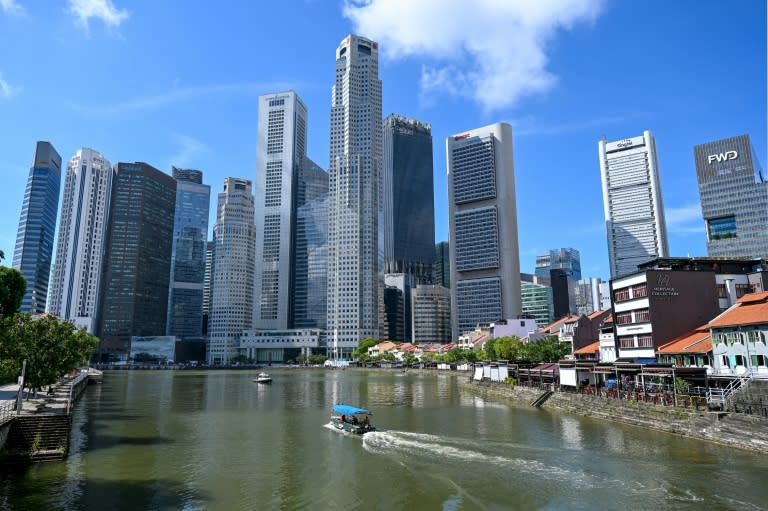

When is a Chinese AI startup not a Chinese AI startup? When it’s based in Singapore, or elsewhere, to distance itself legally and politically from Beijing.
The practice known as “Singapore-washing” is under scrutiny after China blocked a major US acquisition on national security grounds.
China’s top economic planning body said Monday it prohibited the deal between Facebook owner Meta and the Chinese-developed, Singapore-based artificial intelligence agent tool Manus.
That came after a report said two Manus co-founders were prevented from leaving China during a review of the deal.
Here, AFP examines what that means:
– What is Singapore-washing? –
Firms move abroad “who seek a combination of funding overseas, a laxer regulatory environment, or to appeal to a global customer base without an explicitly Chinese image”, said Wendy Chang at the Mercator Institute for China Studies (MERICS).
“Beijing has heretofore tolerated this practice, but the Manus case marks a major turning point” as the US-China AI race heats up, she told AFP.
The move signals “to its own tech leaders, more than to anybody else, that attempts to bypass national regulation will not be tolerated”.
Other Chinese tech companies in the Southeast Asian city-state include e-commerce giant Shein, and TikTok — a subsidiary of ByteDance, which is still based in China.
Manus shifted operations to Singapore last year, but “it’s unclear whether it has moved the official registration as well, which may give Beijing more leverage”, Chang said.
AFP has approached Singaporean authorities for comment.
– Can the deal be undone? –
Meta and Manus announced the acquisition, reportedly worth around US$2 billion, in December.
Meta said Monday that “the transaction complied fully with applicable law”, and “we anticipate an appropriate resolution”.
The Wall Street Journal later reported, citing people familiar with the matter, that the US giant was preparing to backtrack on its acquisition after the Chinese edict.
“It may be challenging or even impossible to ultimately reverse this transaction,” said Nicholas Cook, a partner at law firm Nixon Peabody CWL.
But for Chinese regulators, “no matter the exact deal structure, sensitive AI technology seen as vital to China’s national interests… has found its way into the hands of a major US tech actor”.
“How much the Manus deal can actually be unwound is, in my view, a secondary issue,” Angela Zhang, a law professor at the University of Southern California, told AFP.