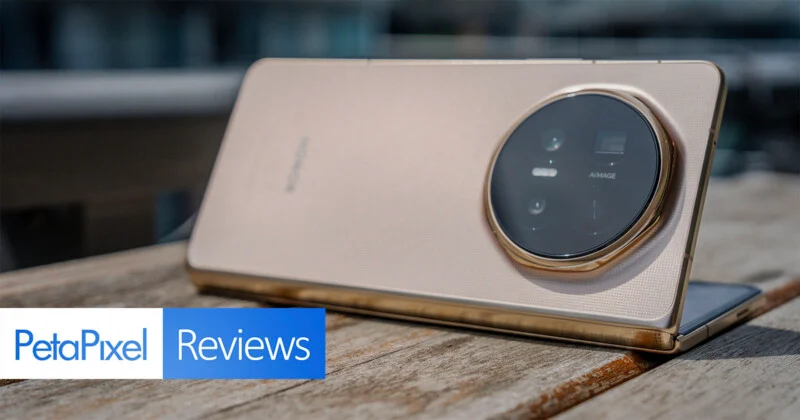
Not everyone needs or wants a foldable phone but if it’s thin and light enough to feel more like a standard smartphone, then is it worth taking the plunge? In many ways, this forms the basis of Honor’s pitch for its foldable lineup, the latest being the Magic V6. Rather than reinvent the category, it simply aims to build off the solid foundation it comes from.
That message doesn’t resonate in North America as much as it does in other markets, especially Asia, where more than half of foldable sales originate. At this point, it’s fair to say that Honor is trying to make the best one on the market, not just the thinnest. In a space where Apple may or may not enter in the near future, it comes off as somewhat of a measuring stick.
Honor Magic V6 Review: Design and Build
I went over some of the design specs when Honor launched the device but I’ve also had it in my hands going back to February 2026. The white variant is 8.75mm when folded closed, which is unusual because the other color variants are both slightly thicker (9mm) and a tad bit heavier (224g vs. 219g).

The reason is that the materials differ between them. The white variant has an Aerospace Special Fiber back cover that’s thinner and lighter by design, allowing it to hit those lower metrics. The gold (my review unit) and black variants use a fiber material, while the red variant (arguably the nicest of the bunch) features a vegan leather finish. Those two material choices ultimately make the difference in thickness and weight.
I didn’t review the Magic V5 here but did test it over a few months in 2025. From a sheer design standpoint, Honor manages to reduce the camera bump in the V6 without sacrificing the existing camera hardware. Hence, thickness for foldable phones, at least on paper, has everything to do with the body itself but camera bumps almost always stand out anyway. This one, less so.
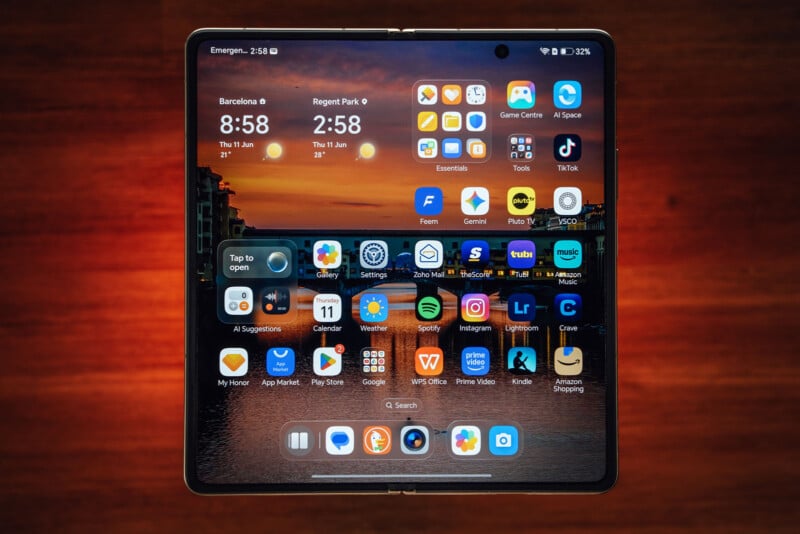
Most changes are incremental, whereas some do make a verifiable difference. The 7.95-inch AMOLED inner display (2172 x 2352) has a better anti-reflective coating this time, and more importantly, a middle crease that is tantalizingly close to being imperceptible. It’s impressive, and something I keep liking more and more as I use it. The 6.52-inch cover screen (2420 x 1080) uses the same coating as well. Both panels support 120Hz refresh rates and offer solid screen brightness. I find the Samsung Galaxy Z Fold 7 gets brighter in daylight conditions but Honor’s can do better than the Oppo Find N6. The Find N6, however, has a flatter crease than both of them.
There’s also stylus support for both screens though you’d have to get one separately — an odd choice for a $1,900 device. Of course, there’s also no built-in holster for it, either. That the Magic V6 has both IP68 and IP69 ratings is a win for durability, and Honor promises improved drop resistance. I didn’t test the latter to find out.
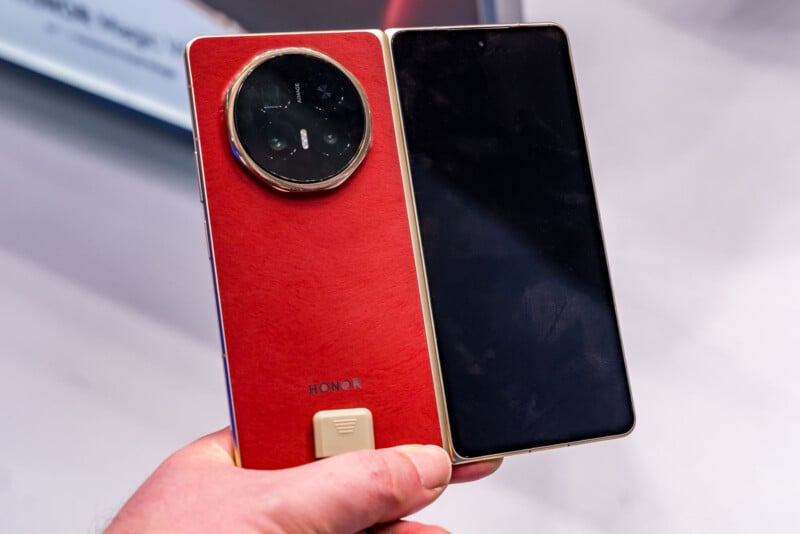
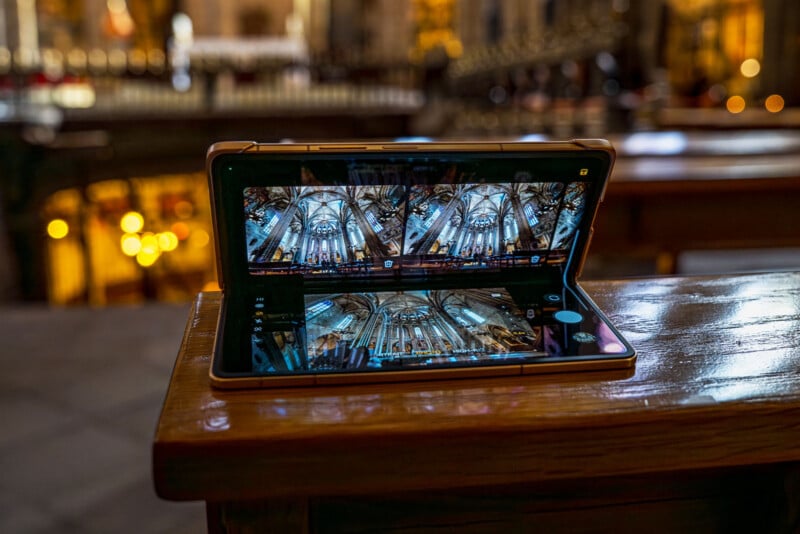
As before, Honor includes a backing plate with a built-in kickstand that can be pretty useful in some camera situations. The only problem it continues to present is that it can get in the frame when using it to rest the upper half while shooting from a bird’s-eye view, though you can often get around that by either trying a 35mm crop for the main sensor or using the telephoto. Interestingly, there’s no front bumper this time, leaving the cover screen a little more exposed.
Honor Magic V6 Review: Camera Features
Honor focused efforts on making changes to the Magic V6 with everything but the camera system. The 50-megapixel main wide lens (23mm equivalent) uses the same Sony IMX906 Type 1/1.56 image sensor and f/1.6 aperture with OIS. The 50-megapixel periscope telephoto (70mm equivalent) uses an OmniVision OV64B Type 1/2 sensor and a slightly wider f/2.5 aperture this time. Rounding things out is the 50-megapixel ultra-wide (13mm equivalent) uses an OV50D Type 1/2.88 sensor and f/2.2 aperture with a 122-degree field of view. Like the main camera, both of these also have OIS and autofocus. Both front cameras also retain the same 20-megapixel sensor.
With not much of a new story to tell on the camera side relative to the V5, Honor plays up that this phone has an “industry-leading” CIPA 6.5-stop image stabilization for sharper photos and more stable videos across much of the system. Despite standing pat, Honor might rest on the laurels of a telephoto camera that still sports a larger sensor than the Find N6 and (considerably larger) than the Galaxy Z Fold 7 and Pixel 10 Pro Fold.
Also, without a storied imaging brand to partner with like its fellow Chinese competitors have, Honor maintains its collaboration with Studio Harcourt Paris for the Portrait mode. The rest of the focus on the software side actually leans more toward usability and AI-driven features.
Honor Magic V6 Review: Seeing Double
MagicOS 10 brings a range of foldable-specific capabilities that genuinely make the large inner display feel purposeful. The Fast-Flex feature allows split-screen and app-snapping with a single fold gesture, streamlining the kind of multitasking the format is meant to excel at. I like how app continuity sees the interface cleanly transition from the cover screen to the inner display when unfolding.
I’m just not sure why Honor has an aversion to letting users keep a second app open next to the camera in split-screen. The best you can do is dragging up said second app from the task bar at the bottom of the screen and using it as a floating display. Try to expand it to cover half the inner display, and it ends up taking over the whole thing. It’s an odd user interface decision that I don’t personally like because it forces concessions at inopportune times.
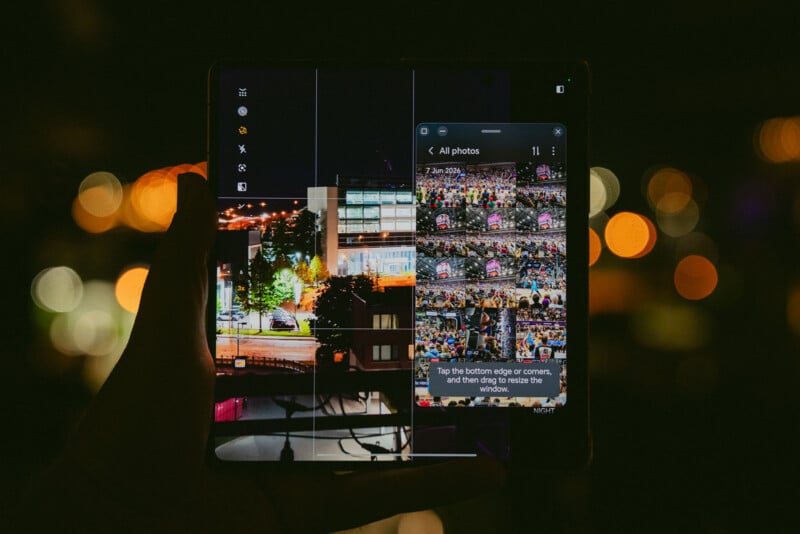
For instance, I sometimes like to have the Gallery app or Lightroom open next to the camera app to compare images in real time, but in this case I have to view images in either app through a small floating window. Fortunately, some third-party apps are more forgiving that way, like VSCO, Varlens, Snapseed, ProShot, Open Camera, and Lightroom.
There are decent multitasking capabilities, including having two imaging or editing apps open, but it’s not as simple as, say, dragging a photo from Gallery to Lightroom and kicking off the editing process from there. Even more so, if I start editing in Gallery first, save the image, and then try to move it to Lightroom, I have to do it through the sharing options.
That’s all well and good, especially since it’s easier to transfer files over to other brands’ devices — including Apple’s — but it adds steps within the Magic V6 that feel unnecessary.

On the AI side, AI Color is a feature I previously tested when reviewing the Honor Magic V8, which allows you to apply a palette color effect based on any of three presets Honor offers, or from photos you already shot yourself. The rest of the Magic Retouch AI suite sticks with options like AI Eraser, AI Upscale, AI Cutout, AI Outpainting, and AI Style. They all generally work the same as they have before, with varying results.
On the camera side, Honor streamlines the interface by cutting some of the modes, with Aperture, Movie, Stickers, and Story all gone this time. I’m not sure any of them are a big loss but their removal focuses more features and performance on what’s already there, which is plenty.
Honor Magic V6 Review: Image Quality
I’m including photos from the Magic V5 here because the results essentially mirror what the V6 will deliver. This phone’s rear camera system prefers daylight shots, producing punchy, vibrant shots regardless of whether you use the Vibrant, Natural, or Authentic base styles. Peek more closely at the images, and you notice an odd mix of smooth and coarse, gritty textures. Depending on the image, it can come out looking bad, whereas it’s fine otherwise — all of which hints that the imaging pipeline still has room to mature.


Context matters, and as far as foldable phone cameras go, there’s good stuff happening here. Dynamic range is pretty good given the limits of the sensors, and with enough ambient lighting, low-light shots can deliver solid results under the circumstances. You run into challenges when trying to push the envelope, like using the Light Painting (long exposure) mode in night situations or trying to freeze action with Motion Sensing enabled, which creates a noisy mess without the brightest light, but I’m also not terribly surprised that I hit a ceiling with those conditions.


By foldable standards, this still makes the Magic V6 a stalwart. One of the great things about using a foldable for photos is the ability to apply perspective more effectively. Majestic shots are the easiest since you just place the bottom half down and tilt the other half to frame the subject. Moving the live preview to either side makes composition a lot easier without contorting your body to see what the camera sees.

This benefits the ultra-wide camera more than any other but it has its moments with the main and telephoto ones as well. More broadly, the telephoto maintains consistency with the main camera in that colors and tones won’t shift wildly when switching between them. Granted, a tighter aperture might require some adjustments but you always have exposure compensation and manual focus close by under the settings pane at the top right.

Portrait mode still feels unique because of the Studio Harcourt integration, though Honor hasn’t added or really adjusted anything with it since bringing it into the V3. This is where the telephoto can come in extra handy as well, given the nice creamy bokeh and subject separation the processing can give you. It also remains an interesting tool to use for street photography.
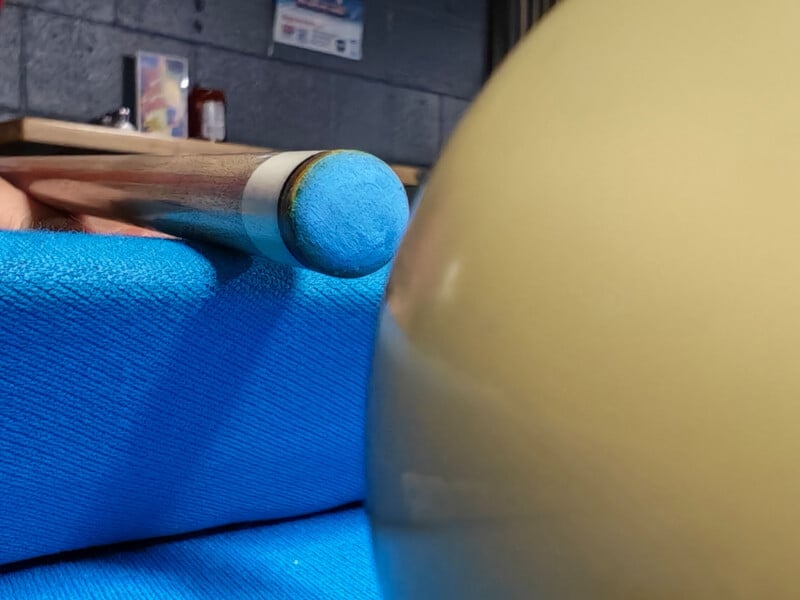
I also like the telephoto for its macro ability to get close to subjects without losing detail at roughly 15cm. There is a Super Macro mode that only uses the main sensor (with a 2x crop as well) but if you want to avoid the wider-angle perspective, the telephoto lens offers a solid alternative at both native 3x optical and 6x crop (140mm equivalent).
Honor Magic V6 Review: Pro and High-Res
Manual controls in Pro mode are what you’d expect, only you can’t shoot in RAW at full resolution. Only JPEG-L lets you do that in Pro, which is a letdown, especially since High-Res mode gives you another way to capture JPEGs at full-res. I tried using Pro mode to capture action shots instead of using Motion Sensing with the regular Photo app and results leave plenty to be desired. Part of the reason is shutter lag but the biggest issue is simply that the sensor isn’t big enough to handle faster scenes.


Additionally, High-Res mode is a little surprising in that it doesn’t always look like it captures more detail relative to the standard pixel-binned 12.5-megapixel photos the phone normally captures.
Honor Magic V6 Review: Video Features
Much like still photos, Honor didn’t tinker much with the video side, either. The Magic V6 can record in 4K at 30 or 60fps with any of the rear cameras, leaving out 24fps as an option. To get that, you have to use Pro mode, switch to video within it, and then select Log to finally unlock that frame rate. The included LUTs are all the same as before, though you have the option to use those LUTs for non-Log footage, too. The problem with the LUTs is that, even having 24fps as an option, choosing one relegates you down to 1080p. The best move is to shoot in straight-up Log and color grade later.
Log lets you choose between 24, 30, and 60fps but you have to switch to (non-Log) Slo-Mo mode to capture anything in 120fps. Overall, the footage isn’t bad, with solid colors and a vibrant dynamic range, but you may find inconsistencies when tracking a moving subject or whilst moving yourself.
Honor Magic V6 Review: Still One of the Best
It’s a testament to just how slowly foldables evolve on the camera side that the Magic V6 is easily one of the best folding phones despite recycling the same camera hardware. It’s indeed true that this isn’t the category representing any sort of imaging arms race, but Honor’s work here feels far ahead of the Samsung Galaxy Z Fold 7 and Google Pixel 10 Pro Fold. We’ll see what those two companies have in store in 2026, but it says something about how much of an afterthought photography is for these device types.

The Magic V6 is also $300 cheaper than its predecessor in USD, so that’s moving in the right direction. Not bad, too, when considering it’s also one of the best-looking foldables out there today. Elegant and tasteful, it feels like any other slab phone in hand and in a pocket, while the multitasking and entertainment value from the inner screen is easy to like.
While I would like to see a greater stride on the camera side here, I can also understand the business case for not doing it given what the V5 costs. It also doesn’t hurt that Honor benefits from a pretty stagnant competitive landscape in that regard.
Are There Alternatives?
Given the Magic V5 is so similar on the camera side, it may be a cheaper alternative with a very close user experience. The Oppo Find N6 is probably the closest competitor from both a camera and UI standpoint since ColorOS is, in my opinion, more polished than MagicOS. Oppo also manages to make its device thin, light, and packed with a 6000mAh battery.
The Magic V6 is no slouch — it has a bigger 6660mAh battery inside. For context, that’s massive compared to the Galaxy Z Fold 7’s 4400mAh and Pixel 10 Pro Fold’s 5015mAh battery. Couple that with faster charging (up to 80W wired, 66W wireless) and better camera output than those two, and Honor has a serious player here.
In North America, where pickings are slim, the Motorola Razr Fold is a standout that may eke out a place for curious consumers. It arguably delivers better productivity and multitasking than Samsung or Google, and offers stronger battery life and camera performance to boot.
Should You Buy It?
Yes, if you missed out on past Honor foldables or want the best of both worlds: a foldable that feels like a standard slab most times. It’s well made and offers a unique experience that most other brands can’t fully match.