Hong Kong is inching closer to welcoming its first listed alternative investment fund with the territory’s financial watchdog proceeding with several more advanced applicants.
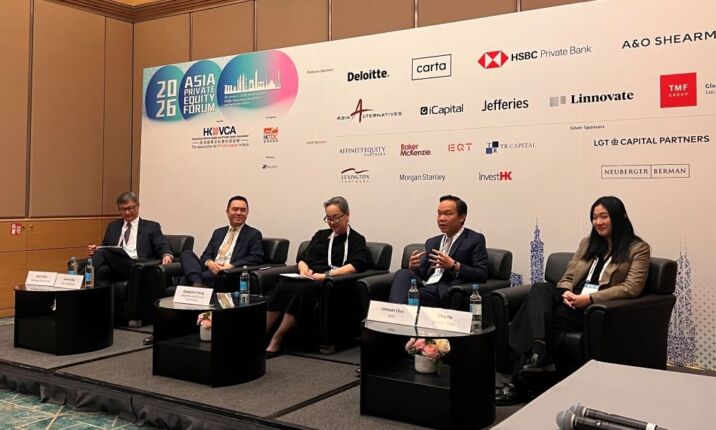
Speaking at the Hong Kong Venture Capital and Private Equity Association 2026 Asia Private Equity Forum last week, Alexandra Yeong, interim head of investment products at the Securities and Futures Commission, said the regulator has met with over 30 interested entities so far. “[We] are working with several potential applicants who have put forward more advanced product proposals. Most of these proposed funds focus on private credit, private equity or some with a combination of both.”
Following the administrative region’s 2024 Policy Address to broaden PE fund distribution, the SFC in February 2025 confirmed that closed-end alternative investment funds were permitted to list on the Hong Kong Stock Exchange. Subsequently, the Mandatory Provident Fund Schemes Authority – which regulates about HK$1.55 trillion ($198.5 billion; €166.4 billion) in retirement assets – permitted the inclusion of these trusts in pension portfolios.
According to the SFC’s circular on listed alternative asset funds (LAFs) released last February, funds seeking to list on the Hong Kong exchange must have an expected market capitalisation of at least HK$780 million and be able to generate regular income streams. An industry source close to the matter told Private Equity International in May that traditional buyout strategies could find it easier to gain approval in the initial stages because they are perceived as less risky.
Traditional buyout funds, however, may not generate “regular income streams” like other products, such as private credit funds. SFC’s Yeong pointed out that the regulator will maintain a bit of flexibility and take into account the nature of various asset classes.
“We do appreciate that there are certain strategies which will not be able to generate regular distributions, so even for private equity, that might not be possible,” she said. The key, she added, is to understand the underlying assets in the strategy and why it’s not able to pay dividends.
Buyout funds may not be the most straightforward fund type to start with, she said.
“For the initial batch, we would really very much like to see the more plain vanilla types of private market assets,” she said, noting that it is important to offer “easily understandable” strategies for retail investors in the initial round to build public confidence and branding for the listed alternatives fund label.
“Managers should really consider all the relevant factors and how they construct the investment portfolio, ensure that it’s well diversified, appropriately structured and also avoid assets which may be excessively risky or complex for retail investors, such as having defaulted loans or capital relief trades,” Yeong added.
Only managers with a presence in Hong Kong and with experience in managing LAFs are eligible to list on the exchange. Speaking on the same panel, Jeremy Ong, partner at Baker McKenzie, said that not many managers would have experience in offering listed PE funds and one option is to bring on relevant personnel with the experience and pre-vet them with the SFC if needed.
“One other area about designing the fund is just on the features of the fund itself… Will there be a fixed regular distribution, irregular distribution variable?” Ong said. “Again, it depends on the strategy and then we can work with the SFC and the applicant in terms of what distribution policy may be suitable for that particular strategy.”
Ong is advising Sequoia Investment Management Company Credit Asia-Pacific on the manager’s application with the SFC to list SIMCo Infrastructure Private Credit OFC, according to the law firm’s website. SIMCo is an infrastructure debt specialist headquartered in London, independent from US venture capital firm Sequoia Capital. The manager listed credit fund Sequoia Economic Infrastructure Income Fund (SEQI) on the London Stock Exchange in 2015 and had total net assets of about £1.5 billion ($2.1 billion; €1.7 billion) as of 28 January, according to the Association of Investment Companies.
Yeong noted that the SFC looks forward to welcoming the first LAF issuer which will happen “hopefully soon”. She added that managers should also put effort into marketing and investor education to adequately communicate risks and key features of LAFs. “It is really essential for the investors to be able to assess their circumstances, their liquidity needs and investment concentration,” she said. “They should not be committing all or a significant portion of their investment into one particular fund.”