In the Capital Connectors series, exclusive interviews with six influential Chinese and global bankers reveal the opportunities and challenges for Hong Kong in its evolution as an international financial hub.
Hong Kong has become the fundraising venue of choice for Chinese technology giants, surpassing the US thanks to growing liquidity, market reforms and proximity to their home market, according to a senior banker at Goldman Sachs.
With Chinese technology firms being a clear focus of international investors and expanding globally, Hong Kong would continue to be a “big beneficiary”, said Jacky Leung, the bank’s head of Hong Kong coverage and co-chief operating officer of the technology, media and telecom group for Asia excluding Japan.
Do you have questions about the biggest topics and trends from around the world? Get the answers with SCMP Knowledge, our new platform of curated content with explainers, FAQs, analyses and infographics brought to you by our award-winning team.
“Hong Kong remains the first and most important destination for Chinese companies to access offshore capital and expand globally, a trend we believe will continue,” he said.
The percentage of Chinese stocks in the portfolios of US and European investors had returned to the high single digits, edging closer to the peak of around 13 per cent in 2021, according to Leung.
“They are making money out of their investments, suggesting a healthy capital market,” he said.
The MSCI China Index and Hong Kong’s Hang Seng Index have gained more than 30 per cent this year.
“That shift has been supporting the market rally, and we are still seeing the inflow of capital coming in, supporting the case for a sustainable market rally,” Leung said, also noting the increasing presence of Middle Eastern investors. Last month, a delegation from Qatar joined Goldman’s inaugural Asia Leaders’ Conference in Hong Kong, which attracted 2,000 participants, including leadership from Tencent Holdings, Baidu and Xiaomi.
Hong Kong’s growing role as a global financing hub for Chinese tech firms has come amid US-China trade tensions and the DeepSeek moment – when the Hangzhou-based start-up shocked the world with a low cost artificial-intelligence model that cemented China’s technology capabilities and policy support.
“The US-China dynamic will not go away overnight, and Hong Kong will continue to serve as a gateway for China to springboard into the rest of the world,” Leung said.
Large tech companies would likely lean towards Hong Kong for listing and fundraising due to the liquidity they could tap into, while mid-sized firms would remain open-minded, depending on the geopolitical environment, he said.
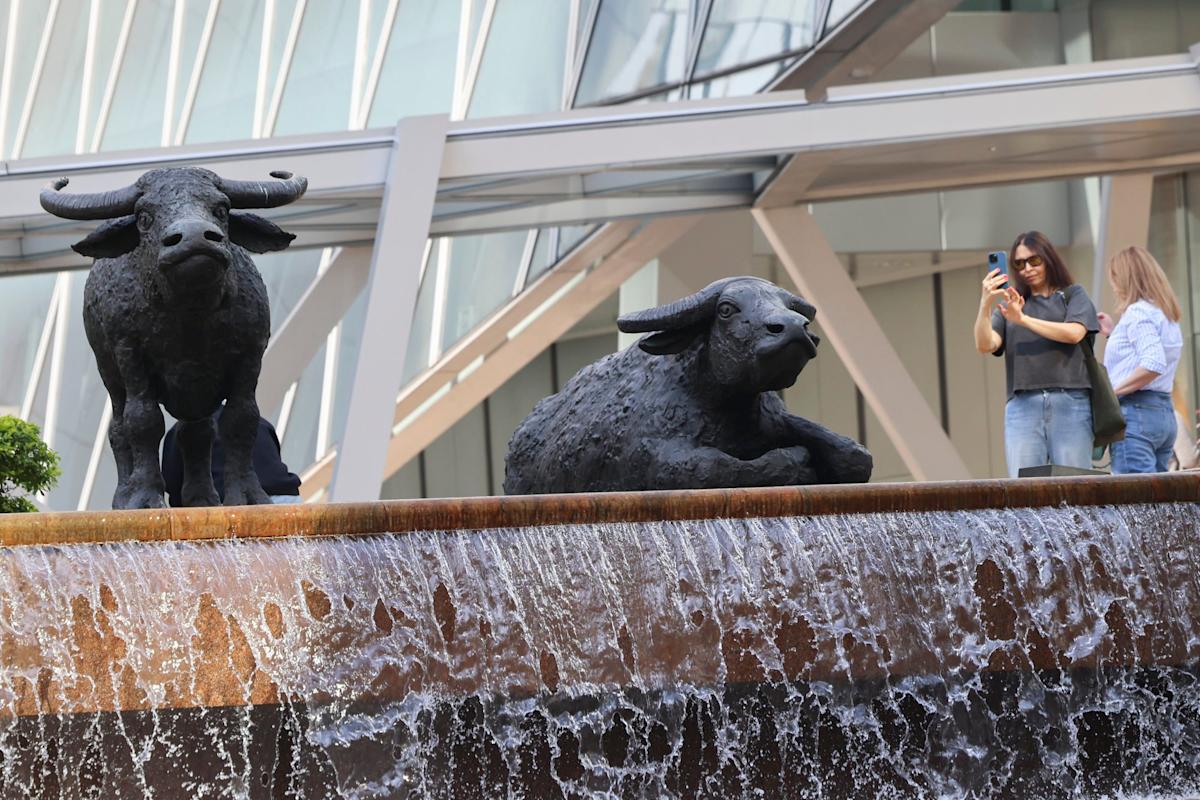
A view of the plaza outside Exchange Square in Central, the home base of Hong Kong’s bourse operator, on January 9, 2025. Photo: Jelly Tse alt=A view of the plaza outside Exchange Square in Central, the home base of Hong Kong’s bourse operator, on January 9, 2025. Photo: Jelly Tse>
Last month, Horizon Robotics, a maker of artificial-intelligence chips that power autonomous driving systems, announced a US$815 million top-up share placement in Hong Kong, its second such financing in three months.
While companies should stay flexible and choose a venue that suits their situation, Leung said Hong Kong’s market characteristics and liquidity were now comparable to those of the US, which has long been a preferred listing destination for many tech players.
“Hong Kong’s liquidity is getting better and will continue to get better because of the funds coming in to trade in a market closer to the issuer and waves of Hong Kong [listings],” he said. “The Hong Kong market is scalable to Chinese tech firms.”
Investors were able to react to news regarding Chinese companies immediately in Hong Kong, according to Leung.
Meanwhile, Leung said a slew of mainland-traded Chinese market leaders pursuing second listings in Hong Kong – the so-called A-to-H trend, referring to the initials used to denote mainland and Hong Kong shares, respectively – helped attract investors and provide valuation references for more companies across the spectrum, from semiconductors and industrial to electronic hardware, software and consumer products.
“There will be more yardsticks of each subsector being traded in the Hong Kong market, which leads to valuation guidance for investors,” he said.
In the first half of this year, 47 mainland-listed companies filed listing applications with the Hong Kong stock exchange, compared with only five in 2024, according to KPMG. At least 43 of the A-share applicants have market capitalisation exceeding 10 billion yuan (US$1.4 billion), the consultancy said in a report.
The ongoing trend benefited from recent reforms by bourse operator Hong Kong Exchanges and Clearing (HKEX), which reduced public float requirements and streamlined listing procedures, making it easier for A-share companies to pursue dual listings and calibrate liquidity between the markets.
Other reforms that have helped attract tech firms include listing relaxations for pre-revenue technology companies, the introduction of a weighted voting-rights structure – a popular design for many tech founders who tend to own small but controlling stakes in their companies – and HKEX’s promotion of gender diversity with a policy banning all-male boards.
“Tech companies will continue to benefit from all the reforms taken by HKEX because they value diversity and liquidity,” Leung said. Ultimately, those that are still solely listed in mainland China or the US will likely be dual-listed in Hong Kong because “the city has become a market by choice for tech companies”.
A primary listing in Hong Kong also provided access to the Hong Kong-mainland Stock Connect scheme and stronger trading focus from investors, Leung said.
“With relatively lower transaction costs, favourable HKEX policies, and the advantage of being closer to the home market, Hong Kong offers clear advantages over the US for Chinese companies,” he said.