

Quick overview
- Gold (XAU/USD) has declined following the FOMC’s hawkish guidance and a rate hike to 3.75%-4.00%.
- The U.S. Dollar has strengthened against major currencies, limiting gold’s upside potential.
- Falling oil prices may alleviate some inflation pressure, providing slight relief for gold prices.
- Despite short-term challenges, long-term fiscal risks could support higher gold prices.
Gold (XAU/USD) has dropped following Federal Open Market Committee (FOMC) guidance last week, with the Fed Funds Target range increased to 3.75%-4.00%. The FOMC provided no surprises with the rate hike, however, the guided commentary noted a more hawkish outlook on the Fed’s policy towards interest rates. Gold is currently trading in the mid-$1,900’s, and the U.S. Dollar has appreciating against most major currencies.
With the September Fed meeting’s rate hike priced in by markets, the focus has shifted to the outlook for future hikes. Oil prices have been falling, which may prevent the Fed from enacting a more restrictive monetary policy.
Fed Delivers the Hike, but the Guidance Is the Bigger Story
Prior expectations of the FOMC’s tightening policy were for a terminal rate of 3.5% to 3.75%. Wednesday’s unexpected change in Fed policy saw a majority of the FOMC members agree that the policy Funds rate would need to rise further to restrictive policy territory. Kevin Warsh commented that the recent 25 bps hike removed “a dose of accommodation” from policy. With the FOMC removing the rate increase in September from market uncertainty, the focus is now on how much the FOMC will further tighten going forward. The CME Group is assigning a 50% probability to the Fed Funds rate hitting the 4.25%-4.50% range in October.
According to Goldman Sachs, further rate hikes are likely in October, and Bank of America suggests there is potential for rate hikes in both October and December. Markets are estimating about a 50% chance of a 0.25 percentage point increase in October. This caps the upside for gold and couldcap limit potential upside for a prolonged period of time. A 0.25 percentage point increase would be less bearish for gold. Instead, gold will likely remain lower for longer. The greenback’s rise makes gold more expensive for other nations and increases the opportunity cost of holding gold. A rebalancing of gold holdings is unlikely in the short-term.
Dollar Jumps to a Seven-Week High
Dollar is expected to appreciate further against other currencies in the near term. Dollar Index climbs above 100 for the first time in a month, after FOMC signal more hawkish policy. Traders expect a second successive 0.75% rate hike in November. 2-year US Treasury yields spikes to 4.72%, the highest since December 2007. Combination of higher US short term interest rates and a strong dollar will limit upside in gold prices. Monetary policy tightening is always positive for the dollar and negatively affects gold prices. Post-Fed gold prices tend to be volatile. After initial volatility post-FOMC, gold prices tend to fall.
Oil Pullback Gives Gold Some Relief
That said, recent fall in oil prices will help dampen inflation and ease some pressure on the Fed. Reuters reported that gold prices rise as Fall in oil prices eases some pressure on inflation. Higher inflation expectations and interest rate hikes have a negative impact on gold prices. Fall in oil prices eases some of that pressure on the yellow metal. That is important because oil is one of the main pathways to transmit risks from the Middle East to U.S. monetary policy. Although lower oil prices can help ease inflation, gold’s path to rising prices becomes more attractive.
Fiscal Risk Still Supports the Bigger Bull Case
The bigger picture and the long-term framework also point to higher gold prices. The U.S. budget and debt ceilings, along with uncertainty in other areas, will also probably continue to support the price of gold. Of course, in the short run, other factors may not be as supportive of gold prices. Warsh believes that the recent increases in U.S. bond yields show that the markets believe that the Fed can achieve its policy goals of full employment and price stability. Warsh is of the view that the recent increase in U.S. bond yields shows that investors expect a strong U.S. economy and higher levels of U.S. capital spending.
Therefore, Warsh believes that recently higher U.S. bond yields do not indicate that the Fed should change its plan to increase interest rates. Overall, Warsh’s comments support the view that the U.S. economy is likely to remain strong in the short run, which could put downward pressure on gold prices.
Gold Technical Analysis: $4,316 Is the Immediate Test
Gold 2-hour chart price action is showing bullish signs after a bounce from the $4,261 support area. Price is currently trading at $4,312. However, while bullish signs are present, the broader trend is still bearish considering price is still trading below the bearish trendline and the moving averages. Price will need to clear the $4,316 resistance level to confirm more upside. The current trend model is still bearish.
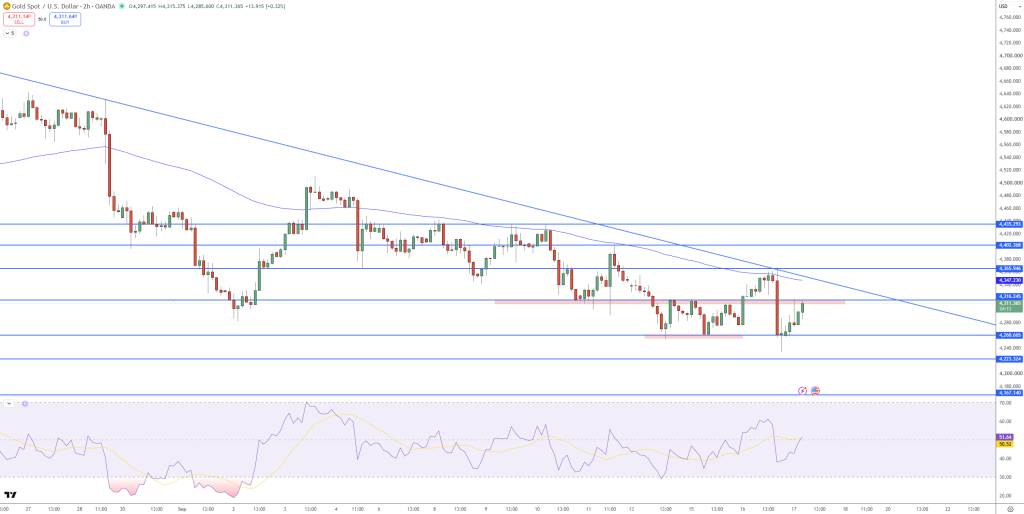
A clear close above $4,316 would bring the next target of $4,347, and then $4,366. Support is expected to be at $4,261. A break below $4,261 would bring the next target of $4,223, and then $4,167. Momentum has improved, however a full bullish reversal has not been confirmed. The 2-hour RSI is currently at 52.
- Current resistance levels: $4,316, $4,347, $4,366, $4,402
- Current support levels: $4,261, $4,223, $4,167
Generally bearish below $4,316. A close above $4,347 would bring a bullish outlook. A close below $4,261 would increase the likelihood of further downside.
Frequently Asked Questions
Why is gold rebounding after the Fed hike?
Gold is getting a reprieve after the defense of the $4,261 area, even as the Fed kept its hawkish outlook.
Is the Fed likely to hike again?
There is around a 50% chance the Fed raises rates in October.
What is the key XAU/USD resistance?
The immediate level is $4,316. A sustained break above it would expose $4,347, then $4,366.

Arslan Ali Butt
Lead Markets Analyst – Multi-Asset (FX, Commodities, Crypto)
Arslan Ali Butt serves as the Lead Commodities and Indices Analyst, bringing a wealth of expertise to the field. With an MBA in Behavioral Finance and active progress towards a Ph.D., Arslan possesses a deep understanding of market dynamics.
His professional journey includes a significant role as a senior analyst at a leading brokerage firm, complementing his extensive experience as a market analyst and day trader. Adept in educating others, Arslan has a commendable track record as an instructor and public speaker.
His incisive analyses, particularly within the realms of cryptocurrency and forex markets, are showcased across esteemed financial publications such as ForexCrunch, InsideBitcoins, and EconomyWatch, solidifying his reputation in the financial community.
