Unlock the Editor’s Digest for free
Roula Khalaf, Editor of the FT, selects her favourite stories in this weekly newsletter.
Global bond markets dropped on Monday after the Bank of Japan signalled that it could raise interest rates later this month.
Japan’s two-year government bond yield, which is particularly sensitive to rate expectations, jumped above 1 per cent for the first time since 2008 on Monday after Bank of Japan governor Kazuo Ueda indicated that the central bank might raise interest rates this month. Longer-term debt also fell, with the 10-year yield up 0.07 percentage points to 1.87 per cent.
The jump in Japanese yields, which move inversely with price, rippled through global fixed income markets, sparking steep declines from Germany to the US.
US Treasury yields on Monday recorded their biggest daily rise in a month, with the two-year rising 0.04 percentage points to 3.52 per cent as traders scaled back expectations of interest rate cuts in 2026. The benchmark 10-year yield rose 0.07 percentage points to 4.08 per cent. The 10-year German Bund yield climbed 0.06 percentage points to 2.75 per cent.
“Global bonds are feeling the butterfly effect following the Bank of Japan’s hawkish signal to prepare for a December rate hike. One central bank across the world just decreased additional rate cut odds in 2026 for the US,” said Matt Miskin, co-chief investment strategist at Manulife John Hancock Investments.
Traders in the US futures market pulled back expectations of interest rate cuts in 2026, with three or four priced in by next December. Expectations, however, of a rate cut this month rose modestly and a quarter-point decrease is now fully priced in by the market.
The global move in bonds also reflected the possibility that with access to higher-yielding bonds at home, Japanese investors may bring cash back home, decreasing demand for foreign government bonds.
“The more it becomes clear that Japanese rates . . . are normalising, the higher the probability that Japanese investors begin to repatriate funds from foreign bond markets or at the very least buy fewer foreign bonds, removing a key source of international finance at a time when sovereign issuance is surging,” said Michael Metcalfe, head of macro strategy at State Street Markets.
Japan’s yen also rallied around 0.7 per cent against the US dollar to ¥155.1 as traders sharpened bets on higher rates.
Investors are bracing themselves for a string of US economic data this week, including ADP payrolls figures, ahead of the Federal Reserve’s decision on interest rates on December 10.
Also on Monday, US stocks dropped, led lower by tech companies, as investors scaled back exposure to risky assets. Wall Street’s tech-heavy Nasdaq Composite index was down 0.7 per cent in mid-morning trading and the S&P 500 weakened 0.6 per cent.
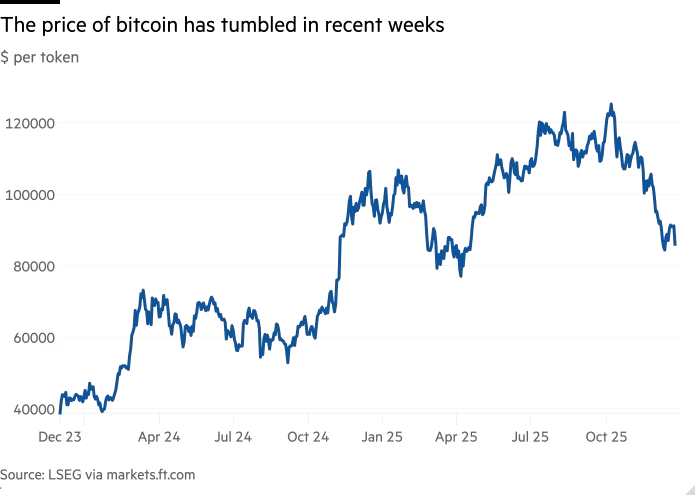
Bitcoin was also under pressure, falling 7 per cent and taking the cryptocurrency’s drop over the past month to more than 20 per cent.
The downbeat start to December follows a shaky November for tech stocks, which broke their monthly winning streak as concerns grew over the valuation of artificial intelligence companies.
Analysts said that the sliding bitcoin price was hurting sentiment across other risky assets, including tech stocks.
“Today’s pullback in equities is correlated with the strong dip in crypto assets,” said Max Kettner, chief multi-asset strategist at HSBC, adding that the correlation between cryptocurrencies and other risky assets such as stocks has been a theme of recent trading sessions.
Kettner added that “beyond near-term sentiment, we have very strong doubts about any causal relationship between crypto and equities . . . [crypto] has no bearing on the inflation, rates, growth or earnings outlook.”
European stocks also fell on Monday. The Stoxx Europe 600 was 0.3 per cent lower by mid-afternoon trading, and Germany’s Dax dropped 1 per cent.