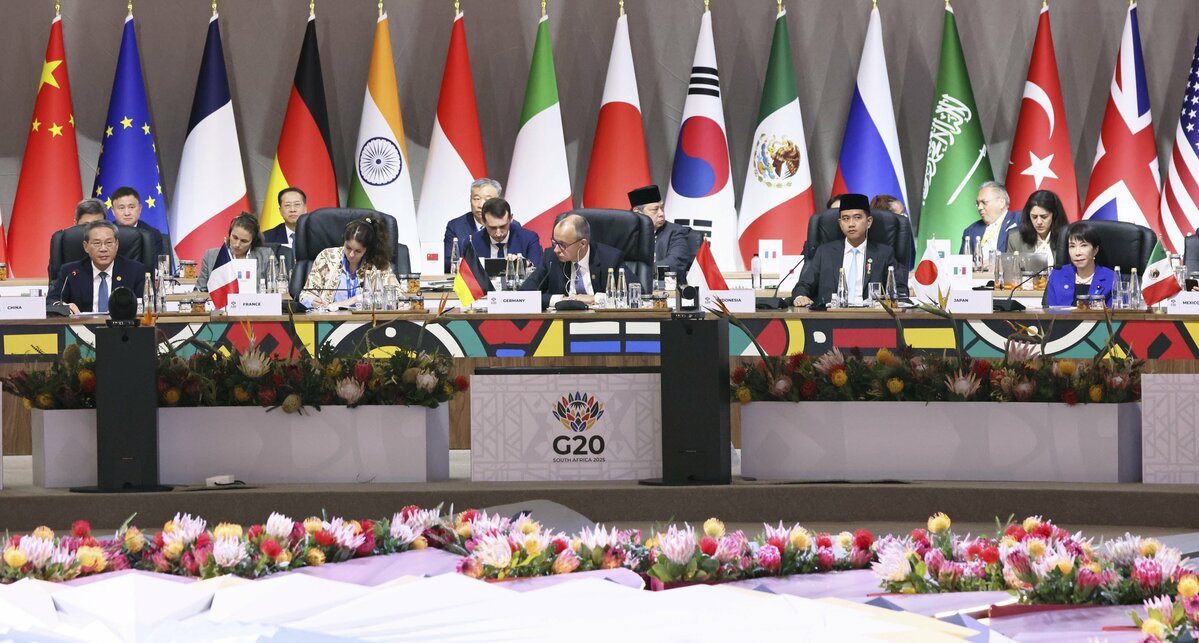
JOHANNESBURG – The Group of 20 economies confirmed the importance of all members sharing responsibility and advancing concrete cooperation to address global challenges, Prime Minister Sanae Takaichi said Sunday, even as Japan and China remain at loggerheads over Taiwan.
Her remarks came after the G20 countries wrapped up their first summit in South Africa, barely preserving the relevance of a multilateral framework under pressure from U.S. President Donald Trump, who did not attend the gathering.
Takaichi, making her G20 debut, joined other leaders, including Chinese Premier Li Qiang, in efforts to prevent a breakup of the forum tasked with tackling challenges, from Trump’s tariffs hitting members to climate change and geopolitical risks.
But she faces a deepening rift with China after her comments on a possible Taiwan contingency — the renegade province Beijing seeks to reunify with the mainland — drew a strong backlash, stalling a recent thaw in bilateral ties that have benefited partly from Sino-U.S. rivalry.
While Trump, Chinese President Xi Jinping and Russian President Vladimir Putin were absent from the annual G20 summit in Johannesburg, Takaichi, a pro-Taiwan lawmaker who took office on Oct. 21, underscored the need for a rules-based international order.
“Japan will continue to work closely with the other G20 members, including next year’s chair, the United States, and will actively contribute to dealing with the various challenges facing the international community,” Takaichi told reporters after the summit.
Tokyo and Beijing are aiming to boost relations with emerging economies in the Global South. Resource-rich Africa, with its growth potential, is a region where both Asian nations are trying to expand their presence and broaden partnerships through aid and investment.
South Africa, which hosted a G20 summit for the first time, defied pressure from Trump despite mounting concern that the gathering would become the first since the group’s inception to close without an outcome document.
On the first day of their two-day summit, the G20 members adopted the leaders’ declaration, prompting South African President Cyril Ramaphosa to stress it “sends an important signal to the world that multilateralism can and does deliver.”
The bilateral spat between the two Asian powers, meanwhile, has shown signs of spilling over onto the global stage, with Beijing attempting to build a coordinated front with emerging countries to push Takaichi into a corner.
During their talks on Saturday, China’s Li and Ramaphosa confirmed support for each other’s country on issues concerning their core interests, with Taiwan in mind, in a counter to Japan. Takaichi said she did not have contact with Li on the sidelines of the summit.
China is also moving to use the United Nations, a symbol of multilateral cooperation that Trump has snubbed, with its ambassador reportedly sending a letter to U.N. Secretary General Antonio Guterres demanding that Takaichi retract her remarks on Taiwan.
On Nov. 7, Takaichi said a Taiwan emergency involving the use of military force by China could constitute a “survival-threatening situation” for Japan, possibly allowing it to exercise the right of collective self-defense to support the United States.
Takaichi will conclude her visit later in the day and return to Japan on Monday.
