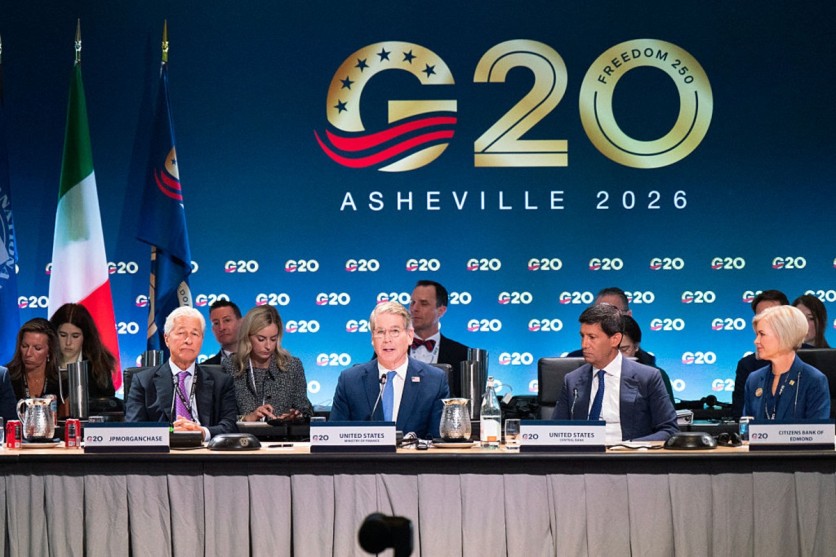

The finance ministers who concluded their two-day Asheville summit Tuesday left with a statement that officially welcomes artificial intelligence investment as a global growth driver — and quietly declined to adopt the specific governance framework their own watchdog said was necessary to make that investment safe. The G20 Chair’s Statement, signed by 19 of 20 members with China as the lone dissenter, endorses AI investment and productivity while deferring the Financial Stability Board’s frontier AI cyber-risk mandate to a nonbinding October paper — a gap between political ambition and regulatory readiness with direct consequences for every financial institution building AI systems under the G20’s newly declared mandate. FSB Chair Andrew Bailey’s pre-summit warning on frontier AI had explicitly identified model-release governance as the machinery most jurisdictions lack.
China Broke Consensus — and Bessent Named It Publicly
When US Treasury Secretary Scott Bessent took the outdoor terrace stage at Asheville’s Omni Grove Park Inn Tuesday afternoon, he departed from diplomatic convention immediately. Asked who had blocked the unanimous communiqué that the US had sought, he named the country directly. “Well, it is clear that the country with the world’s largest and unsustainable current account surplus, People’s Republic of China, was the dissenter,” he told reporters at summit’s close.
The Chair’s Statement — technically a US-authored document recording where 19 of 20 members could agree, rather than a unanimous communiqué — carries a footnote specifying that China objected to paragraphs 4, 10, 11, and 13. Those four paragraphs addressed disruptions to energy and trade that hinder global growth, the requirement that countries eliminate non-market policies exacerbating trade imbalances, the IMF’s mandate to strengthen surveillance of macroeconomic imbalances, and the Common Framework for sovereign debt restructuring.
The imbalances language China rejected was specific. Paragraph 10 of the statement states that “countries with excessive and persistent external surpluses should remove distortions that constrain domestic consumption and that result in an overreliance on exports for growth.” The language does not name China, but Bessent’s press conference did. He described the 19-to-1 alignment as evidence of the problem’s scale rather than a diplomatic setback: the fact that even 19 countries could agree was, in his framing, a measure of how unsustainable the current equilibrium had become. The other G20 members, he said, would take action in the coming “days, weeks or months” to resolve the imbalance.
India’s alignment with the US position meant the split was not the East-versus-West fracture that has paralyzed prior G20 gatherings — it was China standing alone against a bloc that included major developing-world economies.
FSB Cyber Warning: Endorsed in Part, Deferred in Substance
Three days before the summit opened, Financial Stability Board Chair Andrew Bailey sent G20 finance ministers a letter identifying the most immediate threat to the global financial system. It was not sovereign debt. It was not private credit. It was frontier AI. Bailey’s August 31 letter to ministers identified frontier AI cyber risk as the most pressing systemic danger.
Bailey warned that frontier AI may alter cyber risk economics, which could undermine market confidence system-wide, especially due to highly concentrated third-party service providers. His specific request was twofold: financial institutions should strengthen their resilience planning, and governments should build protocols for the safe release and deployment of advanced frontier AI models — governance machinery that most jurisdictions, he wrote, do not yet have.
The Chair’s Statement ministers signed addressed only the first half of that request. Paragraph 5 welcomed AI investment and digital infrastructure “to increase productivity and enable broad adoption, while recognizing the importance of addressing risks, including potential financial sector and other sector-specific risks, and leveraging AI-enabled innovation to strengthen cyber resilience.” On the question of frontier model-release governance — the protocols Bailey explicitly said most jurisdictions lack — the statement offered paragraph 15: ministers “look forward to finalization of the FSB’s paper on Sound Practices for Responsible Adoption of AI.”
That paper, the FSB’s AI sound practices consultation published in June 2026, is expected to be finalized in October 2026 as a non-binding US G20 deliverable. It is voluntary guidance, not a mandate. The political weight that Bailey’s letter implied a G20 communiqué would provide — the kind that converted FSB’s post-2008 bank capital analysis into Basel III requirements — is absent from the statement’s language. G20 ministers welcomed the investment opportunity that AI creates while leaving the governance tools their watchdog requested in a queue behind an October nonbinding paper.
That gap is the one technology sector readers most need to register. Financial institutions are now operating under a G20-level political signal to expand AI investment — and under an FSB advisory framework that will not produce its final form for another month, and will not be binding when it does. Bessent’s own framing at the opening session reflected the US Treasury’s position throughout: AI is a “general-purpose technology with the potential to have profound effects on the global economy,” and economies that embrace its responsible development “will likely set the pace of global growth in the years ahead.” What counts as “responsible” in frontier AI terms remained for October.
The US has not set an equivalent of the European Central Bank’s October 31, 2026 deadline, under which eurozone bank chief executives are required to submit full AI action plans. No American regulator has established a comparable timeline. The Asheville statement does not change that.
Russia Returns — and Bessent Delivers One Message
The Asheville summit’s most visually striking diplomatic moment came before the Chair’s Statement was signed. Russian Finance Minister Anton Siluanov attended in person — his first G20 appearance since invasion of Ukraine in February 2022. Siluanov has been under US sanctions since April 2022 and has served as Russia’s finance minister since 2011.
His physical presence on US soil — at a conference hosted by the Trump administration — required a sanctions exception and signaled a deliberate decision by Washington to reopen high-level financial contact with Moscow. European allies objected. German Finance Minister Lars Klingbeil said Siluanov’s welcome troubled European allies, and coordinated with other European delegations to leave Siluanov’s delegation out of the traditional group photograph — the “family photo” of G20 finance ministers and central bank governors.
The bilateral that followed was substantive and brief in its essential message. A US Treasury spokesperson confirmed the Bessent-Siluanov discussion focused on Trump’s Ukraine peace plan and economic growth. When Siluanov raised other areas of potential mutual interest, a source familiar with the meeting said, Bessent interrupted and made the US position explicit: “nothing is possible until war ends”, according to multiple sources familiar with the exchange.
Russia’s Finance Ministry read the same meeting differently. Siluanov described it as a first introduction between the two officials: “You know, this was our first meeting with Mr. Bessent. It was on the sidelines of the G20. We got to know each other — that’s positive.” The ministry described a basis for financial relations. Bessent’s characterization, filtered through a source, was considerably less optimistic about the near term.
Bessent also used the Asheville venue to press G20 counterparts on Iran, stating that the US has held quiet conversations with both China and Russia about preventing Tehran from obtaining nuclear weapons and keeping the Strait of Hormuz open. The relevance to technology supply chains is direct: sustained closure of the Strait of Hormuz raises oil prices, feeds inflation, and pressures the Federal Reserve — a sequence that directly affects interest rates for AI infrastructure financing.
Bond Yields, Chip Stocks, and Tech Financing
The macroeconomic environment surrounding the Asheville meeting produced its own simultaneous message. By Tuesday evening, the US 10-year Treasury yield climbed to 4.795%, its highest level since Donald Trump returned to the White House. Japan’s 10-year government bond yield hit a three-decade high, breaking above 3% for the first time in three decades. Long-dated borrowing costs across Europe were pressing toward levels governments had hoped belonged to a different monetary era.
Technology bore a disproportionate share of the equity market’s reaction. Global bond yields’ surge, crude oil’s rise, and Monday’s attacks on a cargo ship in the Strait of Hormuz combined to push the S&P 500 and Nasdaq lower — with the S&P 500 down 0.7% and the Nasdaq Composite down 1% by Tuesday’s close, with chip stocks absorbing the heaviest losses.
Bessent, speaking at the same press conference where he named China, sought to reframe the yield signal. Treasury yields, he argued, reflect growth confidence despite inflation, alongside energy-related inflation pressures he expects to fade. That argument has faced market skepticism: a week earlier, the Druckenmiller-Bessent bond buyback dispute illustrated the gap between Treasury’s framing and the bond market’s own pricing.
The concern that elevated borrowing costs will restrain AI investment is not hypothetical — it is already embedded in market pricing. Private AI infrastructure buildout requires multi-year capital commitments. At 4.79% on the 10-year Treasury, the cost of that capital is at a level not seen during the period when most of the current AI investment cycle was planned.
What the Chair’s Statement Means for Technology Readers
For technology investors, financial engineers, and AI practitioners operating within the financial sector, the Asheville statement’s outputs converge on three specific questions.
AI investment vs. AI governance: G20 finance ministers have now formally welcomed AI investment as a growth driver at the highest diplomatic level — which matters for regulatory and political risk assessments. But that endorsement does not carry with it any binding framework for how AI systems in finance must be governed, what constitutes responsible frontier model deployment, or what liability standards apply when AI-driven systems produce systemic disruptions. Those questions remain open.
Digital assets and cross-border payments: Paragraph 16 of the statement commits G20 members to advance “responsible and effective regulatory and supervisory frameworks that preserve financial stability, support economic growth, and establish clear pathways for sound digital financial and digital assets innovation.” It also reaffirms the G20 Roadmap for Enhancing Cross-border Payments, calling on countries to expand payment infrastructure and ISO 20022 data model adoption. For payments infrastructure engineers and digital asset operators, this represents G20-level political backing for the regulatory frameworks the US Treasury has been building domestically.
Anti-fraud and AI exploitation: Paragraph 17’s FATF AI mandate names the “exploitation of AI by fraudsters” as a specific priority. FATF will host a learning and development forum in Dallas later this year focused on implementing anti-money laundering and counter-terrorism financing standards for virtual assets. For financial institutions with AI-powered transaction monitoring systems, the G20’s FATF mandate signals that AI fraud exploitation will be an active regulatory examination area.
What Comes Next
The G20 Finance track has two more major milestones before 2026 ends: a finance ministers meeting in Bangkok in October, and the G20 Leaders’ Summit at Trump National Doral in Miami on December 14-15 per the Treasury G20 Finance Track schedule. The Bangkok meeting will be the first opportunity to assess whether the 19-to-1 alignment on trade imbalances solidifies into coordinated policy action or dissolves into bilateral negotiation. It will also be the first meeting after the FSB’s October AI sound practices paper is released — giving finance ministers their first formal opportunity to decide whether to mandate what Bailey asked for or leave it as voluntary guidance.
On Russia, Siluanov’s Asheville appearance marks a deliberate shift in US engagement posture that European allies have publicly flagged as problematic. Whether it opens a channel that produces movement on Ukraine, or whether it remains a single symbolic meeting with no follow-on, depends on developments outside any finance minister’s control. The economic normalization Siluanov described as a “basis” for financial relations remains, in Bessent’s explicit framing, contingent on the war ending first.
The Asheville summit selected a city as its venue partly to showcase Hurricane Helene’s recovery. It delivered that, and produced something editorially sharper: a moment in which a G20 finance ministers’ meeting publicly named the world’s second-largest economy as the obstacle to coordinated action on trade imbalances, welcomed artificial intelligence as the world’s primary growth opportunity, and quietly handed the governance question for that opportunity to a nonbinding October paper — all while bond markets registered their own verdict on the macro backdrop.
Frequently Asked Questions
Why did China refuse to sign the G20 statement — and what does that actually mean?
China objected to four specific paragraphs in the Chair’s Statement: the section calling for elimination of distortive non-market practices that exacerbate trade imbalances (paragraph 10), the section strengthening IMF surveillance of macroeconomic imbalances (paragraph 11), the section on sovereign debt restructuring under the Common Framework (paragraph 13), and the section on energy trade disruptions affecting global growth (paragraph 4). Paragraph 10 is the most structurally consequential: it would have committed China, as the economy with the world’s largest current account surplus, to take steps to reduce its reliance on exports and eliminate practices that produce that surplus. China’s refusal to sign those paragraphs does not prevent the other 19 members from acting on them — but it removes China from any coordinated framework for doing so, and signals that Beijing views the language as directed at constraining its economic model rather than addressing a shared problem. The full Chair’s Statement footnote specifying China’s objections is available at the US Treasury website.
What exactly did the G20 say about AI — and what did it leave out?
The Chair’s Statement said two things about AI. First, it welcomed “investment in artificial intelligence, computing, and digital infrastructure to increase productivity and enable broad adoption” — an endorsement of AI investment at the G20 political level. Second, it noted the importance of “addressing risks, including potential financial sector and other sector-specific risks, and leveraging AI-enabled innovation to strengthen cyber resilience.” What it did not say: anything about model-release governance, deployment protocols, or the specific frontier AI cyber risk that FSB Chair Andrew Bailey had identified, three days earlier, as the financial system’s most immediate threat. Bailey had specifically asked G20 governments to build protocols for managing the development, release, and deployment of advanced frontier AI models — a request that the statement deferred to an October FSB paper that will be nonbinding when finalized. Bailey’s August 31 letter is publicly available through the FSB.
Why does the Bessent-Siluanov meeting matter for technology markets?
It matters because Russia’s continued war in Ukraine is one of the structural drivers of elevated energy prices, which are feeding into inflation, which is influencing Federal Reserve rate expectations, which are pushing bond yields to multi-decade highs — and those yields directly affect the cost of capital for AI infrastructure investment. The Bessent-Siluanov meeting signals that the Trump administration is willing to use financial diplomacy to push for Ukraine peace; whether that diplomacy produces results will determine whether one of the most significant macro pressures on technology sector financing eases or persists. Bessent’s stated position — no economic normalization until the war ends — means the channel is open but the conditions for relief remain tied to a conflict that finance ministers cannot resolve. The CNBC account of the Bessent-Siluanov exchange provides further context on the bilateral’s substance.
What should an investor in AI infrastructure stocks take from the Asheville statement?
Two things cut in opposite directions. The favorable signal: G20-level political endorsement of AI investment as a growth driver matters for regulatory risk assessment. When 19 of the world’s largest economies formally declare that responsible AI adoption will set the pace of global growth, the regulatory direction is clear — AI investment will not be politically opposed at the G20 level. The unfavorable signal: the macro environment in which that investment must be financed has deteriorated simultaneously. The 10-year Treasury yield at 4.795%, rising global sovereign yields, and elevated oil prices driven by Middle East conflict mean that multi-year AI infrastructure capital commitments are being planned against borrowing costs significantly higher than those that defined the period when most current AI investment cycles were designed. The governance framework for how those systems must be operated — Bailey’s frontier AI cyber-risk standard — remains nonbinding until at least October, and voluntary after that. CNBC’s G20 market coverage provides the macro backdrop detail.