Former Real Madrid head coach Alvaro Arbeloa’s hiring by Fulham clearly shows that the Spaniard’s turbulent five months on the Bernabeu bench have enhanced, rather than damaged, his managerial reputation.
Arbeloa, now 43, was an emergency appointment by Madrid’s president Florentino Perez in early January, stepping up from coaching the club’s third-tier reserve team after Xabi Alonso was sacked midway through his debut campaign.
His 28 games in charge across all competitions over the second half of last season brought 18 wins, two draws and eight defeats, with 58 goals scored and 34 conceded, and zero trophies won.
As a rookie coach at senior level, his spell in the Bernabeu dugout looked likely to be short once Madrid had lost a Champions League quarter-final to Bayern Munich 6-4 on aggregate in mid-April, a feeling compounded when arch-rivals Barcelona won 2-0 in El Clasico in May, confirming the Catalans as back-to-back champions in La Liga.
The 56-cap Spain international right-back came into a difficult situation, with the team struggling after various leading dressing-room players had not taken to Alonso’s methods.
His debut game was an absolute disaster — a 3-2 elimination from the Copa del Rey away to second division Albacete, who had never beaten Madrid in 10 meetings.
The following weeks did bring some signs of growth. Though Arbeloa did not introduce any new sophisticated tactical ideas, he improved the mood around the training ground, while simplifying the playing style and allowing his players more freedom to make their own decisions during matches.
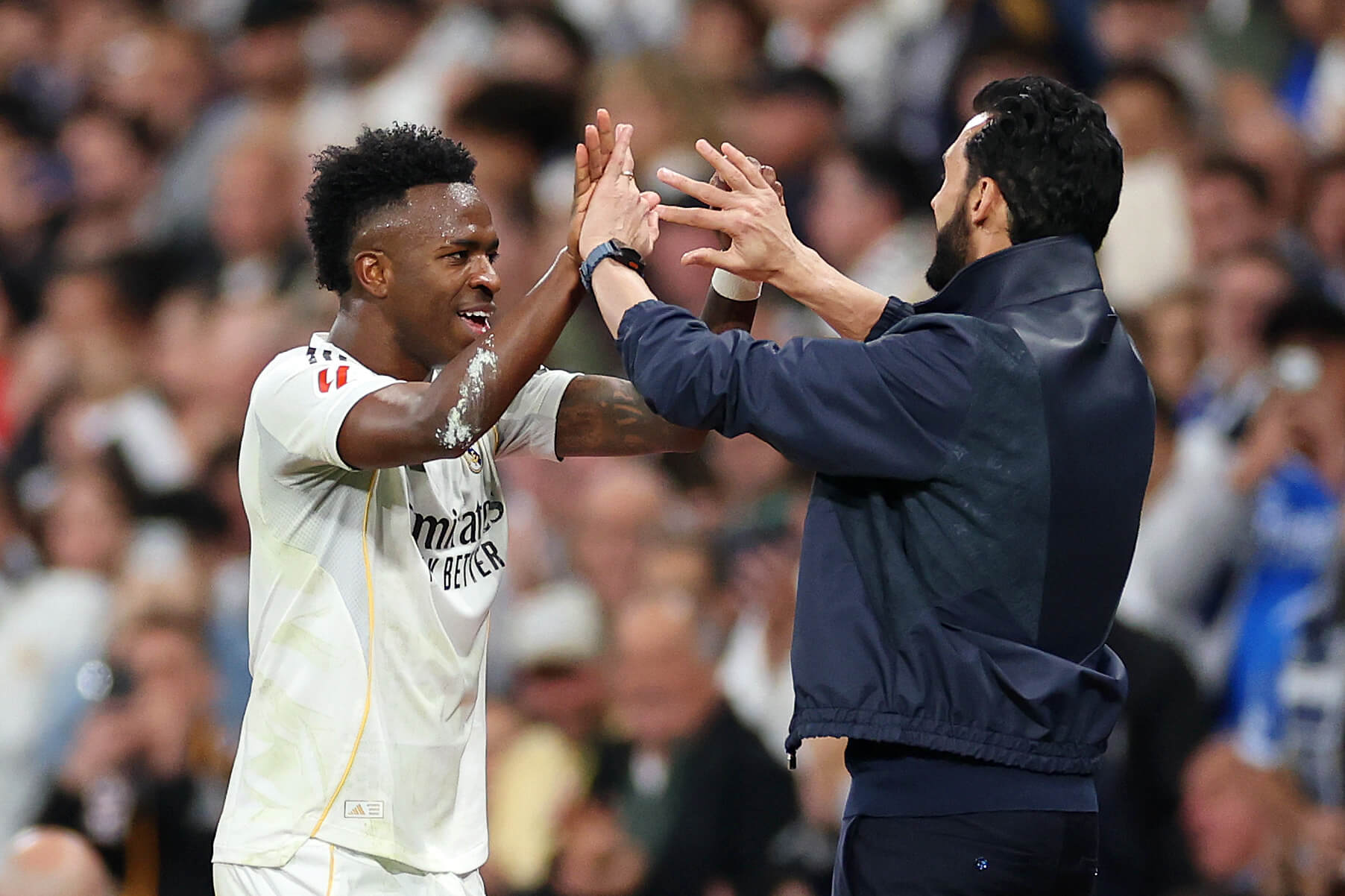
That helped draw better performances from stars who had felt under-appreciated by Alonso, including Vinicius Junior and Federico Valverde. Promoting promising 18-year-old Spanish midfielder Thiago Pitarch to the senior team also worked well.
Vinicius Jr’s performances improved significantly under Arbeloa (Florencia Tan Jun/Getty Images)
There were some energetic and committed performances in big games — especially Champions League knockout-phase victories against Benfica and Manchester City, and a 3-2 win against city rivals Atletico Madrid in La Liga.
Such high-profile wins over teams coached by managerial luminaries in Jose Mourinho, Pep Guardiola and Diego Simeone really helped Arbeloa’s standing around the Bernabeu, allowing some to reject the idea that a man who made almost 250 appearances for the club in his playing days had only been given the job in the first place because of his unquestioning loyalty to president Perez.
Yet problems kept surfacing within the team.
Losses in La Liga at home to Getafe and away at relegation-bound Mallorca allowed Barcelona to zoom clear in the table and easily retain their league title.
Arbeloa’s tactical nous was also seriously questioned following Madrid’s Champions League elimination, when Bayern counterpart Vincent Kompany clearly came out on top. Only the individual quality of players such as Kylian Mbappe, Vinicius Jr and Arda Guler kept Madrid in that tie until they conceded twice late in the second leg in Germany.
Even more damaging, Arbeloa appeared helpless through the final weeks of the season as it became clear the atmosphere at Madrid’s training ground had turned toxic.
Incidents included a heated argument between defensive duo Antonio Rudiger and Alvaro Carreras, while Mbappe insulted a member of the coaching staff during a training game and was photographed with his girlfriend in Sardinia when he was supposed to be working on recovery from an injury (the Frenchman said he was given permission to make that trip). Long-serving club captain Dani Carvajal grew openly frustrated.
Worst of all was Arbeloa not intervening with authority when Valverde and team-mate Aurelien Tchouameni clashed at training. The tension was allowed to simmer on for 24 hours, until an even more serious incident the next day, when Valverde was knocked unconscious after banging his head on the corner of a table during a dressing-room fight, and had to be taken to hospital.
It would be unfair to blame Arbeloa for all that went wrong.
Managing Madrid is one of the most difficult jobs in world sport, for multiple reasons. The dressing room is packed with galactico-level egos who require special management. The Bernabeu crowd are notoriously difficult to please. The all-powerful Perez makes important decisions without consulting his head coach.
The truth about Real Madrid and player power
Adam Crafton and Reuben Pinder
Alonso found it all really difficult and only lasted a matter of months in the job, but his reputation did not suffer too much as a result. He has quickly been given another chance at the top level as Chelsea manager, just down the road from Fulham’s Craven Cottage stadium in west London.
However, Alonso had previously proven himself at Bayer Leverkusen, going unbeaten domestically to win the club’s first Bundesliga title and the DFB-Pokal (Germany’s equivalent of the Copa del Rey or FA Cup) in 2023-24, while also reaching that season’s Europa League final.
Arbeloa’s only other coaching experience has come in Madrid’s academy and with their reserve team — Real Madrid Castilla, who play in Spain’s third tier. He only joined the latter a year ago and had lost eight of his 19 games before Perez promoted him to lead the senior side.

Arbeloa was considered a loyal servant to Madrid’s club president Perez (Oscar del Pozo/AFP via Getty Images)
On a positive note, Arbeloa built a huge amount of experience as a player.
He was at Liverpool from 2006 to 2009, helping them reach the Champions League final in his debut season. Across two spells at boyhood club Madrid, his trophies included two Champions Leagues and a La Liga title. A squad member as Spain won both the 2008 European Championship and the World Cup two years later, he played every minute of their six matches as they retained their Euros title in 2012.
He has worked under many top managers, including Rafa Benitez, Mourinho, Carlo Ancelotti and Vicente del Bosque. Arbeloa also knows London — his playing career ended with a season at West Ham United, although he played only four times for them in that 2016-17 campaign due to persistent injuries.
A very confident character, and a good communicator in English as well as Spanish, Arbeloa has a university qualification in journalism. A clever guy, he will surely have learned a lot from his short but intense experience on the Bernabeu bench.
“Two months as a Real Madrid coach is like a master’s degree,” Arbeloa said in an early March press conference before facing Guardiola’s City. “Every day here is not only a tremendous joy, but also a huge learning experience.”
Without that time on such a high-profile stage, it is difficult to imagine Arbeloa having been in the frame for any Premier League job this summer.
Most coaches in Spain and elsewhere want to work in England, drawn by the resources available, both in terms of their own salaries and the quality of player they would get to work with there. That short, sharp spell at the Bernabeu has springboarded him over other candidates — many of whom possess longer and more impressive track records — to succeed the Benfica-bound Marco Silva.
Arbeloa believes he is ready for a career as a head coach. Before his final game with Madrid on May 23, he ruled out continuing next season as part of the incoming Mourinho’s first-team staff.
“I’ve made the leap, I’ve improved a lot these months, and I see myself ready for new challenges,” Arbeloa said in a press conference.
“There were moments when I thought more about what was good for Real Madrid, rather than about myself,” he added. “In another place, in other circumstances, it would have been different. But there’s no looking back, and no room for regrets.”
Fulham is now that other place.
That brief reign as Madrid coach could be seen as a final gift from Perez and the club for all Arbeloa’s loyalty over the years. How he does now, is over to him.