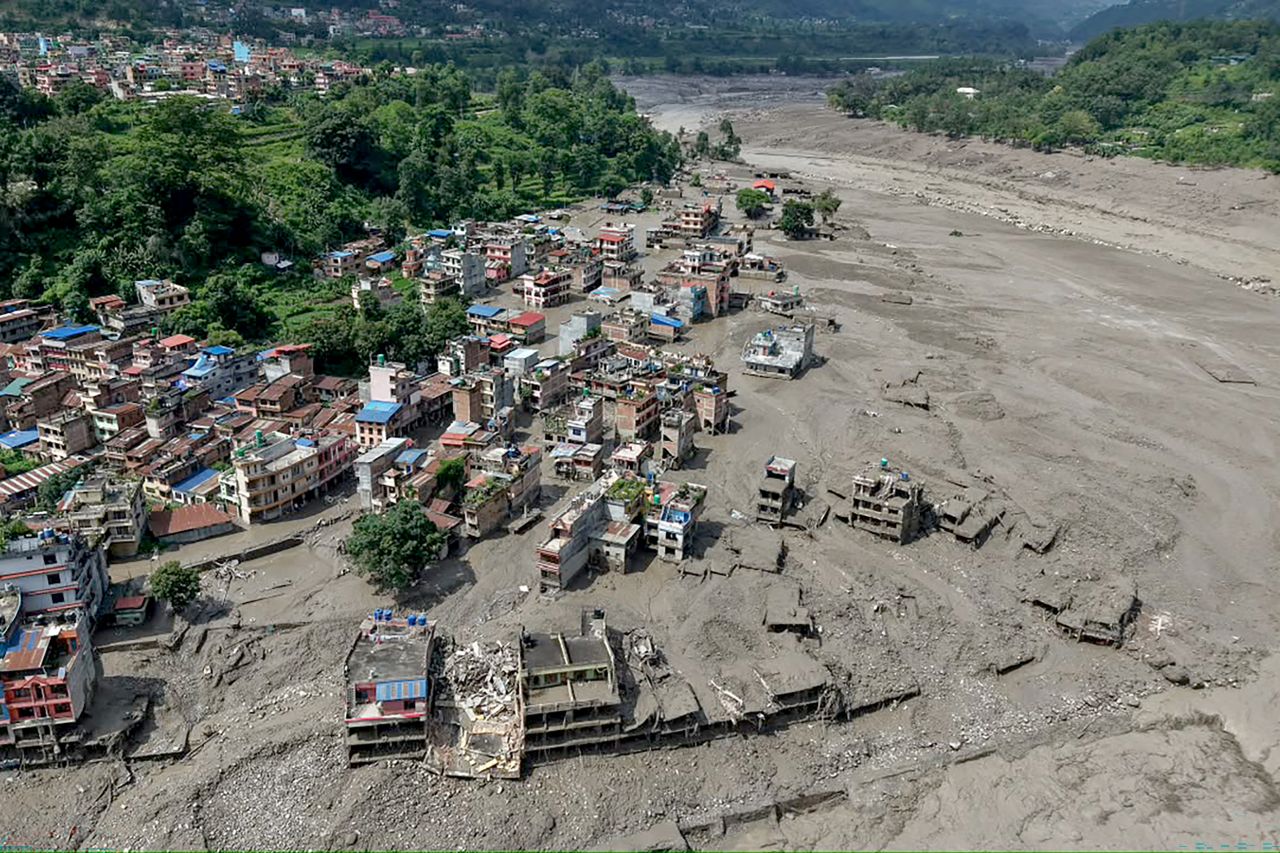
Hundreds are missing and at least 22 people have died after torrential floods hit the Himalayan border areas of Nepal and in Tibet in China.
Houses, roads, bridges and power projects were swept away in Nepal while officials in Tibet said they feared “major casualties” with some missing in the county of Gyirong after a mudslide hit a land crossing between the neighbours.
Officials said 384 tourists, including 291 from countries including India, the United States, the United Kingdom and Malaysia, were reported missing
Rescue helicopters could not land in Nepal’s affected areas of Syapru Besi and Timure in the mountainous district of Rasuwa, with a population of about 50,000, officials said, with the river flowing above its normal course.
Television broadcast images of crumbled homes in the flood waters, floating cars and a metal bridge being washed away, while witnesses told Reuters the waters engulfed entire villages.
“There could be heavy casualties or loss of property,” said the district administrator Narendra Pariyar, who urged dwellers on the banks of the Bhote Koshi River to move to higher ground, after reports of villages and project sites being swept up.
“There is devastation everywhere we look,” Tula Bahadur BK, a health worker in Rasuwa, told Reuters. “The settlements next to the river have been completely swept away. Five of my own relatives are missing.”
Nepal’s rescue helicopters would be unable to land in the affected areas until the waters recede, army spokesperson Raja Ram Basnet said.
The cause of the flooding was not immediately clear, but a deadly flash flood on the same river last year was eventually traced to the draining of a glacier lake.
China’s official Xinhua news agency said the mudslide occurred on the Nepali side and hit the Gyirong port to cut roads, communications and power links in the Shigatse region near the border with Nepal, but did not elaborate.
China’s president, Xi Jinping, urged “all-out” search efforts for the missing as well as stronger monitoring and early warning systems to prevent secondary disasters.
Nepal’s energy ministry said 430MW of electricity supplies were affected, mostly from hydroelectric projects, or more than 12% of total national hydropower capacity of 3.2GW, a Reuters calculation showed.
Police and military were joining in the rescue effort, said Nepal’s prime minister, Balendra Shah. “Instructions have been given … to move the people living in the lower areas to safer places,” he said. “People along the river are advised to exercise extra caution and remain alert.“
From its origins in Tibet, the Bhote Koshi River empties into Nepal’s Trishuli River that eventually flows into India as the Gandak River.
Last year’s Bhote Koshi flood killed nine people as it washed away a “friendship bridge” linking Nepal and China, disrupting trade and transport for months. That flood was triggered by the draining of a supraglacial lake in Tibet, a regional climate monitor said.