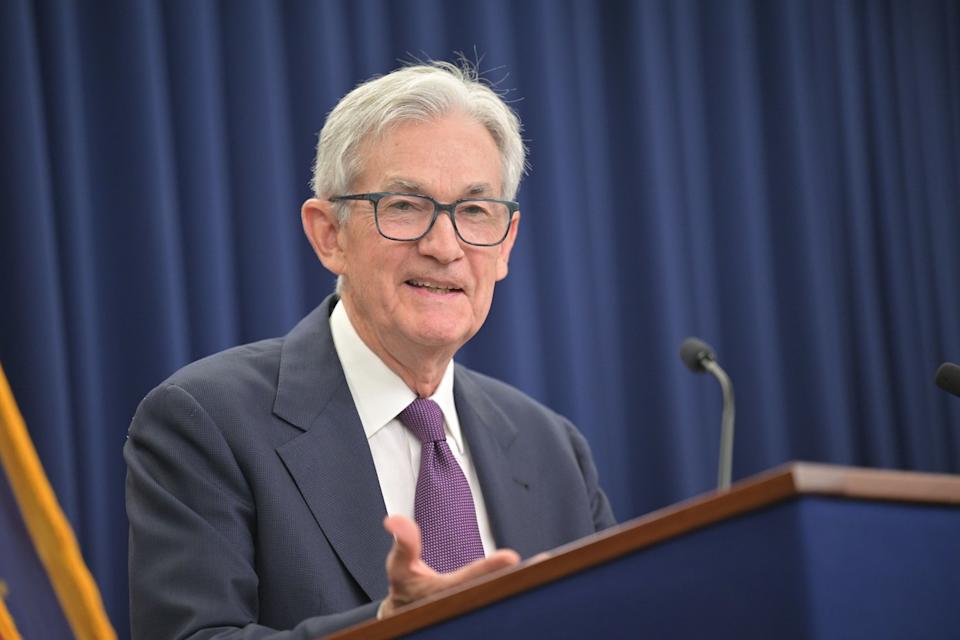
April 29 was, arguably, the most important day of the second quarter for Wall Street — and I’m not talking about the four members of the “Magnificent Seven” that reported their operating results on that date. It marked the final Federal Open Market Committee (FOMC) meeting with Jerome Powell as Fed chair.
May 15 represents the end of Powell’s second term as Fed chair, and presumably paves the way for President Donald Trump’s nominee to succeed Powell, Kevin Warsh, to begin his first term. For the Dow Jones Industrial Average (DJINDICES: ^DJI), S&P 500 (SNPINDEX: ^GSPC), and Nasdaq Composite (NASDAQINDEX: ^IXIC), this shift may constitute a dubious turning point.
|
Will AI create the world’s first trillionaire? Our team just released a report on a little-known company, called an “Indispensable Monopoly,” providing the critical technology Nvidia and Intel both need. |
Powell and the FOMC offer a worrisome interest rate update for Wall Street
Heading into Powell’s final FOMC meeting as Fed chair, the consensus was that the 12-person body responsible for setting the nation’s monetary policy would stand pat and leave the federal funds target rate unchanged at 3.50% to 3.75% — and that’s exactly what happened. However, this doesn’t tell the complete story.
In addition to leaving the federal funds target rate unchanged, the FOMC meeting statement provided a worrisome update for Wall Street and investors.

Though Powell maintained that all voting members of the FOMC are attentive to both sides of the dual mandate (price stability and maximizing employment), there was a record number of dissents. Stephen Miran yet again pushed for a quarter-point reduction in the federal funds rate, while Beth Hammack, Neel Kashkari, and Lorie Logan supported maintaining the current target range but opposed including an easing bias in the FOMC statement. It’s been 34 years since an FOMC meeting featured four dissents.
The bigger takeaway is that a quarter of the FOMC’s voting members are vocally opposed to continuing the central bank’s rate-easing cycle, which delivered six interest rate reductions since September 2024.
The prospect of interest rate cuts in 2026 appears to be firmly off the table, which is an unfavorable development for the stock market.
A historically expensive stock market may be vulnerable without additional rate cuts
When the year began, the stock market was at its second-priciest valuation spanning 155 years, according to the S&P 500’s Shiller Price-to-Earnings (P/E) Ratio (also known as the Cyclically Adjusted P/E Ratio, or CAPE Ratio). Although factors like the rise of artificial intelligence (AI) and record share buybacks have provided a big-time boost to equities, the expectation of additional interest rate cuts was built into premium valuations.