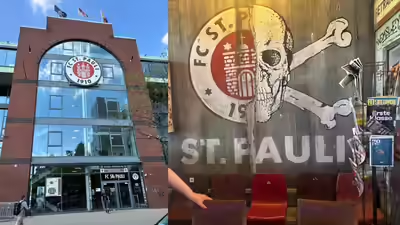
HAMBURG: After Germany fell down to Paraguay in a penalty shootout on June 29, it was mourning across the most populated country in the European Union but grieving was immense at FC St Pauli, the over century old prestigious football club, in the port city of Hamburg.The imposing walls, the stands and the green grass at the football club all were up in tears. They could not have imagined for the four time FIFA World Cup champions to exit so early from the prestigious tournament which is watched and debated by millions and millions of fans all across the world.Established in 1910, the 115 years old FC St Pauli with home ground named as Millerntor Stadium with a capacity of 29,500 spectators, is an integral part of the Hanseatic City of Hamburg.It might have modest achievements in the sporting field but St Pauli made a niche for transforming into ‘Kult’ (iconic, legendary) club as it is considered one of the most left-wing football clubs in the world, with a long-standing commitment to anti-fascism, anti-racism, anti-sexism, and LGBTQ+ rights. Throughout the 1990s and 2000s, St Pauli formalised its political commitments.A decision was made to ban neo-Nazis from the stadium and to make anti-fascism as club policy at the club’ annual general meeting on October 28, 1991 and members flaunted this policy while wearing T-Shirts with Anti Fascism written on them. The club also promotes multicultural engagement and grassroots activism, supporting refugees, marginalised youth, and local squatter communities.During the illustrious 115 years history, FC St Pauli witnessed many highs and lows with a number of world class players having played for the club with a number of rock stars and bands performed at the club, which saw a major renovation of the Millernton stadium from 2009 to 2015.Over four decades ago supporters adopted the skull and crossbones featuring a skull with pirate eyepatch as their own unofficial emblem. The stadium is adjoined to a bunker built in 1942 during world war-II. The massive concrete structure built to save people during the war is anti-aircraft gun emplacement and air-raid shelter.Out of many stalwarts Ivan Klasnić, a prolific striker who built a decorated career in the Premier League and with the Croatian national team. Paul Caligiuri, the American midfielder known for scoring the goal that sent the US team to the 1990 World Cup. Gerald Asamoah, a striker who represented the Germany national team.Max Kruse, achieved stardom in the Bundesliga. Viktor Gyökeres, Swedish striker who rose to prominence as one of Europe’s most feared goal scorers, played for FC St Pauli.“Sustainability is the core theme of FC St Pauli’ mission, spanning climate action, social responsibility and community engagement. The club produces their own merchandise under ecologically sustainable initiatives rather than partnering with massive corporate sports apparel manufacturers”, said Franziska Altenrath, head of strategy, change and sustainability at FC St Pauli and Roger Hasenbein, a veteran member of club’ supervisory board.They added the club also promotes multicultural engagement and grassroots activism, supporting refugees, marginalised youth, and local squatter communities.The club is involved together with other professional clubs, textile partners, GIZ to promote a socially and environmentally sustainable supply chain in merchandising.FC St Pauli has thousands of members and supporters from across the world and fans play an active role in shaping the identity, values and future of the club, says Tonja Tietjen, tour guide of FC St Pauli for the last 38 years.In the arena of field, FC St Pauli has been playing in and out of Bundesliga, the highest level of the German football league system which comprises 18 teams. For the season 2026-27, FC St Pauli will play in 2 Bundesliga, the second division of professional football in Germany.In a historic moment for FC St Pauli, the football cooperative St Pauli (FCSP) became the majority owner of Millerntor Stadium in November 2025 and with this the centrepiece of the club now belongs to the cooperative – and thus to its over 22,000 members, who subscribed to shares with a total value of over 29 million euro.The takeover of the stadium company is a key step to ensuring the future of the Millerntor remains securely in the hands of the FCSP community in the long term.The FC St Pauli has an Indian connection as under the project ‘from the field to the fanshop’ it supports smallholder farmers in Gujarat in switching from conventional cotton farming to organic cotton.Alongside sustainable cotton production and improving the living conditions of cotton producers, the project strengthens children and young people in the growing regions through sports and educational programs. It has ecological goals as shift from conventional to organic cotton farming, reduce pesticides and protect soil and water resources, promote sustainable agriculture along the textile supply chain.It has social goals such as to improve the income and living conditions of cotton producers, empower women through training, health and education programs and help reduce the risk of child labor through sports and education programs. It has societal goals as raise awareness among fans and the public about sustainable textiles and uses the reach of professional football to encourage sustainable consumption.Leveraging the reach of the club to strengthen sustainable supply chains, the 450 smallholder farmers are participating in a cooperative and nearly 1,400 hectares of cotton land being converted to organic.
FC St Pauli with illustrious history spanning over 115 years, witness to historic moments in world football
Visited 8 times, 1 visit(s) today