Sustainability Week 2025
This article is part of a series of sustainability-themed articles we’re running to observe Earth Day 2026 and promote more sustainable practices. Check out all of our Sustainability Week 2026 content.
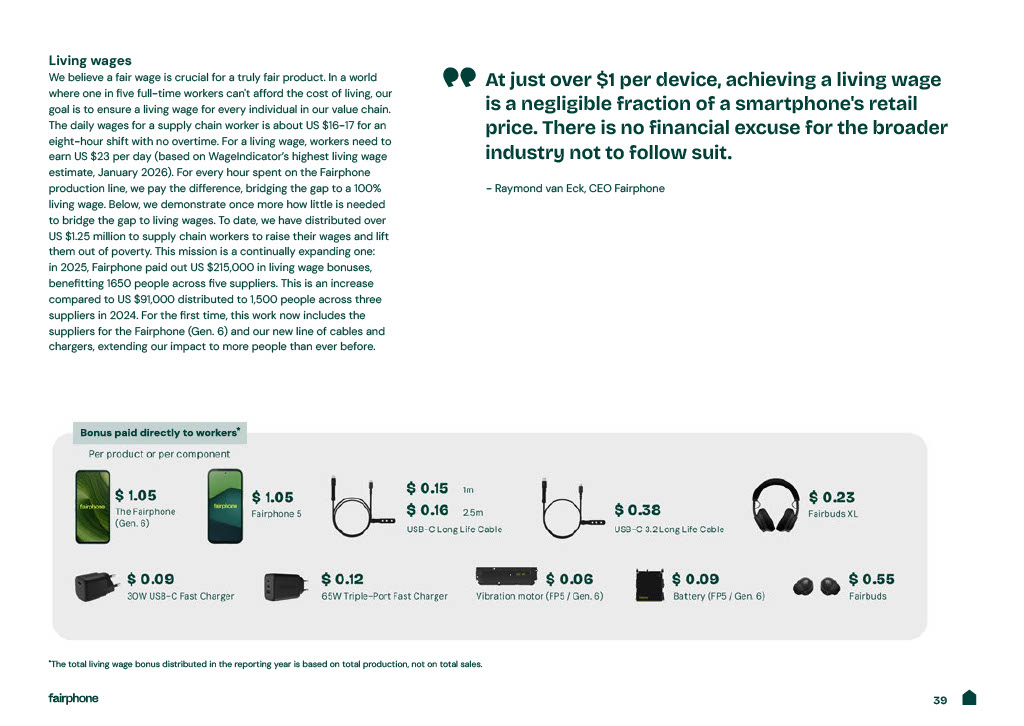
Fairphone has released its 2025 Impact Report, and the sustainability-focused electronics manufacturer is calling on all smartphone manufacturers to implement a fair living wage across their respective workforces.
“In much of the tech industry, impact is still treated like a shadow. It trails the product after launch, after the supply chain is locked, after the story is already written,” Monique Lempers, Chief Impact Officer at Fairphone, writes in the report. “People should not have to trade their health for a paycheck, and communities should not have to absorb the hidden cost of the world’s electronics.”
Article continues below
“At just over $1 per device, achieving a living wage is a negligible fraction of a smartphone’s retail price,” Fairphone CEO Raymond van Eck adds, referring to the ‘living wage bonus’ his company pays to workers to bridge the gap between their actual wage and the local living wage. “There is no financial excuse for the broader industry not to follow suit.”
Image 1 of 2


Fairphone doesn’t call out specific manufacturers by name in the report, but Lempers told me in an interview that research “confirms a substantial gap between legal minimums and the income required for basic social participation in major manufacturing hubs.”
“Across the consumer electronics industry, a vast segment of the production workforce earns significantly less than a living wage […] Generally, this disparity follows a ‘margin-tech’ correlation: high-tech firms with better margins tend to offer better pay, while lower-tech, lower-margin operations are most likely to have the widest wage gaps.”
It’s clear, then, that Fairphone hasn’t necessarily got large-scale corporations like Apple and Samsung in its sights. And indeed, in its latest Supply Chain Progress Report, Apple notes that it takes “extensive steps to confirm fair and legal compensation of wages and bonuses based on accurate measures of time worked.”
It should be noted, though, that overseas contractors used by the likes of Apple and Samsung don’t necessarily abide by the same standards as their clients.
In 2025, Le Monde reported that the “base salary for an iPhone assembler at Foxconn is $295 per month” — the legal minimum, but just under half the average wage in Zhengzhou. Around 20% of all iPhones are also now assembled in India (via The Financial Times), and neither China nor India has a legally mandated national living wage.
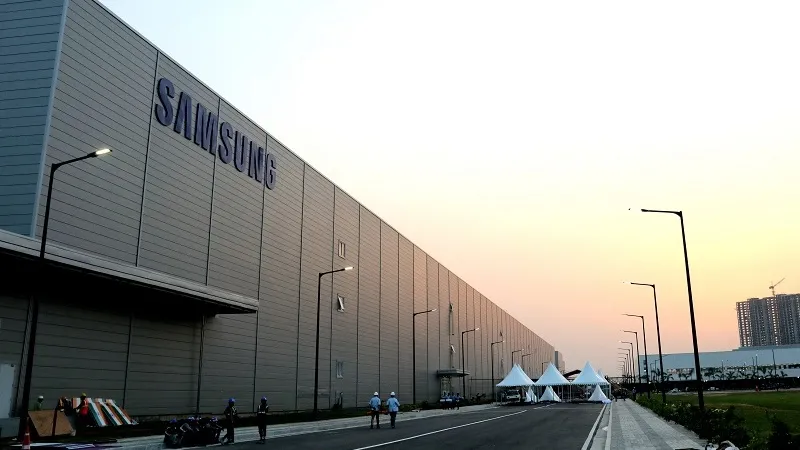
Samsung doesn’t publish an equivalent annual supply chain report, but in response to a 2024 wage strike at a Samsung plant in India, the company said it “maintains absolute compliance with all existing labor laws.”
Evidently, monitoring and enforcing labor standards is a complex undertaking for all multinational tech companies (Apple itself acknowledges that “the scale and scope of [its] supply chain make it a complex and dynamic operating environment, stretching across more than 50 countries and regions with varying laws and cultural norms”).
But Fairphone — which actually published an official guide to paying living wages in a supply chain back in 2022 — has outlined three more general strategic changes that it hopes even the largest tech brands can implement moving forward:
- Design for longevity: By adopting modular, repairable designs, moving from selling disposable gadgets to supporting long-term ownership, while physically offsetting their waste footprint.
- Systemic restoration: Moving beyond a risk and ‘do no harm’ approach, by ensuring living wages for factory workers and by supporting the professionalization and higher value distribution to artisanal mining to uplift communities rather than boycotting them.
- Integrated impact: Ultimately, we want to see that social and ecological health become core business KPIs, ensuring that profit is no longer decoupled from the well-being of the planet and its people.

The smartphone industry is at least waking up to the importance of sustainable business practices, particularly in Europe, where politicians are actively working to eliminate the concept of planned obsolescence. Recently announced EU laws, for instance, will force all new smartphones sold in the EU to have replaceable batteries and at least seven years of spare parts. You can also thank the EU for ‘encouraging’ Apple to adopt USB-C charging on its iPhones.
But Fairphone wants manufacturers to jump before they’re pushed.
“Europe’s Ecodesign and due diligence rules are raising the floor, while climate pressure and geopolitical strain are exposing just how fragile global supply chains have become,” Lempers says. “But compliance is only the starting line. The point is not to do the minimum required. The point is to raise the bar, prove it can be done, and make it impossible for the rest of the industry to keep pretending change is unrealistic.”

Follow TechRadar on Google News and add us as a preferred source to get our expert news, reviews, and opinion in your feeds.