Another day, another shock.
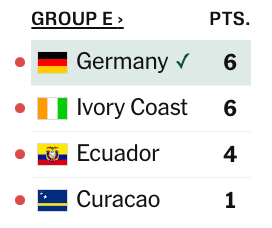
Ecuador delivered the greatest day in their World Cup history with a memorable 2-1 win over Germany to confirm their place in the last 32 as one of the best third-placed sides. According to The Athletic’s projections, they are most likely to face co-hosts Mexico in the last 32, and possibly England in the last 16.
After falling behind in controversial circumstances through Leroy Sane in the second minute, Germany looked well set to make it three wins out of three in the group stage but the impressive Nilson Angulo quickly equalised and Gonzalo Plata scored a 77th-minute winner.
It sparked euphoric scenes among the Ecuador contingent in New York New Jersey Stadium. But for Germany, there will be some pointed questions for head coach Julian Nagelsmann, even if his side had already booked their place in the knockout phase. Here, The Athletic‘s writers analyse the main talking points.

Was this one of this World Cup’s greatest moments?
With 13 minutes left here, Ecuador were going out.
It would have felt a bit unfortunate given their brave, physical style and how they had run Germany ragged at times here, but a 1-1 draw would have left them on two points, which would not have been enough to send them through. And when Gonzalo Plata skied over the bar from a Moises Caicedo cross, it felt like the story of their tournament: not enough quality when it mattered.
But then, when Plata buried from close range from Kevin Rodriguez’s flick, the celebrations were so wild you could feel the stadium vibrate. It was a great moment, one of the best of the World Cup, and fully deserved for these Ecuadorian players and fans.

Gonzalo Plata hooks in Ecuador’s second goal (Mattia Ozbot/Getty Images)
Their four points mean they will go through as one of the best third-placers. And given how they play, their physicality, their courage, and the quality they have in players such as Caicedo and Nilson Angulo, who scored their brilliant opener, nobody will want to play them in the knockout rounds.
Jack Pitt-Brooke

Are Germany really World Cup contenders?
Germany have not really been talked up as a tournament contender, and this game was evidence of why.
They are through, and their qualification has never really been in doubt — what a change from the last two World Cups — but they have carried some obvious flaws which Ivory Coast very nearly took advantage of, and Ecuador ultimately did.
The attacking midfield combination between Florian Wirtz and Jamal Musiala is not really functioning yet, with neither player in prime form. The double pivot midfield of Aleksandar Pavlovic and Felix Nmecha can use possession effectively, but lacks the defensive security to protect a back four that looks vulnerable.

Manuel Neuer is beaten by Nilson Angulo (Jewel Samad/AFP via Getty Images)
And defence is the heart of the issue. The loss of the injured Nico Schlotterbeck has damaged Germany’s ability to move the ball up the field. Schlotterbeck is among the best passing centre-backs at the tournament — or at least he was. But his left foot also provided balance without the ball, and with Antonio Rudiger’s right foot replacing it, that part of the side, which was hardly a strength, now looks even more unstable.
Germany will now head to Boston next Monday, but they will have to be a lot better than this once they get there.
Seb Stafford-Bloor
Are referees being more lenient at this tournament?
The decision to allow Germany’s first goal was clearly contentious. Former Bundesliga referee Manuel Graefe, writing on X, described the failure to penalise Pavlovic’s high foot on Pedro Vite as “a joke”.

Aleksandar Pavlovic was not punished for this high foot on Pedro Vite (Patrick Smith – FIFA/FIFA via Getty Images)
Graefe can be quite strident in his views, but it did seem extraordinarily lenient, at least compared to the normal refereeing standard seen across Europe; it’s inconceivable that that goal would have been allowed to stand in the Champions League, for instance.
The Athletic’s refereeing expert Graham Scott agreed. “It is highly unusual for a referee not to penalise such a challenge, especially when there has been contact with the head or face,” he said. “The incident occurred during the attacking phase of play and would have been checked by the VAR. So far in this World Cup, VARs have generally been reluctant to intervene, but I expected an intervention here.”
But then the tournament has been full of moments like that. Some have been more memorable than others — the non-red card for Lionel Messi against Tunisia, for instance — but hands-off officiating has been a theme. Consider some of the tackles that were not penalised in England’s 0-0 draw with Ghana, or the two penalties that were not awarded to Scotland during their 1-0 defeat by Morocco.
Outside of the penalty box, referees seem to have tolerated robust tackling in the way they did a few decades ago, allowing far more physical contact than we’re used to seeing.
Is this a directive? Is it one of those little tweaks that sometimes gets made ahead of a tournament, with the aim of promoting a faster game? Nobody has said anything publicly, but we’ve seen this too often already at this tournament for it to be a coincidence.
Seb Stafford-Bloor
Do Germany have the right attacking balance?
World Cup group stages serve a specific purpose.
The primary remit is qualification, with managers hoping that their team operates at its peak performance in the latter stages. It is also an opportunity to find some rhythm and familiarity in your attacking ideas, and Germany’s 7-1 victory over Curacao suggested they had hit the ground running in their World Cup pursuit.
Things were not quite as fluid against Ivory Coast or Ecuador. Julian Nagelsmann’s side boast plenty of talent going forward, and the neat combinations between Wirtz, Musiala and Kai Havertz can be sumptuous when Germany are at their best.

Florian Wirtz is one of Germany’s many technically gifted attackers (Jan Woitas/picture alliance via Getty Images)
However, when things are not fully clicking, those same profiles can be a little too similar when considering Germany’s overall attacking balance. Sane can still offer a burst of pace but the 30-year-old is not the lightening-quick winger he once was. A profile that can offer more speed and dribbling qualities would offer Nagelsmann a greater variety in his forward line.
The man he has relied on the most to impact the attack from the bench has been the poacher-profile of Deniz Undav, who has repaid the faith with three goals from three substitute appearances — two of which single-handedly turned the game around against Ivory Coast.
Maybe Germany did not go full tilt against Ecuador because they had already qualified in first place in the group, but the natural thought is to look at how their attack might fare against stronger opposition in the knockout rounds. In truth, there is work to do.
Mark Carey