Amid rising digital fatigue, more users are turning to minimalist phones

As digital fatigue grows and social media addiction intensifies, dumbphones — minimalistic mobile phones with just essential features like texting and calling — are making an unexpected return among younger generations.
Although the emerging trend remains niche compared with the smartphone market, the interest in these low-tech devices is undeniable.
Yang Wang, a market analyst at the technology research firm Counter Research, found that the dumbphone market is growing. Last year, 15 percent of global phone sales were of dumbphones, selling around 1.7 million units in the U.S.
Similarly, Ammy Archer, a media relations and research lead at the phone plan comparison company WhistleOut, said the interest in dumbphones is especially prominent among younger generations, particularly Gen Z.
“In a survey earlier this year, we found out that over half (59 percent) of Gen Z wants to make the switch to a dumbphone this year, along with 49 percent of millennials. One in four people interested in dumbphones don’t even care about retaining apps, which speaks to a drive for really unplugging,” Archer said.
Smartphones help students simplify countless tasks; however, their excessive dependency is becoming a growing concern. “Just a couple of years ago, we discovered that over half of Americans consider themselves addicted to their phones,” Archer said.
Digital wellness expert Yaron Litwin at the parental control app Canopy noted that smartphones can prompt negative consequences to users, such as harmful expectations, sleep deprivation, lower attention span, and social isolation — not to mention exposure to threats like cyberbullying, identity theft, or sextortion, a form of extortion in which someone is pressured to send explicit images or money.
The switch to these low-tech devices may reflect a growing public awareness of the disconnection in modern life and a turn toward digital minimalism, the lifestyle of using technology intentionally. “What’s changed is that more people are finally giving themselves permission to step back,” said professional family counselor Tessa Stuckey. She added that smartphones often act as “emotional pacifiers,” impairing people’s ability to handle discomfort and boredom.
These concerns have fueled online movements like Bring Back Blackberry and a growing wave of content creators documenting their switch to dumbphones — yet the trend extends beyond dumbphones.
The aesthetic appeal, sense of ownership, and growing advocacy for preserving analog media have turned dumbphones into symbols of digital minimalism. On social platforms, users share CDs, MP3 players, VHS tapes, video consoles, cameras, and other forms of physical media not only out of nostalgia but as a collective pushback against the pressures of hyperconnected life. On Instagram alone, the hashtag #physicalmedia appears in more than 672,000 posts, while TikTok features over 153,000 posts using the same tag.
As a result, returning to dumbphones has emerged as an alternative for those looking to disconnect from an overstimulated digital world and use their time more intentionally.
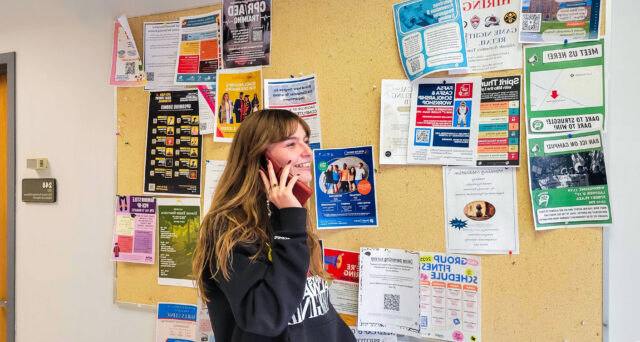
“It has been very helpful to not have social media in my pocket,” said Addy Montague, an MSU Denver student who has exchanged her smartphone for a Cricket Debut Flex, a flip phone.
Since she changed her smartphone, she admits having more time to be present — and bored. “I let myself be bored. Boredom is actually really good for your brain. If something terrible happens and I’m feeling really sad, I’m able to think about it instead of just immediately distracting myself,” Montague said.
According to The Conversation, moderate moments of boredom activate the brain’s default mode network, which encourages creativity and introspection while reducing anxiety and dependence on external gratification. A study published in the journal PNAS NEXUS also found that stepping back from smartphones can meaningfully decrease depressive symptoms and improve attention spans.
Montague said she has noticed other positive effects, including better sleep habits and sharper critical thinking. “I feel like I’m better at forming my own opinions instead of just repeating whatever I see when I scroll,” she said.
She also realized how often smartphones are used to avoid even a few seconds of silence. “When I’m hanging out in a group, and there’s an awkward pause, everyone’s first reaction is to pull out their phones and start looking at them,” she said.
Navigating those moments without a smartphone has helped her feel more comfortable in social settings. “It’s like exposure therapy — you have to just sit in the uncomfortable silence.”
Despite the benefits of this minimalistic lifestyle, Montague noted that rejecting smartphones altogether isn’t realistic for everyone. “I have a lot of friends who drive, but for some reason don’t know their way around Denver, even though they’ve lived here their whole lives,” she said.
Many students rely on features provided by smartphones such as Google Maps, Apple Pay, or RTD CollegePass, making it nearly impossible to live without these conveniences.
In response, companies such as Punkt and Light have developed new phones with minimalistic designs to reduce digital overload. These devices strip away algorithm-driven feeds and app stores, offering only essential features like calls, texts, and navigation.
Light co-founder Kaiwei Tang believes the issue is not phone usage, but the business model of the attention economy. “Every free app, every social media platform, every browser, is trying to maximize engagement so they can make money collecting data and categorizing people into different groups so they can sell it to advertisers,” Tang said.
Despite the momentum toward digital minimalism, Montague understands that technology will continue to advance and that most people will keep embracing it. Still, she plans to keep her flip phone. “I plan to stick with it for as long as I can. Definitely a lot of modern conveniences are lost, but I think the gains are better,” she said.
14