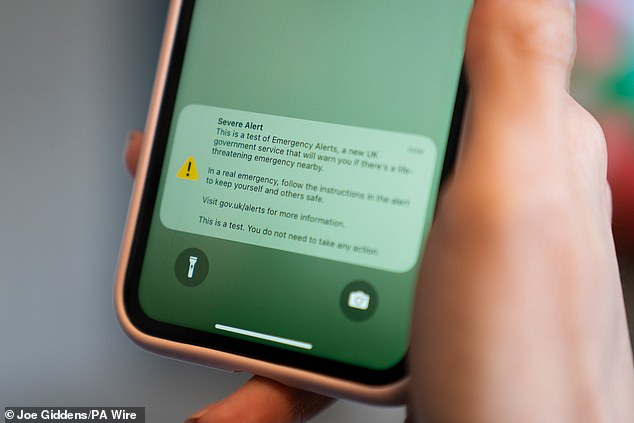
It will be the moment when millions of mobile phones will vibrate and ring at the very same time.
At about 3pm next Sunday, an official ‘Emergency Alert’ will be sent to all 4G and 5G-enabled phones and tablets.
The phones will vibrate and emit a siren-like tone for ten seconds.
But happily, there will also be a message making clear that it is only a drill albeit one of the largest public safety exercises of its kind ever staged in the UK.
The Sunday afternoon timing has chosen by government emergency planners to minimise disruption to work and school routines.
Since the Emergency Alerts system was launched in April 2023, it has been used five times to warn of life-threatening danger, including during Storm Éowyn in January 2025 when 4.5million people across Scotland and Northern Ireland received an urgent warning of extreme conditions.
Cabinet Office officials also said that the system has also proved invaluable in local emergencies – for example, in Plymouth, where more than 10,000 residents were evacuated in hours after an unexploded Second World War bomb was discovered.
And last night, Chancellor of the Duchy of Lancaster, Pat McFadden said: ‘Next Sunday will be one of the UK’s largest public safety exercises in history, as we ensure the Emergency Alerts system is ready to help keep the country safe.
At about 3pm next Sunday, an official ‘Emergency Alert’ will be sent to all 4G and 5G-enabled phones and tablets. Pictured: File photo

Since the Emergency Alerts system was launched in April 2023, it has been used five times to warn of life-threatening danger, including during Storm Éowyn (pictured, the aftermath) in January 2025

Cabinet Office officials said it has also proved invaluable in local emergencies – for example, in Plymouth, where residents were evacuated after an unexploded Second World War bomb was discovered (pictured)
‘The test alert will be issued by COBR, the government’s emergency planning team whose work usually takes place behind the scenes.
‘Emergency Alerts have the power to save lives.
‘In real life emergencies, it’s vital to rapidly share warnings and advice, which is why we keep the system on standby 24/7.’
COBR brings together ministers, senior officials and expert planners to coordinate the national response during major incidents.
Its role is usually behind closed doors, but the test offers a rare glimpse into how this function ensures a swift, joined-up response to emergencies.
Next week’s test follows the publication of the government’s Resilience Action Plan, which sets out unprecedented investment in national preparedness.
Measures include £1billion for a new network of National Biosecurity Centres and £4.2billion to strengthen flood defences protecting communities across England.