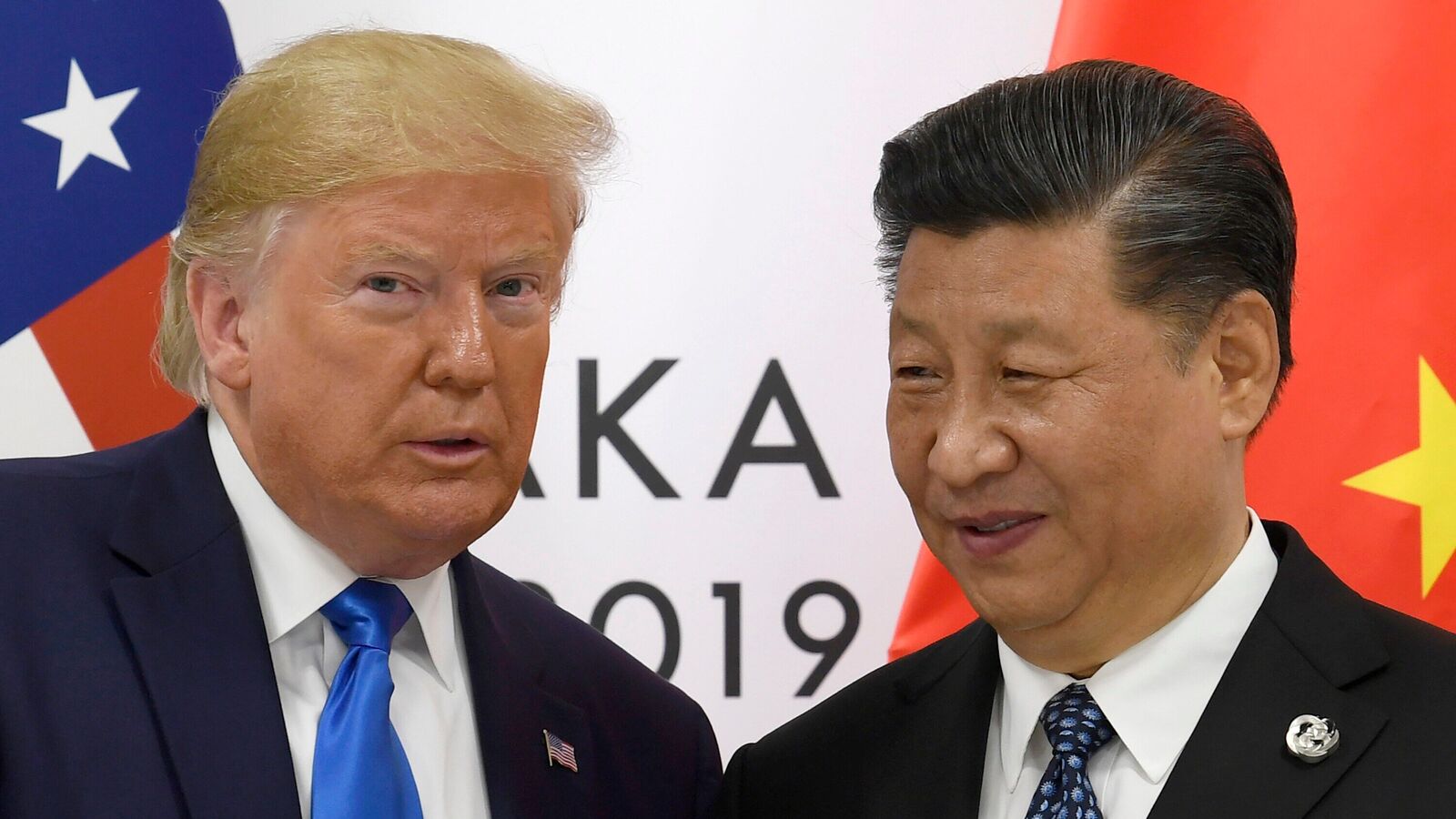
US President Donald Trump is expected to press Chinese President Xi Jinping over Beijing’s restrictions on Nvidia’s advanced Blackwell AI chips when the two leaders meet on the sidelines of the Asia-Pacific Economic Cooperation (APEC) summit in Gyeongju this week.
Speaking to reporters aboard Air Force One en route to Gyeongju, South Korea, Trump praised Nvidia’s Blackwell as the “super-duper chip” and said he might speak to Xi about them, without elaborating.
“I think we may be talking about that with President Xi,” Trump said, adding he was “very optimistic” about his meeting with Xi, the first since he returned to the White House.
While Trump will skip the main APEC leaders’ session, he plans to attend a private dinner with South Korean President Lee Jae-myung and hold several bilateral meetings, including the highly anticipated face-to-face with Xi, before departing on Thursday.
Negotiators from Washington and Beijing reportedly finalised a framework agreement on Sunday to halt additional American tariffs, according to US officials — a breakthrough that sent global markets soaring to record highs.
Sales of the US firm’s high-end AI chips to China have been a key sticking point in protracted trade talks between the world’s two largest economies this year.
Beijing has long been irked by Washington’s export controls that ban Nvidia from selling its most advanced AI chips to China. The US has justified these restrictions by alleging the Chinese military would use the chips to increase its capabilities.
What will Trump discuss with Xi?
At the centre of the Trump–Xi dialogue will be Nvidia’s Blackwell AI chip architecture, a cutting-edge processor series that underpins advances in artificial intelligence, data analysis, and defence systems.
“Trump said he would speak to Xi about Nvidia’s state-of-the-art Blackwell AI chips, with sales to China a key sticking point in trade talks,” a senior White House official told reporters on Wednesday.
Washington’s export ban on high-end AI chips has become the cornerstone of its policy to constrain China’s technological rise. The restrictions have limited Beijing’s access to semiconductors required for AI model training, supercomputing, and cloud infrastructure — all strategic pillars of Xi’s “Made in China 2025” agenda.
The Blackwell line, which Trump has described as “super-duper” chips that would “define the next era of American innovation,” symbolises the United States’ dominance in next-generation computing. For Beijing, however, being locked out of this technology underscores a painful dependency that China has been racing to overcome.
China’s ban on Nvidia AI chips — a strategic counter-move
Beijing’s tightening of rules on US chip imports, including de facto restrictions on Nvidia’s advanced GPUs, marks a turning point in the tech standoff. The move effectively prevents Chinese firms from purchasing or deploying Nvidia’s latest hardware for AI development, forcing them to rely on domestic alternatives or older, less efficient chips.
China’s Commerce Ministry has framed the decision as a national security measure, mirroring Washington’s rhetoric in its own export bans. Analysts, however, see it as a strategic response — part of a broader attempt to demonstrate that Beijing will not remain a passive target of Western tech containment.
“China is very calm in facing all these conflicts and difficulties set up by the United States,” said Wang Wen, dean of the Chongyang Institute for Financial Studies at Renmin University in Beijing. “The United States is still a major partner, however, among China’s landscape, the US is losing its importance.”
Huawei’s rise reshapes China’s AI ambitions
As Nvidia’s access to the Chinese market shrinks, Huawei Technologies has rapidly emerged as the national champion in AI chip design and production. Its Ascend 910B and newer Ascend 920 processors have drawn international attention as potential rivals to Nvidia’s A100 and H100 lines.
Huawei’s recent advances in semiconductor manufacturing, despite US sanctions, have galvanised Beijing’s confidence that it can eventually achieve technological self-sufficiency. The company’s chips, designed for AI training and inference, are already being deployed in major Chinese data centres and government-linked research facilities.
Industry observers suggest that Huawei’s progress could redefine the competitive landscape in global AI, particularly if Chinese software ecosystems continue to mature independently from US-controlled platforms.
For Xi, this narrative supports his long-standing vision of “tech sovereignty” — ensuring that China’s digital future no longer depends on Western hardware.
The Taiwan question looms large
Since returning to office in January, Trump has vacillated on Taiwan, the self-governed island claimed by China but supported by Washington under its policy of strategic ambiguity.
“Trump says Xi has told him he will not invade Taiwan while the Republican president is in office,” one White House official said. “But Trump has yet to approve any new US arms sales to Taipei.”
On Tuesday, Taiwan’s Foreign Minister Lin Chia-lung expressed confidence that Trump would not abandon the island. “We are not worried that Trump would ‘abandon’ Taiwan in his meeting this week with Xi,” Lin said.
Still, tensions remain high. On Wednesday, Beijing reiterated it “absolutely will not” rule out the use of force over Taiwan. Trump, for his part, downplayed the issue, telling reporters that he “did not know whether he would even discuss Taiwan” with Xi.
What to expect from the Trump–Xi meeting
For Trump, the Gyeongju meeting represents both an economic opportunity and a political balancing act — a chance to project American strength while preserving diplomatic channels. For Xi, it is an occasion to reaffirm that Beijing is no longer a subordinate actor in global politics but an equal negotiator with Washington.
Both leaders are under pressure to stabilise markets and prevent further economic damage. Yet beneath the rhetoric of cooperation lies a deeper struggle — one centred on AI supremacy, semiconductor control, and digital influence.
While a limited truce may emerge from the talks, neither side appears ready to relinquish its ambitions. As Trump put it, the Blackwell chips are “super-duper.” But for Xi, the greater message may be that China’s technological rise no longer requires America’s permission.
