Oil has finally become everyone else’s problem. After days in which crude prices climbed while equities, bond markets and currencies remained relatively composed, Thursday brought the first convincing signs that investors are beginning to treat higher energy prices as a broader macroeconomic threat. Brent crude surged toward $100 and WTI broke above $90, while Treasury yields jumped, stocks turned lower and the Dollar rallied sharply. The synchronized move suggests markets are starting to price the return of stagflation risks rather than viewing the latest oil rally as a temporary geopolitical premium.
The catalyst was another escalation in Middle East tensions. Yemen’s Houthis said they had targeted two Saudi oil tankers with drones and missiles, raising concerns that the Red Sea is becoming an active second front alongside the Strait of Hormuz. President Donald Trump then warned that the US would hold Iran responsible for future Houthi attacks, threatening “major military punishment” against both Tehran and the Houthis. Coming as US forces completed a twelfth consecutive night of strikes on Iran, the developments reinforced fears that disruptions to global energy supplies could become more prolonged.
The reaction across fixed-income markets was particularly striking. US 10-year Treasury yields climbed above 4.70% for the first time since January 2025 as investors reassessed the inflation outlook in light of surging energy prices. Germany’s 10-year Bund yield also pushed above 3.2%, reaching its highest level since 2011, underscoring that the repricing is extending well beyond the United States. Rising bond yields point to growing expectations that central banks may need to keep monetary policy restrictive for longer if higher oil prices feed into broader inflation.
Equity markets also began reflecting those concerns. European stocks traded lower across the board, while US futures pointed to a sharply weaker open, with Dow futures down more than -500 points and Nasdaq futures lower by around -380 points. Although the selling remained orderly, the pattern is consistent with investors becoming less willing to dismiss higher energy costs as a risk confined to commodity markets. Instead, attention is shifting toward the implications for corporate margins, consumer spending and inflation.
Currency markets completed the broader repricing. The Dollar led gains as higher Treasury yields boosted its appeal, while USD/JPY climbed to fresh 40-year highs above 163 despite the continued risk of official intervention. The Canadian Dollar benefited from the surge in crude prices, and the Euro remained supported after the ECB acknowledged that “the full inflationary impact of the energy shock has yet to play out” while maintaining its data-dependent policy stance. By contrast, the New Zealand Dollar underperformed, followed by the Yen and Swiss Franc.
The next milestone is Brent’s test of $100. Markets have so far been willing to view higher oil prices as an insurance premium against geopolitical uncertainty rather than evidence of physical supply shortages. A sustained break above $100—particularly if accompanied by confirmation that attacks are materially disrupting exports through both the Red Sea and the Strait of Hormuz—would strengthen the case that the oil rally is evolving into a genuine supply shock. That would likely reinforce the current repricing across bonds, equities and currencies, extending the resurgence in global stagflation fears.
Red Sea Attacks Push Brent Oil Toward $100. Will Markets Finally React?
Brent oil’s rally is entering a potentially decisive phase as renewed Middle East tensions push prices toward the key $100 level. While broader financial markets have so far remained relatively calm, a decisive break above $100—particularly if accompanied by evidence of actual supply disruptions through both the Red Sea and Strait of Hormuz—could mark the point where investors begin pricing a genuine energy supply shock rather than simply elevated geopolitical risk. Read more.
ECB Holds Rates, Closely Watches Energy Shock and Inflation Spillovers
The European Central Bank left interest rates unchanged as expected but delivered a mildly hawkish message by emphasizing that the recent energy shock is still working its way through the economy. The Governing Council warned that “the full inflationary impact of the energy shock has yet to play out” and said it is closely monitoring the shock’s intensity, duration and potential second-round effects on broader inflation. While reiterating its commitment to a data-dependent, meeting-by-meeting approach and avoiding any pre-commitment on future rates, the ECB signaled that rising energy prices remain a key risk to the inflation outlook. Read More.
US Jobless Claims Fall Shaprly to 187k vs exp 212k
US initial jobless claims fell by 22K to 187K in the week ended July 18, well below expectations of 212K. Continuing claims also edged lower to 1.796 million while the insured unemployment rate held at 1.2%, pointing to an exceptionally tight labor market with limited layoffs and steady re-employment. Read More.
Canada Retail Sales Rise 1.0% in May, June Momentum Seen Continuing
Canada’s retail sales increased 1.0% in May, with all nine retail subsectors posting gains, highlighting resilient consumer spending despite a challenging macro backdrop. Core retail sales, which exclude autos and gasoline, rose 0.9%, pointing to broad-based strength beyond energy-related spending. Statistics Canada’s advance estimate of a further 0.4% rise in June suggests household demand remained firm heading into the end of the second quarter. Read More.
EUR/CHF Rally Points to Hawkish ECB Hold as Oil Reignites Inflation Risks
EUR/CHF may already be revealing how markets expect the European Central Bank to respond to a rapidly changing inflation outlook. Although the ECB is widely expected to leave its deposit rate unchanged at 2.25%, Brent crude’s surge back above $95 following renewed US-Iran hostilities has revived concerns that energy-driven inflation could persist for longer. The breakout in EUR/CHF suggests investors have begun pricing a hawkish hold and a growing possibility of another ECB rate hike later this year. The key question now is whether President Christine Lagarde validates that repricing—or pushes back against it—during her press conference. Read More.
Australian Jobs Blow Past Forecasts With 76.3k Growth as Participation Keeps Unemployment Steady
Australia’s labour market significantly outperformed expectations in June, with employment rising by 76,300 compared with forecasts for a 15,000 increase. However, the unemployment rate remained at 4.4% because more people entered the workforce, lifting the participation rate to 67.0%. The ABS said part of the hiring reflected delayed job commencements from May, while higher job retention also supported employment growth. Although the data reinforce the resilience of the labour market, the rise in underemployment to 6.5% suggests spare capacity has not been fully absorbed, leaving inflation data as the key determinant of the Reserve Bank of Australia’s next policy move. Read More.
USD/CHF Daily Outlook
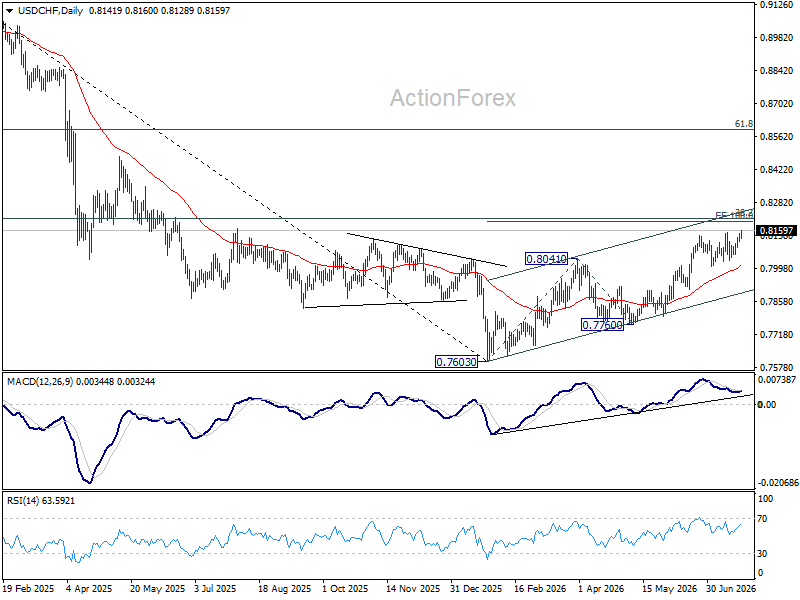
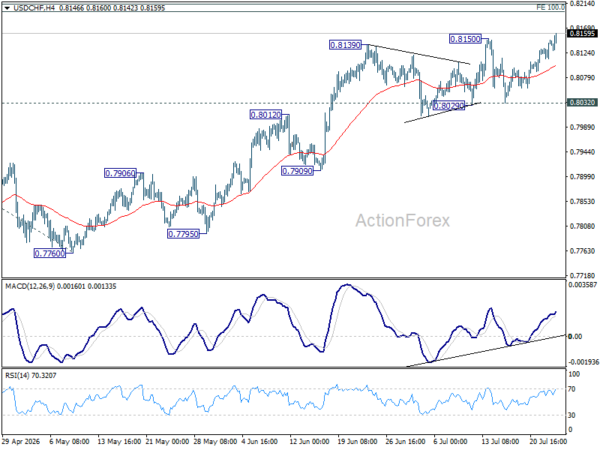
Intraday bias in USD/CHF is back on the upside with break of 0.8150. Rise from 0.7603 is resuming and should target 100% projection 0.7603 to 0.8041 from 0.7600 at 0.8198 next. For now, outlook will remain bullish as long as 0.8029 support holds, in case of retreat.
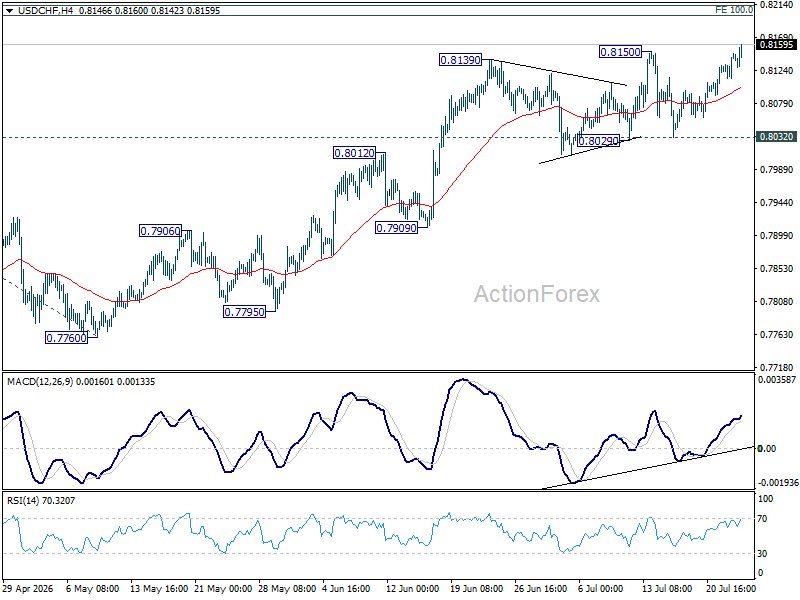
In the bigger picture, while a medium term bottom was formed at 0.7603, it’s still early to call for bullish trend reversal. As long as 38.2% retracement of 0.9200 (2025 high) to 0.7603 at 0.8213 holds, the larger down trend could still continue through 0.7603 at a later stage. However, firm break of 0.7603 will argue that the trend has reversed and turn focus to 0.8332 support turned resistance (2023 low) for confirmation.