Europe’s ‘strengths cannot protect weaknesses’ as global economic order rapidly changes, ex ECB chief Draghi warns
Speaking of ideas for Europe to get out of its current geopolitical position, the former Italian prime minister and European Central Bank president Mario Draghi is seen by some as a leading thinker on the issue.

Draghi – possibly best known for his “whatever it takes” comment on saving the eurozone during the global economic crisis – has long been an outspoken advocate of further integration and some deep reforms to how the EU operates.
His Draghi report, published in 2024, further outlined his thinking on how to improve Europe’s competitiveness, and it has influenced the European Commission’s policy in this area (although he seems to think they don’t move quickly enough.)
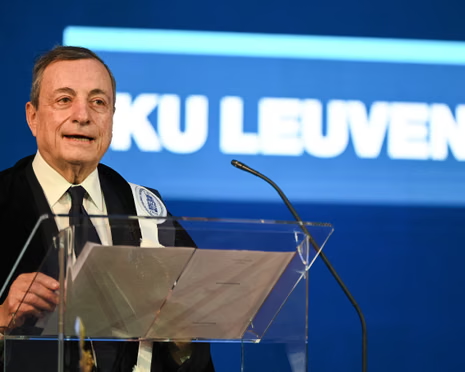
Earlier this morning, he delivered a speech at the KU Leuven in Belgium, spoke about the current position that Europe finds itself in, and had some interesting things to say.
Draghi agreed with people warning that the current economic world order is collapsing – in fact he openly declared it “defunct” and “dead” – but warned that “the collapse of this order is not itself the threat: … the threat is what may replace it.”
In particular, he said that the EU faced a US that “emphasises the costs it has borne while ignoring the benefits it has reaped” over the decades, and a China that “that controls critical nodes in global supply chains and is willing to exploit that leverage, flooding markets, withholding critical inputs, forcing others to bear the cost of its own imbalances.”
This is a future in which Europe risks becoming subordinated, divided, and deindustrialised at once.
Draghi said the bloc should urgently diversify its trade policy, and deepen its position in critical supply chains, as the rivalry gets more heated.
He warned that the shift in power “requires Europe to move from confederation to federation.”
“Where Europe has federated on trade, on competition, on the single market, on monetary policy, we are respected as a power and negotiate as one. …
Where we have not, on defence, on industrial policy, on foreign affairs, we are treated as a loose assembly of middle-sized states to be divided and dealt with accordingly.
And where trade and security intersect, our strengths cannot protect our weaknesses.”
He pointedly added that “a Europe unified on trade but fragmented on defence will find its commercial power leveraged against its security dependence, as is happening now.”
The former Italian PM said that the EU’s consideration of US threats on Greenland “forced clarity about the capacity to act,” and a strong response in the face of a direct threat “resonated with the public in ways that no summit communique could have achieved.”
Expect this speech to make some waves among EU policymakers and commentariat. It’s worth reading – or watching – it in full.
Key events
-
‘There’s no such thing as a better coloniser’: Indigenous views on Trump’s Greenland push
-
US still wants to control and rule Greenland, territory’s prime minister warns
-
UK revokes accreditation of Russian diplomat in ‘reciprocal’ action after spying allegations
-
Europe’s ‘strengths cannot protect weaknesses’ as global economic order rapidly changes, ex ECB chief Draghi warns
-
Balloons from Belarus cross into Polish airspace for third night in row
-
EU signals readiness to talk with UK on closer economic integration at summit ‘soon’
-
EU declines to comment on UK Starmer’s SAFE comments
-
Ukraine’s energy system remains challenged by impact from Russian strikes, Zelenskyy says
-
Russia is ‘absolutely’ at war with Europe, former top US general in Europe says, as he urges further support to Ukraine
-
More than 400 former European top officials urges EU to put pressure on Israel over Gaza
-
Ukraine-Russia talks to restart on Wednesday, Kremlin says
-
Advocates of new European army ‘haven’t thought this through,’ EU’s Kallas says
-
Focus on Ukrainian concessions risks blurring lines on Russia’s responsibility for aggression, EU’s Kallas says
-
There ‘should be discussion’ on European nuclear deterrence, Norwegian PM says
-
Trump’s Nato comments are ‘plain wrong’ as collective security is ‘not charity, but made of self-interest,’ Norwegian PM says
-
Morning opening: Our own Groundhog Day
‘There’s no such thing as a better coloniser’: Indigenous views on Trump’s Greenland push

Ashifa Kassam
European community affairs correspondent
On a bitterly cold recent morning in the Canadian Arctic, about 70 people took to the streets. Braving the bone-chilling winds, they marched through the Inuit-governed territory of Nunavut, waving signs that read: “We stand with Greenland” and “Greenland is a partner, not a purchase.”
It was a glimpse of how, for Indigenous peoples across the Arctic, the battle over Greenland has become a wider reckoning, seemingly pitting the long-fought battle to assert their rights against a global push for power.
Donald Trump’s tug-of-war over Greenland recalled “centuries of imperialism by different nation states but also colonisation by different actors,” said Natan Obed, the president of Canada’s national Inuit organisation, Inuit Tapiriit Kanatami.
Particularly concerning was the focus on Greenland’s efforts to extract mineral wealth or create defence positions, said Obed.
“That’s the scariest part of the rhetoric that has been circulating,” he said. “I did believe we were beyond this central premise that if Indigenous peoples do not improve our land based on the criteria of imperialist actors, that somehow we do not have self-determination. The decisions that are made about our land and what we want for it are ours alone.”
The conversation over Greenland had reinforced how Indigenous peoples are uniquely vulnerable to geopolitical turbulence, said Gunn-Britt Retter of the Saami Council, an organisation representing the Sámi peoples of Finland, Russia, Norway and Sweden.
“When geopolitics gets heated, you get into this mode where state leaders start talking and the first thing that is forgotten is Indigenous peoples,” said Retter. “There’s always something more important. It’s like, ‘Yeah we value Indigenous peoples or we respect the rights of Indigenous peoples, but right now this is more important.”

Jakub Krupa
And since we are on Greenland, let me bring you our European community affairs correspondent Ashifa Kassam, as she recently spoke with the Indigenous peoples on how they perceive the US interest in Greenland.
Here’s her report.
US still wants to control and rule Greenland, territory’s prime minister warns
Greenland’s prime minister warned that while US president Donald Trump has ruled out military force, Washington still fundamentally seeks to control the Arctic island.
In a written statement, published on the Greenlandic parliament’s website and reported in the local press, Jens Frederik-Nielsen warned that the US view of Greenland “has not changed: Greenland should be attached to the United States and governed from there.”
“This has – not surprisingly – created great insecurity among us all.
Some of our compatriots have severe sleep problems, children feel the worry and anxiety of adults, and we all live with constant uncertainty about what might happen in the future morning.
From the side of the Government of Greenland, we want to say it very clearly: this is completely unacceptable.”
In his note, Frederik-Nielsen added that “although it is directly about Greenland, this is also about the future of Nato, the protection of the western world and global democracy.”
“If international laws and rules – not least national borders and national sovereignty – are not respected, great powers risk dividing the world, whereby freedom and self-determination will no longer exist.”
He stressed the continued need for close cooperation with Denmark and other EU and Nato countries to respond to the US interest.
His comments come as the parliament, Inatsisartut, meets for a special session on the territory’s independence.
UK revokes accreditation of Russian diplomat in ‘reciprocal’ action after spying allegations
Meanwhile, we are getting a strong news line from the UK, with the country revoking the accreditation of a Russian diplomat in the UK after an “unprovoked and unjustified decision to expel a British diplomat last month and its baseless accusations against our staff.”
Last month, Russia revoked the accreditation of a UK diplomat alleging they were involved in the work of UK intelligence agencies.
A spokesperson for the UK Foreign, Commonwealth and Development Office said today:
“Summoning the Russian Ambassador, a senior FCDO official made it clear that the UK will not stand for intimidation of British Embassy staff and so we are taking reciprocal action today, revoking the accreditation of a Russian diplomat.
It is deeply disappointing that Russia continually seeks to disrupt the work of the UK’s diplomatic missions and deter our support for Ukraine.
Any further action taken by Russia will be considered an escalation and responded to accordingly.”
This and other UK news stories are covered by Andrew Sparrow on his UK blog here:
Jakub Krupa
By the way, it seems that Phil the Groundhog has let us all down (9:59): his handlers say he has seen his shadow, and therefore we are going to get six more weeks of winter, and no joy of early spring.
We just can’t catch a break, can we? Thanks Phil. Thanks for nothing.
Does anyone know a solid European groundhog that could run an alternative forecast for us?
Asking for a blog.
Europe’s ‘strengths cannot protect weaknesses’ as global economic order rapidly changes, ex ECB chief Draghi warns
Speaking of ideas for Europe to get out of its current geopolitical position, the former Italian prime minister and European Central Bank president Mario Draghi is seen by some as a leading thinker on the issue.
Draghi – possibly best known for his “whatever it takes” comment on saving the eurozone during the global economic crisis – has long been an outspoken advocate of further integration and some deep reforms to how the EU operates.
His Draghi report, published in 2024, further outlined his thinking on how to improve Europe’s competitiveness, and it has influenced the European Commission’s policy in this area (although he seems to think they don’t move quickly enough.)
Earlier this morning, he delivered a speech at the KU Leuven in Belgium, spoke about the current position that Europe finds itself in, and had some interesting things to say.
Draghi agreed with people warning that the current economic world order is collapsing – in fact he openly declared it “defunct” and “dead” – but warned that “the collapse of this order is not itself the threat: … the threat is what may replace it.”
In particular, he said that the EU faced a US that “emphasises the costs it has borne while ignoring the benefits it has reaped” over the decades, and a China that “that controls critical nodes in global supply chains and is willing to exploit that leverage, flooding markets, withholding critical inputs, forcing others to bear the cost of its own imbalances.”
This is a future in which Europe risks becoming subordinated, divided, and deindustrialised at once.
Draghi said the bloc should urgently diversify its trade policy, and deepen its position in critical supply chains, as the rivalry gets more heated.
He warned that the shift in power “requires Europe to move from confederation to federation.”
“Where Europe has federated on trade, on competition, on the single market, on monetary policy, we are respected as a power and negotiate as one. …
Where we have not, on defence, on industrial policy, on foreign affairs, we are treated as a loose assembly of middle-sized states to be divided and dealt with accordingly.
And where trade and security intersect, our strengths cannot protect our weaknesses.”
He pointedly added that “a Europe unified on trade but fragmented on defence will find its commercial power leveraged against its security dependence, as is happening now.”
The former Italian PM said that the EU’s consideration of US threats on Greenland “forced clarity about the capacity to act,” and a strong response in the face of a direct threat “resonated with the public in ways that no summit communique could have achieved.”
Expect this speech to make some waves among EU policymakers and commentariat. It’s worth reading – or watching – it in full.
Balloons from Belarus cross into Polish airspace for third night in row
Separately, balloons used to smuggle cigarettes from Belarus have been reported crossing into Polish airspace for a third night in a row, AP reported.
Polish authorities on Monday said the “hybrid incidents” were part of the threat to the country’s eastern border posed by Russia’s ally Belarus.
“The Belarusian side made another attempt at reconnaissance and checking the reaction of the Polish air defense systems,” the Operational Command of the Polish Armed Forces wrote in a report on X into the incidents from 31 January to 1 February.
AP noted that Poland’s military said the recent incidents posed “no threat to the security of the Polish airspace”. However, temporary restrictions for civil aviation were imposed on part of the airspace over the Podlaskie region bordering Belarus.
In December, Lithuania declared a national emergency over security risks posed by meteorological balloons sent from Belarus that had violated its airspace. The balloons had forced Lithuania to repeatedly shut down its main airport in Vilnius, stranding thousands of people.
EU signals readiness to talk with UK on closer economic integration at summit ‘soon’
Oh, there’s a bit more on any potential UK plans to get closer to the EU, including its single market.
Commission chief spokesperson Paula Pinho said this:
“Our single market is really one of the treasures of the EU or, if I were to put it into a British context, it’s really the jewel of the crown, right?
So we very much appreciate that these advantages of the single market are recognised by prime minister Starmer.
Now, we will be having a summit with UK soon, I understand there’s not a final date yet agreed, but this will be the occasion to discuss with UK what, exactly they, have in mind, and how they propose to go about it.
So that’s all we can say for the moment.”
EU declines to comment on UK Starmer’s SAFE comments
The European Union did not really comment on suggestions that the UK could restart its push to be associated with the SAFE, or Security Action for Europe, plan, as suggested by prime minister Keir Starmer over the weekend.
Asked by my colleague Jennifer Rankin, the commission’s spokesperson noted that the negotiations with the UK “ended last year and we all know how they ended.”
“We have seen the comments and are of course aware of the comments. Let’s take it step by step,” he said, adding the EU would not be willing to speculate on any “SAFE II” scheme in the future.
Ukraine’s energy system remains challenged by impact from Russian strikes, Zelenskyy says
Ukraine’s Volodymyr Zelenskyy said the country’s energy system remained “seriously” challenged by the impact of recent Russian strikes.
More than 200 buildings are still without heating in Kyiv, as temperatures plummeted to -17 Celsius, with “crews from many regions of Ukraine … deployed for the repair work.”
He also said there were new strikes on some energy facilities in frontline and border communities, but no “targeted strikes by Russian missiles or shaheds against energy infrastructure.”
Instead, “the Russian army remains focused on terror against our logistics – primarily railway infrastructure,” he said.
Russia is ‘absolutely’ at war with Europe, former top US general in Europe says, as he urges further support to Ukraine
Meanwhile, Ben Hodges, former commanding general of US army in Europe, warned that “Russia is absolutely at war with Europe, even if we don’t acknowledge it or don’t want to believe it.”
Speaking at the Oslo conference I mentioned earlier, Hodges said that describing Russia’s actions as “hybrid warfare” is “terrible” and misleading, as doesn’t properly capture the extent of Russia’s hostile activities.
He warned that Russians want Europeans to “stop supporting Ukraine,” and “until we can inflict consequences on the Russians for what they’re doing, it is only going to continue every day.”
He said that Europe should focus on supporting Ukraine and building up its defence capabilities.
“Europe absolutely can defend yourself. Please stop whining. Why is this so much whingeing about [on], you know, if the US leave, what are we going to do? Come on.
… Europe … why are we so scared: ‘please, don’t leave the US leave…’ Please stand up to my president. Hold us accountable. Make us live up to our talking points.”
Hodges also expressed his fury about Donald Trump and his defence secretary Pete Hegseth’s recent remarks, saying he was “sick to my stomach” hearing the president’s comments on the sacrifice of Nato alliance in Afghanistan.
“What makes Nato successful? The reason the Soviet Union never attacked us in a conventional way … is not because we have gazillions of dollars invested in equipment. It’s because they always knew that we would all show up,” he said.
He warned that “this birdcage liner known as the National Security Strategy” risked isolating US allies in Europe.
More than 400 former European top officials urges EU to put pressure on Israel over Gaza

Jennifer Rankin
in Brussels
More than 400 European former top diplomats and officials have urged the EU to increase pressure on Israel to end “excesses and unremitting violations of international law” over Gaza and the West Bank.
The statement, due to be sent to EU leaders on Monday, calls on the bloc and its member states to take action in line with its support for a UN resolution for a two-state solution and a just and lasting peace in the Middle East.
The document itemises the grim reality of life for Palestinians, citing 500 people, including 100 children, who were killed by “targeted” Israeli military activity during the first phase of the ceasefire declared last year; heavy restrictions on humanitarian aid into Gaza; Israeli settler building projects in the West bank and East Jerusalem widely seen to undermine the two-state solution.
“The EU should act firmly against all those pursuing annexationist agendas aimed at threatening Palestinians’ inalienable rights of self-determination and undermining the two-state solution,” states the text, which by late on Sunday had been signed by 403 people, who had worked as EU ambassadors or senior officials or for EU member states.
The signatories call on the EU to launch a “time-limited dialogue with Israel” on the application of the EU-Israel association agreement, which includes a commitment to human rights. The authors say the EU should suspend that agreement in the absence of “constructive responses and actions” to halt what it calls “Israeli excesses and unremitting violations of international law”.
The authors also call on the EU to desist from membership of Donald Trump’s Board of Peace, raising worries about its potential to supplant the UN, as well as “fundamental concerns” about its governance. Hungary and Bulgaria have already signed up to the board, while France and Sweden are among the governments that have declined to join.
The European Commission last year proposed suspending the trade provisions of the EU-Israel association agreement, but the proposal has languished since Donald Trump announced a ceasefire and board of peace last October.
The latest statement is the fourth intervention from the group, which remains unusual in offering sustained criticism of EU policy from senior people who used to work for it.
Ukraine-Russia talks to restart on Wednesday, Kremlin says
Meanwhile, we are getting a news line from the Kremlin, saying that Russia and Ukraine have narrowed their differences on some issues but not on other more complex issues.
Make of that what you will.
The latest round of talks was meant to take place on Sunday, but didn’t take place “due to scheduling reasons.”
But the talks are scheduled to resume in Abu Dhabi on Wednesday and Thursday this week, the Kremlin said.
Advocates of new European army ‘haven’t thought this through,’ EU’s Kallas says
EU’s Kallas also expressed some scepticism about the idea of forming a different European force, separate from Nato.
“Those who say that we need a European army … maybe those people haven’t really thought this through practically because, having been a prime minister, you know that you have one army, you have one defence budget.
So if you are already part of Nato, … you can’t … create a separate army, besides the army that you already have.
In times of crisis, what is the most important is the chain of command: who gives orders to whom.
If you have … a European Army and then you have Nato, then … the ball just falls between the chairs, and this is extremely, extremely dangerous. That’s why I say we have to strengthen European defence, which is also part of Nato and it’s really complimentary to Nato.
Let’s not throw Nato out of the window.”
Norway’s Støre backed her, saying any such proposals are causing “a lot of damage,” and insisting “this is not the road” that Europeans should pursue.
Focus on Ukrainian concessions risks blurring lines on Russia’s responsibility for aggression, EU’s Kallas says
EU’s top diplomat Kallas also offered her take on the state of play in Ukraine, less than a month away from the fourth anniversary of the full-scale invasion by Russia.
She said “the problem is that what we are seeing right now is that … there has been a lot of pressure on Ukrainians to make very difficult concessions,” but she warned this risked “blurring the picture, where the problem actually lies.”
“If you think of last 100 years, Russia has attacked at least 19 countries, some as many as 3 or 4 times.
None of those countries has ever attacked Russia.”
She said Europe should push for concessions from Russia, including limits on their military, army, and nuclear weapons plus demand the accountability “for the crimes that they have committed.”
Kallas said that Russians are trying to focus on talks with the US to avoid having difficult conversations, as they see that “talking to the Americans is [helping] them [with] the maximalist demands that they haven’t even conquered militarily.”
But she insisted the EU had “a very clear role” to sense check any potential future peace deal, because “you need Europe on board.”
There ‘should be discussion’ on European nuclear deterrence, Norwegian PM says
Norway’s Støre also appeared to back calls for a broader debate on European nuclear deterrence to provide a Europe-based independent alternative – but still insisted it should be rooted in Nato.
He said:
“I think there will be a discussion among Europeans and should be a discussion about the nuclear deterrent. But it has to be European and inside the logic of Nato.
Obviously, we have a Nato strategy, which is very clear that the nuclear is a prime deterrent, but it is not Nordic; it is Nato’s and European.”
EU’s top diplomat Kaja Kallas added that the move away from non-proliferation with more countries discussing the idea of having own nuclear weapon has its roots in Russia’s war against Ukraine.
“It started with, Russia’s war because then a lot of countries saw that, actually, threatening with the nuclear weapon works, you get to walk away with what you want.”
She continued:
“All those countries who have appetite for the neighbours territories are like, OK, we should have a nuclear weapon because then we get what we want.
And all those countries who are afraid of their neighbours think that this is the only thing that works, so we should have a nuclear weapon.
And I think in terms of the world order, this is a very dangerous development.”
Støre also said more needs to be done to deepen European Nato’s partnerships and integration between different countries.
“When we buy our frigates from the United Kingdom, it is more than the purchase. This is about integration of our naval defence in crisis. Basically, [we] will be very, very closely working together. So we buy our submarines from Germany and our tanks from Germany. It is also a deep industrial integration in security terms with Germany,” he said.
But he insisted that – despite some calls for a separate European defence organisation – this should take place within the already existing Nato structures, benefiting from the alliance’s command structures and experience.
Trump’s Nato comments are ‘plain wrong’ as collective security is ‘not charity, but made of self-interest,’ Norwegian PM says
Norway’s Støre also spoke about the need to strengthen the European security by investing with other European partners – and the changing nature of Europe’s alliance with the US.
In a pointed rebuke to Trump’s recent criticism of Nato saying:
“When I met President Trump [for the] first time I … looked him in the eyes and said: it’s important for a Norwegian prime minister to look a US president in the eyes and say: 100 km from my border is the world’s largest nuclear arsenal and it is not directed against me, but against you.
It makes a difference that we monitor those submarines. We know when they leave port, we know when they test their new weapon systems and we share it with you and we collaborate … on monitoring that.
And that is why I just have to say it rings completely false when the American president stands in Davos saying that we have given everything to Nato and Nato gives nothing in return. It is wrong. It’s plain wrong.
I think big part of the US knows that because it matters every day, every hour. The collective security is not a charity. It is made out of self-interest.”
Morning opening: Our own Groundhog Day
Jakub Krupa
After 378 days, January is finally over, and so welcome to the new year month of February.
It’s a Groundhog Day in the US. Although, let’s be honest, you would be forgiven for feeling like you have been living your own personal time loop since 20 January last year lately.
The movie-famous groundhog will make an appearance at some point this afternoon to reveal if we should expect a long winter, or an early spring. As doom and gloom dominates the headlines, we’re all rooting for a bit of sun, Phil. Don’t let us down.
But over in Europe, we still have lots of more important topics to cover – even though, indeed, so many of them have been making the headlines for a long time now.
Norway’s prime minister Jonas Gahr Støre and EU top diplomat Kaja Kallas are speaking at the Oslo Security Conference this morning, warning about the end of the world as we know it, and how Europe needs to adapt to the new realities, not just with aggressive Russia, but also a rapidly changing nature of Europe’s alliance with the US.
Kallas in particular warned that the US shift away from Europe is a “long term” process that the bloc needs to urgently adapt to.
“Actually, if we look at the transatlantic policy, or we look at what, what the US administration … the decisions that they have taken. it didn’t really start with President Trump. I think there’s a lot of convergence with the policies of different administrations. So … it might be so easy to think that one personality comes, there are elections, then another one, but I think it’s a long term that we really need to look at.”
She said that back in October, over 40% of Americans considered Europeans their closest allies, a view shared by only 14% of Europeans, adding that we have since “seen a lot happening, so I think it might be even lower.” (Think: tariffs, Greenland, Nato.)
Sounds familiar? Yeah, it’s definitely Groundhog Day today.
They have no definitive answers on how to resolve it – although both hinted at ‘more Europe’ as part of the solution – but the task is getting increasingly urgent. Let’s see what they can come up with. More lines to come from this event, no doubt.
Separately, I will also keep an eye on Ukraine with the latest there, as the wartorn country – already struggling with energy and heat production amid continuing Russian strikes – face extreme cold, with temperatures falling below 20 Celsius.
The broader central and eastern European region is also affected. It’s -20 Celsius in Vilnius, -18 Celsius in Warsaw, -12 in Riga, and -9 in Berlin.
Spring cannot come early enough.
It’s Monday, 2 February 2026, it’s Jakub Krupa here, and this is Europe Live.
Good morning.