For years, Connecticut teachers have been concerned that students have been distracted by their cell phones during the school day.
On Monday, the state House of Representatives voted overwhelmingly for a controversial bill that would enact a “bell to bell, no school grounds policy,’‘ meaning that children could not use their phones during the school day, lawmakers said. While many school districts already have policies, lawmakers said it will be better to have one, uniform statewide policy where there is no access to phones during the day except in certain situations such as special education.
After more than 3 1/2 hours of debate, the House voted 117 to 31 with three lawmakers absent. Three House Democrats voted against the bill, while Republicans were generally split on the matter. If approved by the state Senate and signed into law, Connecticut would join 28 other states with statewide bans.
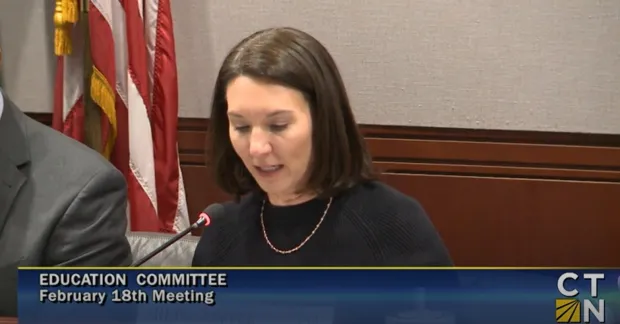
Rep. Jennifer Leeper, a Fairfield Democrat who co-chairs the legislature’s education committee, said New Haven and other school districts currently use a “Yondr pouch” that requires students to place their phones in a magnetically locked pouch that is stored in a separate area throughout the day.
“It’s been a really positive experience,” Leeper said. “Parents have been really happy with it … (There’s) more engagement in the classroom. … Right now, our local boards of ed don’t have to have a policy. Those policies could allow for cell phones during the day.”
Cell phones will not be banned on school buses because they are generally not on school grounds and not during the “bell to bell” period, lawmakers said. The local school board would decide whether cell phones could be used during after-school activities, and the districts would set their own policies on issues such as discipline for violating the policy, lawmakers said.
While legislators disagreed on how much control the local school boards should have, there seemed to be universal agreement that phones are a major distraction.
“There is no data that says cell phones in schools are good for children,” Leeper told her House colleagues. “We know phones are not good for children in schools.”
As some lawmakers said they were torn over the issue, Leeper said she understood the various views on cell phones.
“This is not a partisan issue,” Leeper said. “This is a tricky issue.”
But Rep. Lezlye Zupkus, the ranking House Republican on the legislature’s education committee, said the ban should be expanded to everyone in the schools.
“Our children don’t need cell phones, but neither do our teachers,” Zupkus told her House colleagues. “Teachers and administrators can walk around with their cell phones, but kids can’t.”
In agreement on a broader issue, Zupkus said, “Cell phones are bad for kids.”
Republicans offered an amendment, known as LCO 4832, that said teachers and administrators could not use cell phones in schools, either. But Leeper said that teachers need their cell phones to call 911 in case of an emergency.
“The reason we have not carved out teachers is because it is part of the safety plan of districts,” Leeper said.
The amendment was soundly defeated by 123-24 with four lawmakers absent.

House debate
Some lawmakers said they struggled on the vote, saying they were philosophically concerned about cell phones but also wanted to avoid unfunded mandates and allow their local school boards to retain as much authority as possible.
Schools that have already enacted policies in the past few years have had positive experiences, lawmakers said.
“Their cafeterias are loud again,” Leeper said, rather than having a quiet cafeteria with students staring at their phones.
Rep. Moira Rader, a Guilford Democrat, agreed that cafeterias have been much louder as children have become more social instead of concentrating on their phones.
“The data is irrefutable,” Rader said. “Cell phones are damaging” to children in schools.
Rep. Stephen Meskers, an Old Greenwich Democrat, said he was initially concerned about local control and mandates, but then he started thinking about the importance of helping children. As the father of three, he said that the children in the cell phone debate must take priority.
Saying that he was surprised by various lawmakers who were either opposed or supportive, Meskers said the debate followed the adage that “politics makes strange bedfellows.”
Zupkus, who voted against the bill, said she saw no need for the legislation.
“This is just to make people feel good that they’re doing something,” Zupkus said. “I certainly don’t see the need for this.”
State Rep. Gale Mastrofrancesco, a Wolcott Republican, said cell phones have changed society.
“There’s no doubt about it that people in general are addicted to their cell phones,” Mastrofrancesco said. “I do believe people are distracted. The obsession we have today with cell phones is truly remarkable. … When a child is on their cell phone, they are not paying attention to what is happening in class.”
Looking across the House chamber, Mastrofrancesco said that legislators themselves often have their heads down as they are looking at their cell phones during the debates.
“We are distracted by our cell phones as the kids in school,” she said. “We, as adults and parents, should set an example for children. When you’re out at dinner, don’t be on your phone.”

Rep. Greg Howard, a Stonington Republican who has two sons, said the issue did not require state legislative action because school districts already have the ability to make their own policies that work best for their schools. He said that he knew students who put one phone in their Yondr pouch like the other students and then still kept a separate phone in their pocket.
“Each individual district can address that and doesn’t need our help,” Howard said.
Rep. Tony Scott, a Monroe Republican who said that school districts should make the decisions, held up his cell phone, and said, “I have twin daughters, 17 years old. They live and die by this thing. … They are totally fine with the policy. … It is working in Monroe. My worry is edicts from Hartford. … The fact that there is no enforcement of this bill makes it a feel-good bill.”
Waving her phone in the House chamber, state Rep. Amy Romano of Shelton said, “This phone here is like a drug. … My own son was suspended for using his device. … I had to stand by the administration, and guess what? He didn’t play his Friday night football game and learned his lesson.”
Rep. Tina Courpas, a Greenwich Republican, asked why the legislature believes it can make better policy decisions than the individual school districts.
“This bill is affirmatively overriding local policy,” Courpas said. “There is only one question: who decides? It’s a classic example of one size does not fit all.”

Lamont speech
The issue has been a problem for years, and it gained widespread attention from Gov. Ned Lamont.
In February 2024, Lamont placed a spotlight on the issue during his State of the State Address to a joint session of the General Assembly on opening day of the legislative session. Lamont told the standing-room-only crowd that “severe anxiety and aberrant behavior can be traced back to social media.
“Social media is often anti-social, and too much smartphone makes you stupid,” Lamont continued.
In an attempt to improve the situation, Lamont said the best way is to take a “little bit from China and a little bit from Beyoncé.”
In China, children are limited in using TikTok to only one hour each day. At concerts by superstar Beyoncé, fans must place their phones in a “Yondr Pouch” — a special sleeve that locks magnetically and prevents use.
Soon after, Lamont and state Attorney General William Tong visited a pilot program at a public middle school in Manchester, where phones were surrendered by the students during the school day and placed in special pouches so that they would not be a distraction from learning.
Two years later, lawmakers are still tackling the problem. The bill now goes to the state Senate as lawmakers race to finish their work as the 2026 legislative session ends on May 6.
Christopher Keating can be reached at ckeating@courant.com