A decade ago Jua Power, a family-owned solar-energy firm, had little reason to leave China in search of customers. With the country in the midst of a green-energy boom, “we had plenty of orders domestically,” recalls Xu Bo, its chief executive. But as China’s economy has slowed and profits in its solar industry have fallen, Mr Xu’s calculus has shifted. In March 2025 he decided to build a factory in Tatu City, a special economic zone (SEZ) in Kenya. It is the firm’s first direct overseas investment in its nearly six-decade history.
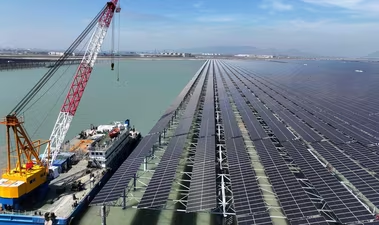
Workers install solar panels with a crane at the CNNC Tianwan tidal flat photovoltaic power plant in Lianyungang (AFP)
Jua Power joins a growing wave of Chinese manufacturers who have recently landed in Kenya and other parts of Africa. In 2025 Chinese foreign direct investment in manufacturing in Africa surged to $12.3bn, spread across 64 new projects—the highest number in a single year in at least a decade, according to fDi Markets, a data provider. (Total capital expenditure announced in 2023 was $24.6bn, but spread across 35 projects.) Between 2023 and 2025 China invested more than America and Europe put together. Never before has Africa been so attractive to Chinese manufacturers, says John Mwendwa, the head of Kenya’s investment authority.
Not all planned projects will come to fruition. But at a time when Chinese lending to Africa is shrinking, and the Chinese state is less inclined than it used to be to bankroll huge infrastructure projects, the surge of private capital into African steel mills, textile factories, electric-vehicle assembly plants and more shows how Africa’s relationship with its largest trading partner is changing—and how important that relationship remains.
As wages in Chinese factories rose in the early 2010s, many expected that Africa’s relatively low labour costs, youthful population and free-trade agreements with America and the EU would make it “a magnet for Chinese offshoring”, notes Eric Olander, co-founder of the China Global South Project, a media initiative focused on the relationship. An influential book published in 2017 predicted that as China shifted from manufacturing to services Africa would replace it as the “factory of the world”. African policymakers hoped export-led growth would speed up development and create millions of new jobs.
That dream has disappointed, says Mr Olander. In Ethiopia, once touted as the “China of Africa” on account of its commitment to export-oriented industrialisation, manufacturing as a share of GDP fell from a recent peak of 6% in 2017 to 4.4% in 2024. In sub-Saharan Africa as a whole that year the share was 10% of GDP—down from 18% in 1981. Rising protectionism in the West and uncertainty about the future of the African Growth and Opportunity Act, America’s duty-free scheme for African exporters, may dim prospects further.
But Chinese investors are undeterred, as Kenya shows. Tatu City is in talks with over 1,000 Chinese companies, says Preston Mendenhall of Rendeavour, the company that owns the SEZ. George Olaka of Arise IIP, which builds industrial parks across Africa, says he is negotiating with a number of big Chinese investors looking to set up factories in Kenya, including a solar supplier and a glass manufacturer. Six of seven flagship Chinese projects announced last year, including a steel plant and a garment factory, have begun construction, according to Kenya’s investment authority.
Chinese firms are attracted by Africa’s rapid population growth and improving economic prospects. Before the start of the Iran war in February, the IMF predicted for the first time in years that annual economic growth in sub-Saharan Africa would be faster than in the Asia-Pacific region. In 2026, 12 of the world’s 20 fastest growing economies are expected to be in Africa.
But the main reason Chinese manufacturers are looking to Africa is trouble at home. “In China the manufacturing industry has reached a very critical turning point,” says Zhao Tongtao of Letol, an agricultural-machinery manufacturer which recently arrived in Tatu City. Industrial profits in China remain low, despite some recent signs of recovery. Fierce price wars plague everything from cement and steel to electric cars and solar panels.
Africa offers the prospect of much higher returns. Charlie Yang, a Chinese entrepreneur who founded a medical-equipment factory in Kenya last year, says that prices there for items like plasters can be three to four times higher than back home. Partly because of this, many Chinese manufacturers in Africa focus on serving local or regional consumers. Few export beyond the continent.
That is not quite what those who hope to see Africa become a global manufacturing hub usually have in mind. For economists such as Joe Studwell, author of “How Africa Works”, a new study of African development, countries grow rich by building large, highly productive manufacturing firms that sell to the world. Factories targeting Africa’s small, fragmented domestic markets do not entirely fit the bill. Still the bigger ones could deepen regional integration, which African policymakers have long claimed they want to improve.
Some fret that Chinese factories could undermine indigenous manufacturing. Since a Chinese-owned steel plant launched in Zimbabwe in 2024, big steel operations in South Africa have been forced to close, says Lufuno Munzhelele of the South African Iron and Steel Institute, an industry lobby. Such fears are especially acute because of Africa’s yawning trade deficit with China, which last year increased by 65% to a record $102bn. The Chinese government says its decision to eliminate tariffs on almost all African imports from May 1st will help. But this is likely to benefit agricultural products, such as coffee, more than manufactured ones, of which Africa does not yet export much.
Others are more sanguine. Evidence of Chinese firms displacing African ones is scarce, notes Carlos Oya of the School of Oriental and African Studies in London. Many are instead “filling gaps in domestic manufacturing capabilities”. There is little reason why factories that start by producing for local markets cannot grow into globally competitive exporters—especially if tariff wars, trade disruption and geopolitical volatility prompt overseas buyers to look more closely at Africa. In the meantime Chinese factories are providing jobs and training for workers across the continent. African governments would be wise to help them flourish.