Australia and its partners in the Five Eyes intelligence alliance have issued a rare joint notice warning about Chinese spies aggressively using LinkedIn and other job platforms to “lure” recruits with access to sensitive information.
“China’s military intelligence services are using an increasingly wide array of professional networking sites and online job platforms to target Five Eyes government and military personnel, and anyone with access to classified or privileged information,” the domestic security agencies from the US, Britain, Canada, Australia and New Zealand said.
The “Safeguarding Our Secrets” bulletin said the Chinese operatives were posting fake online job ads, posing as “employees of private consultancies, think tanks or human resources firms”.
Their primary targets are government or military personnel, or anyone with access to classified information.
Also at risk are academics, journalists, think tank employees, and professionals with links to defence and economic sectors who may have indirect access to government data.
“Chinese military intelligence services ultimately seek to acquire privileged military, political and economic intelligence that can provide China with a strategic and tactical advantage over the Five Eyes,” according to the notice.
A full recruitment process
The FBI posted about the threat, warning: “Applicants beware!”
“The threat is real,” the US law enforcement agency said.
According to the Five Eyes notice, spies were carrying out an “aggressive” recruitment strategy, attempting to form long-term relationships that would result in the exchange of classified or privileged information.
The tactics included a full recruitment process:
- First contact. Recruiters post job ads on professional networking platforms and hiring websites, then reach out to candidates whose resumes showed a likelihood of access to sensitive information.
- Interview. Interviews are held virtually, with the recruiters concealing their identity. Applicants may be probed about their access to government contacts, or military members asked about their roles.
- Initial testing. Candidates are asked to write a trial report on topics such as China’s bilateral relations, the Indo-Pacific region and related defence or trade issues.
- More requests and platform shift. Recruits are informed that clients require more privileged information for additional reports. At some point in the recruitment process, intelligence officers typically transition the conversation to a more “secure” platform, such as encrypted messaging applications.
- Payment. Recruits receive anywhere from a few hundred to several thousand dollars per report, and may be offered more money for increasingly sensitive information. Payment methods include third-party payment platforms, such as PayPal and Wise.
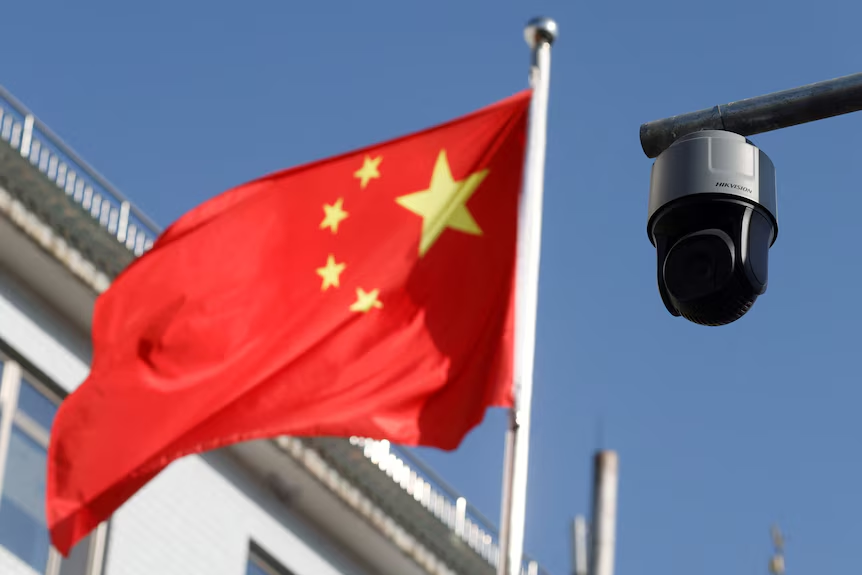
Beijing has repeatedly rejected such espionage claims made by Western intelligence agencies. (Reuters: Carlos Garcia Rawlins/File)
Clive Hamilton, a professor of public ethics at Charles Sturt University in Canberra, said the method being used was not necessarily new but it was “surprising and disturbing” that people were being drawn into it.
“There are plenty of naive experts out there who seem quite happy to sell their expertise without understanding the risks of doing so,” he told the ABC.
“When money is dangled before people, and then they’re flattered for the importance of their work by their handlers, people get sucked into this.”
Clive Hamilton has researched China’s espionage and foreign interference in Australia. (Supplied)
The intelligence agencies said even if an applicant did not have direct access to classified information, there were still risks.
“Even unclassified information on government policy, or on military strategy, capabilities and installations, can be collected and combined with more sensitive reporting to form a comprehensive operational picture,” the notice said.
Rare joint warning
Although there have been similar warnings from individual Five Eyes countries in the past, the joint bulletin has been described as unprecedented.
Professor Hamilton said the move was “quite unusual”.
“There have been warnings from agencies individually in the past, including ASIO, but I’m not aware that they’ve got together to issue a warning like this in the past,” he said.
Beijing has repeatedly rejected such espionage claims, calling them “pure fabrication and malicious slander”.
The US has previously warned about Chinese intelligence using deception to target current and former US government employees.
In November, Britain’s MI5 security service cautioned MPs about Chinese agents trying to spy on parliament.
Australia has also been sounding the alarm, warning about “unprecedented” levels of espionage and foreign interference.
In 2024, ASIO official Ewan Macmillan told a parliamentary inquiry that “hostile foreign states and their intelligence services and their proxies are aggressively seeking access to Australia’s secrets”.
“Whether this be information or knowledge or expertise of our defence and national security capabilities,” Mr Macmillan said.
“Individuals with access to secrets or knowledge related to these critical capabilities are being actively targeted by these intelligence services.”
Professor Hamilton said China had been expanding its influence throughout the Asia-Pacific region, and Australia had become a growing target.
“Australia is increasingly engaged in the region for security reasons, which means there are more Australians who have sensitive information, whether they be in the military, the intelligence service, or the diplomatic core,” he said.
“They’re usually people who’ve recently left those organisations, and are looking to forge new careers and they are particularly vulnerable to this kind of inducement.”