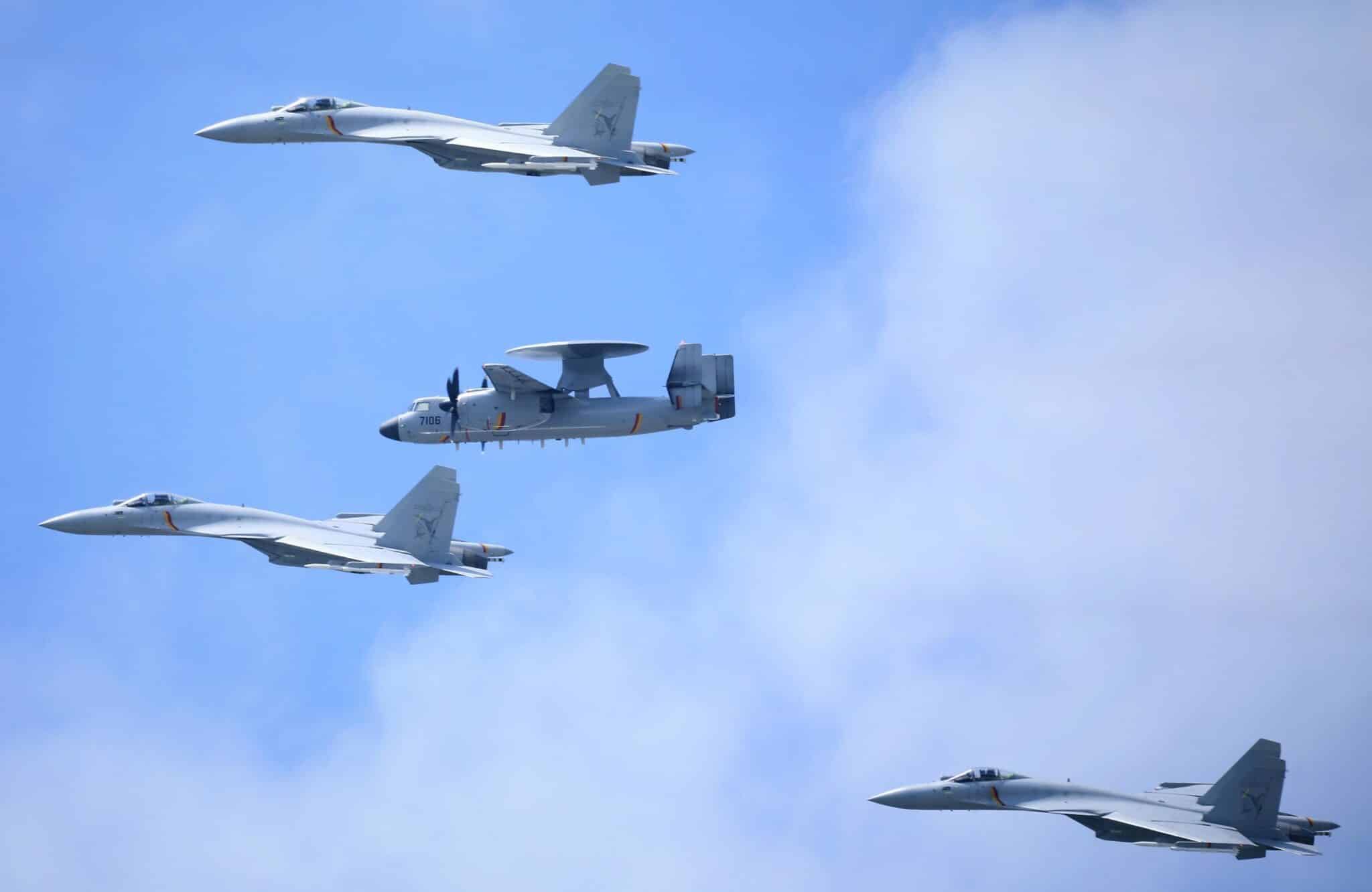
Significant developments in China’s naval aviation are continuing into 2025. Naval News takes a closer look at the latest milestones and examines the emerging trends that are still taking shape.
The Chinese aircraft carrier program is now well into its third decade of development. The unfinished former Soviet carrier Varyag originally arrived in Dalian in the early 2000s for rebuilding. In 2012 the ship joined service with PLAN as Liaoning (16). During that time China has made significant advances not just designing, building and operating further aircraft carriers. Beijing has also progressed significantly developing and fielding its an increasingly indigenous Chinese carrier aviation force.
Builder Jiangnan remains busy getting China’s third carrier and first supercarrier Fujian (18) closer to commissioning in Shanghai. Meanwhile the most pertinent developments for carrierborne fixed wing aviation concern equipping the Fujian with an appropriate airwing. Three important in question are two combat jets, the J-15T and the J-35, and additionally the KJ-600 early warning and command aircraft (AEWC). Furthermore China appears set to induct an adaption of the JL-10 training jet for carrier operations.
J-15T/DT – The ultimate Flanker carrier-borne fighter
The J-15T is the most recent naval adaption of the venerable Flanker-series of Soviet fighter jet-designs. The type represents the first iteration for taking off from catapult-equipped carriers. Shenyang Aircraft Corporation (SAC), the producer for all Chinese Flanker-types, is in charge of production. So far SAC has delivered at least three batches of J-15T to PLAN and is producing the fourth lot. The original J-15 is designed for operation from ramp-equipped carriers like Liaoning (16) and Shandong (17). The aircraft is an evolution or amalgam of the Soviet Su-33 and the J-11B, itself a development of the Su-27. China obtained one prototype of the Su-33 in 2004 from Ukraine, launching domestic develpment. Until recently J-15 has provided the backbone of Chinese carrier aviation, particularly for building and training the new force.
The J-15T, previously often referred to as J-15B for its production variant, may be viewed as the ultimate Flanker-derived carrierborne fighter design benefitting from catapult launch to maximise range and payload capabilities of the heavy fighter. Prototypes for the effort appeared from 2015, and series production is underway since at least 2021. In 2024 a substantial number of J-15T appeared onboard both Liaoning and Shandong in the context of the first dual carrier operation for PLAN. Operating the same type from catapult- and ramp-equipped carriers would further enhance commonality and capability across Chinese carrier aviation.
Most recently in late July official footage suggested the J-15T has begun with testing including catapult launches onboard Fujian. Related imagery partially showed J-15T at launch positions and implied overflights of the carrier.
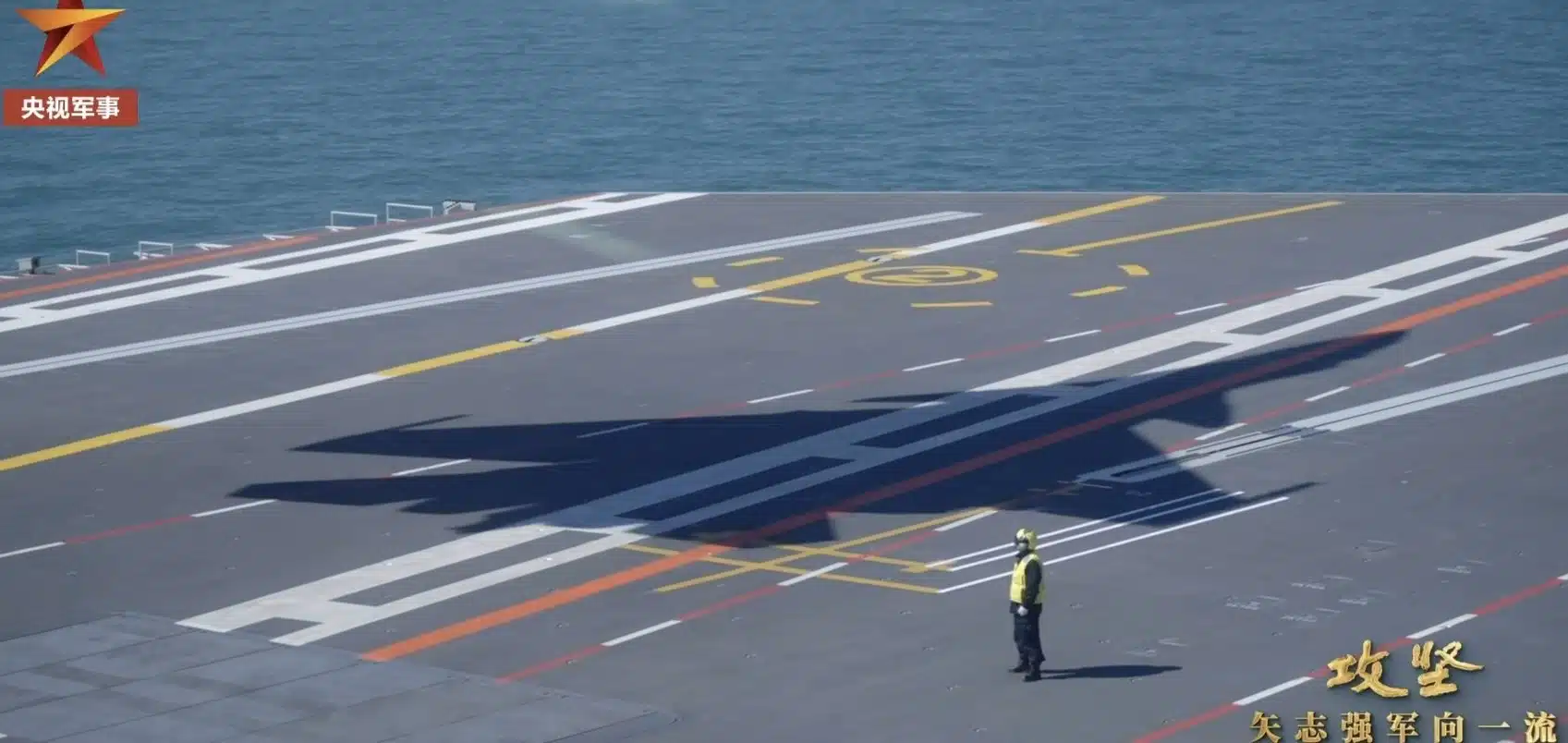
Earlier, in May this year new imagery also confirmed a catapult-capable adaption of the J-15D, an electronic warfare-variant analoguous to the American F/A-18G, will operate from Fujian. Observers refer to the new variant as J-15DT. The earlier J-15D is already operational onboard Liaoning and Shandong. The type most recently appeared in numbers at the dual carrier-exercise last year similar to J-15T.
Developments suggest fielding of catapult-capable J-15 adaptions for a to be commissioned Fujian is on track. Ongoing J-15T and J-15DT-deliveries may further equip Liaoning and Shandong in significant quantities as part of logistics harmonization.
J-35 – The PLAN next generation naval combat jet
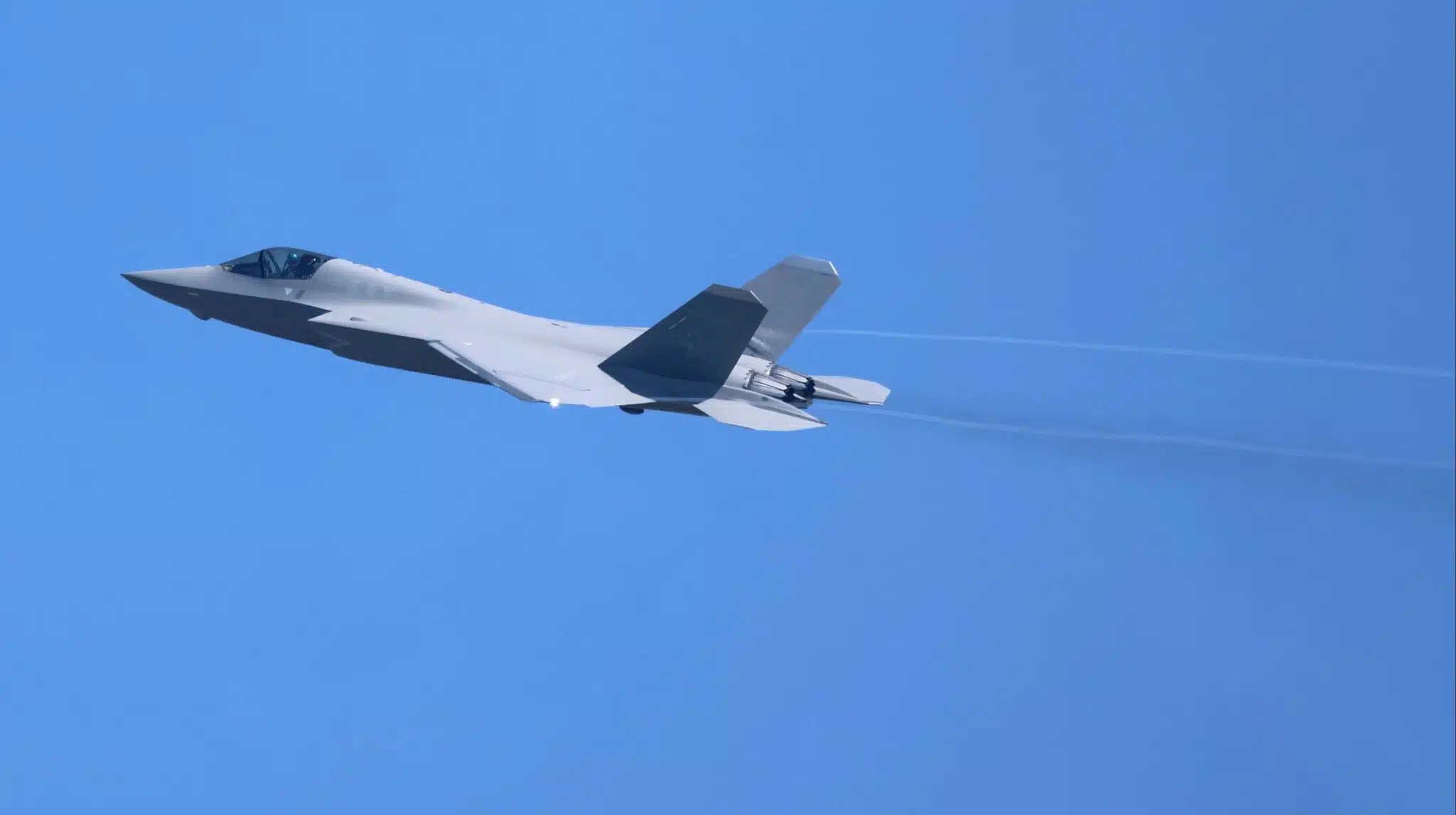
As Naval News described before, the J-35 evolved out of SAC’s earlier FC-31 next generation fighter. The FC-31 appeared as an in-house developed and promoted design primarily for export, including on various defence trade shows since 2011. A first prototype for FC-31 flew in October 2012. Two successive prototypes improved on the original design over the next four years. In 2018 first rumours suggested PLAN was interested in adapting the design for Chinese carrier aviation.
A mockup of J-35 appeared on the landbased carrier testing facility in Wuhan in 2021. The new design shows significant revisions over FC-31, including in basic dimensions, an elevated cockpit, and folding wings. Prototypes for J-35 have conducted flight testing since 2021. Series production appears to now be underway, with aircraft appearing in regular PLAN livery.

While mockups of J-35 have been present onboard Fujian for the last two years, the testing status of operational airframes onboard the new carrier remains unclear as of this writing. Notably, while J-35 appears set to feature prominently as part of Fujian‘s airwing, the design may also operate from the two STOBAR-carriers. A mockup of J-35 appeared on Liaoning at Dalian in early 2024, suggesting related testing.
KJ-600 – First carrier AEWC platform for PLAN

One of the more substantial capability improvements the new catapult-equipped supercarrier Fujian can offer over the existing STOBAR-carriers in PLAN service is the capability to operate large fixed wing aircraft for a variety of roles. The most notable of these would be AEWC, the airborne command post-function directing combat assets towards objectives and providing airborne early warning to Chinese naval fleet detachments. This is the designated role for the new KJ-600, a Chinese analogue to the American E-2 series of aircraft. Over the last few months a large number of high quality imagery of the design appeared on Chinese social media.
The new design saw development at Xi’an Aircraft Industrial Corporation (XAC) since at least 2016. Mockups appeared from 2017 and the first flight probably occurred in 2021. Based on imagery at least six prototypes or low rate-initial production aircraft are flying so far. The most recent image suggests the type may be operational with PLAN, at least for further testing. The current production status remains unclear, pending new imagery. The design will likely make a big public appearance at the parade celebrating the end of WW2 in Asia on 3rd of September this year.
KJ-600 shows remarkable similarity in overall configuration to the American E-2 series. Notable differences concern the tail design featuring conventional vertical stabilizers instead of the inverted design on E-2, and a large nose mounted radome. The main radar seems to feature a double sided rotating AESA. The aircraft currently lacks an inflight refuelling probe, though further development may add this capability.
It is presently not clear whether PLAN has interested in a carrier onboard delivery-variant of the KJ-600, similar to American C-2 Greyhound. Such a capability would seem to be desirable to further enhance operations of Fujian and future supercarriers with bulk and outsized cargo delivery such as for aircraft engines and other spare parts. A mockup of KJ-600 missing the radome appeared in footage next to Fujian fitting out in Shanghai in 2024. However, a stronger possibility points to a partially assembled KJ-600 seen regularly on the new carrier.
JL-10 – Light Trainer for carrier service
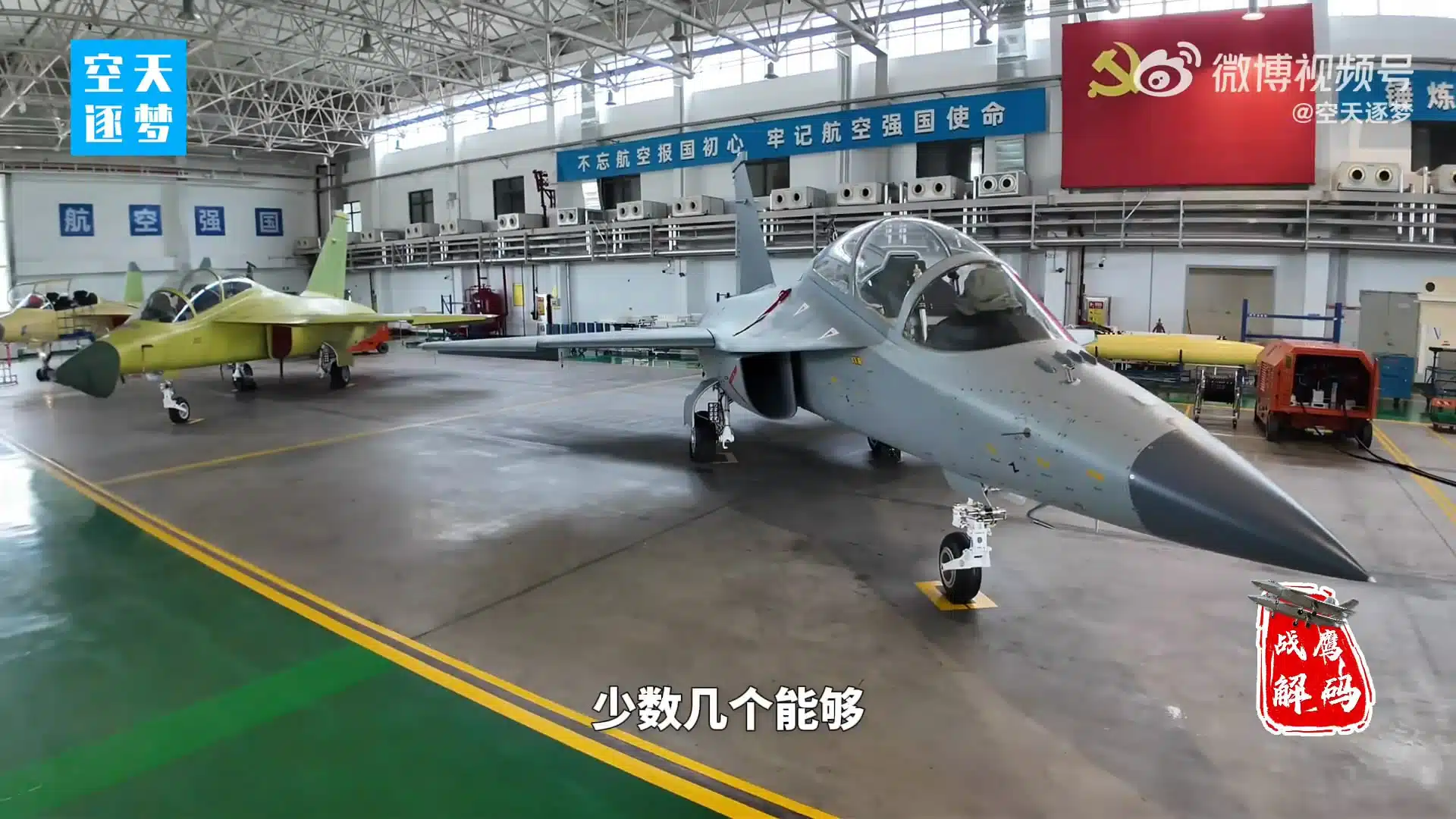
The JL-10, also referred to as L-15, is a light tandem jet trainer which can provide the advanced jet trainer or lead in fighter trainer role depending on engine configuration. The Hongdu-produced design is in service with PLAAF and in a land-based training role with PLAN. A radar-equipped variant can also perform the light fighter-role. Mockups for JL-10 appeared onboard Fujian from 2024, suggesting a carrier-based variant dubbed the JL-10J is in active development. Whether such a design would purely perform as trainer or assume a combat-role remains to be seen.
Most interestingly, Hongdu appears to be in the process of fielding a further developed new variant for carrier-service. Based on sketches circulated in 2024, the aircraft, dubbed JL-15 by commentators, first appeared to be a JL-10 with twin vertical stabilizers instead of the conventional tail on JL-10. However, the most recent image revealed in July 2025 shows an airframe that appears to display further deviations from the JL-10 reference configuration, including a reshaped cockpit and twin forward landing gear. Further details and the status of this effort remain unclear pending detailed imagery.
Known Unknowns – next generation fighters and drones

The range of aircraft as outlined above illustrates PLAN is for now well set up to equip future carrier airwings with capable designs fulfilling combat, support and training roles. Nevertheless some future efforts further enhancing and evolving this posture remain obscure. Recent imagery revealing not one, but two next generation fighter jets for PLAAF are a point in case. At this stage it is unclear whether for instance the SAC-designed future fighter, dubbed J-XDS, will see adaption for operations onboard aircraft carriers. Considering the very long development timelines for cutting edge aviation designs it seems logical PLAN is already surveying their options for acquiring a complementary successor to the J-35, also with an eye on shedding Flanker-derived capabilities in the mid-term.
Another unknown relates to the status of carrierborne drone operations with PLAN. China continues to field and develop a wide range of uncrewed capabilities, including for combat applications. An equivalent to designs pursued by Western militaries in the shape of “Loyal Wingman”- or collaborative combat aircraft designs is very likely in advanced development, based on circulated imagery and released information. Additionally PLAN may have interest in fielding a carrier-based support drone similar to American MQ-25 for roles such as inflight refuelling and reconnaissance.
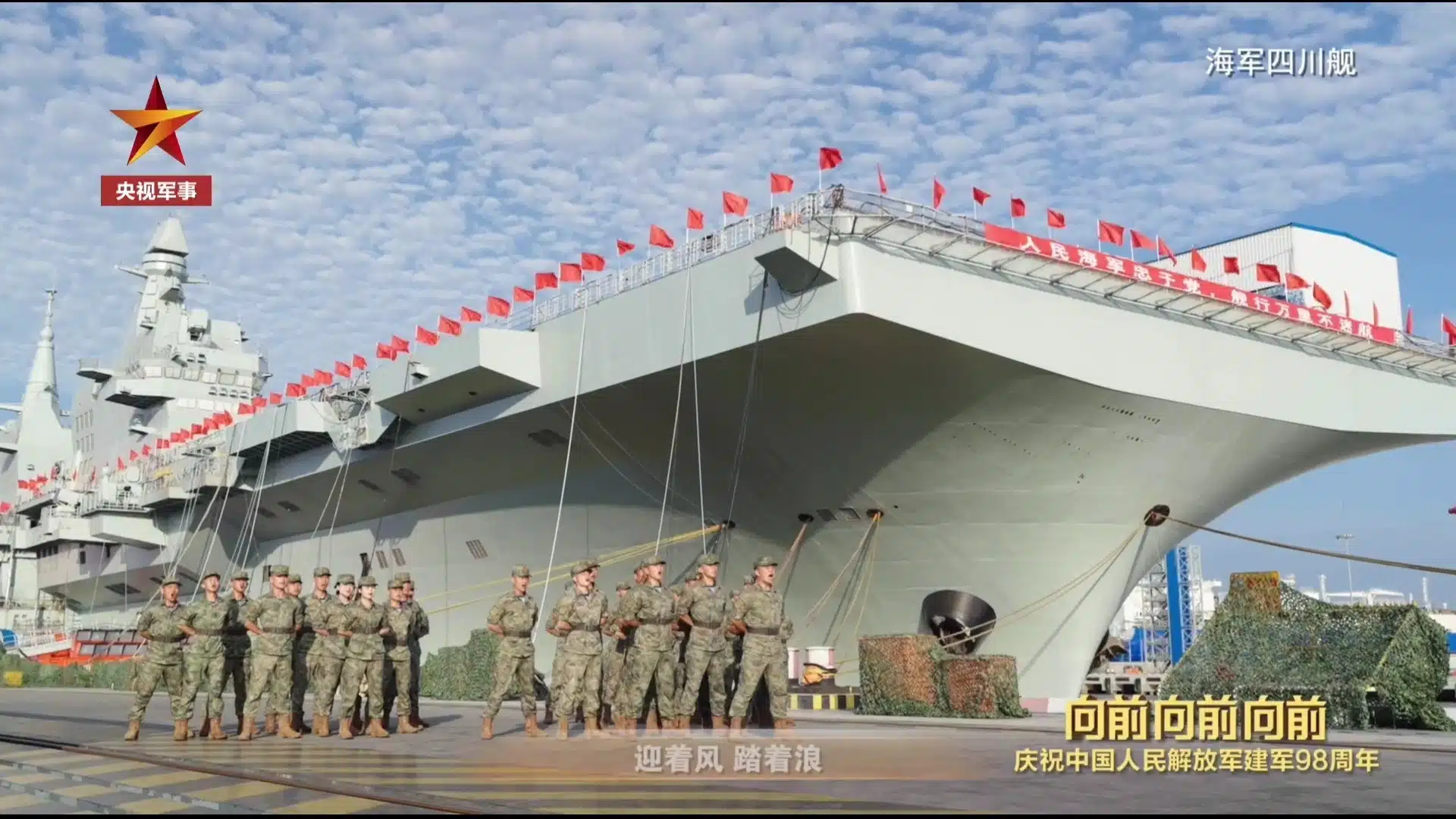
The Type 076 amphibious assault ship Sichuan (51), currently fitting out in Shanghai, featuring an electromagnetic catapult as a world first for amphibious ships, also illustrates considerable PLAN interest in acquiring uncrewed fixed wing capabilities for naval service. Sichuan appears close to sea trials, suggesting further information in this regard will come to light in the near future. Nevertheless, Fujian and future large carriers appear well set up to support far more capable UAV-designs than an amphibious carrier. What course Chinese carrier aviation will pursue in this regard remains to be seen.
