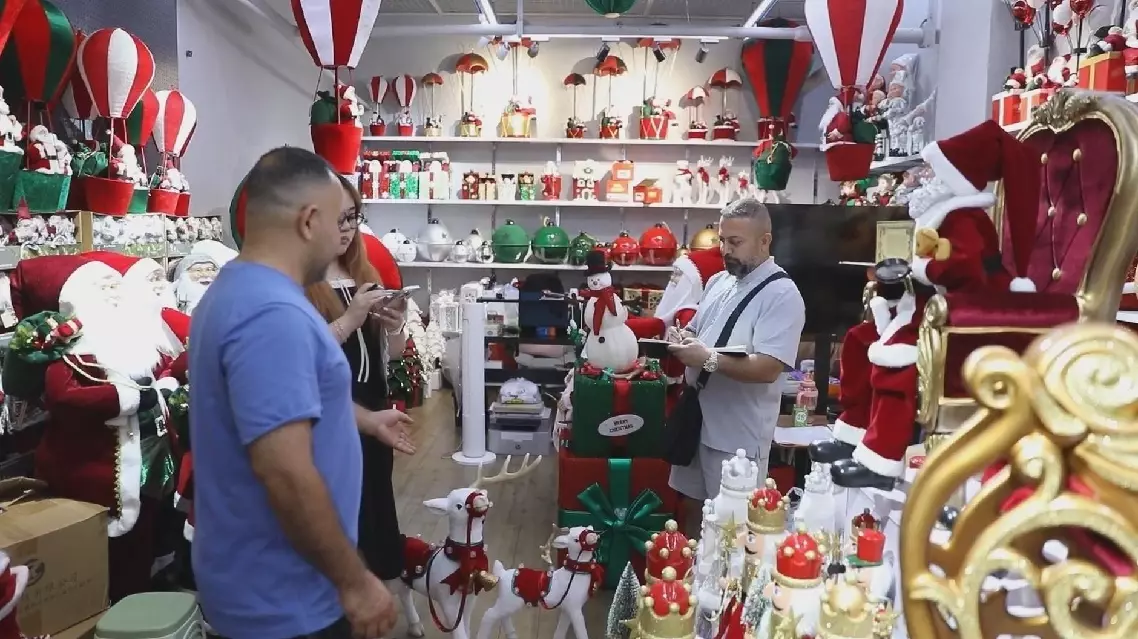
China’s Yiwu International Trade Market is experiencing a peak season for holiday goods exports as global traders flock to restock Christmas decorations.
Business owners report that clients from Europe, the Americas and other long-haul markets began bulk purchasing as early as March and April. Procurement for holiday products is entering its peak season, with immediate availability and fast delivery emerging as top priorities for buyers.
“I have a company in China that serves many clients. In total, we need about 10 to 15 containers [for the Christmas], because everyone needs these products, whether toys or decorations, during the Christmas. Chinese products are the most cost-effective. China is the world’s factory, and the prices here are very favorable,” said Julio, a purchaser from Ecuador.
Dubbed the “world supermarket,” Yiwu has already exported 2.14 billion yuan of Christmas supplies in the first half of this year, marking a year-on-year increase of 20.4 percent, according to Yiwu Customs.
“We started getting busy around April after the Spring Festival, but July, August, and September are our busiest months. Currently, our orders are scheduled at least through September,” said Ding Tianyue, sales director of a local packaging materials company.
Behind the growth in Yiwu’s overseas orders, product innovation has become a key driver.
“I need new designs every year. I don’t want the exact same models annually. There must be new products and fresh ideas. If I see a new design, I buy it,” said Maher Aziz, a purchaser from Iraq. This year, holiday goods in many Yiwu stores are evolving from static decorations into dynamic, interactive products. By integrating electric motors, music, lighting, and sound-activated sensors, vendors are bringing traditional ornaments to life to boost interactivity.
“Take this larger product as an example. It can be placed in restaurants or at store entrances to attract customers. Because it is motorized and sound-activated, it starts singing whenever someone approaches. Basically, every client who sees it will place an order,” said Zhang Xuyin, a merchant at Yiwu International Trade Market.
Zhang said her company launches hundreds of new designs annually. They will test market reactions in the showroom before focusing production on popular styles. These market-vetted innovations are driving significant growth in overall corporate orders, she said.
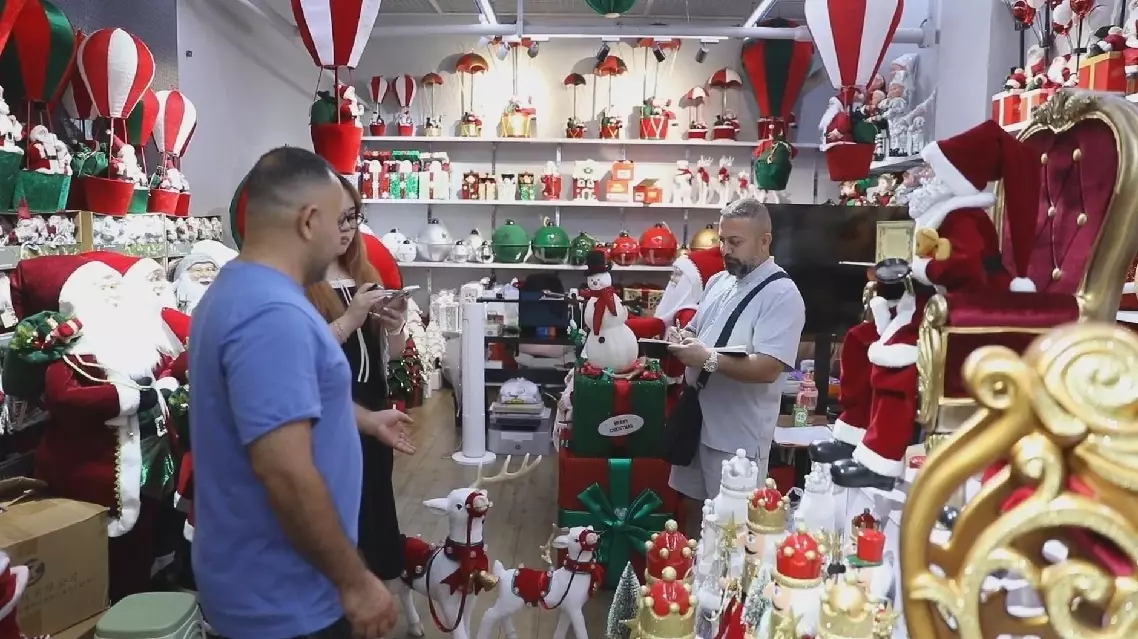
China’s Yiwu market experiences peak season for holiday goods exports
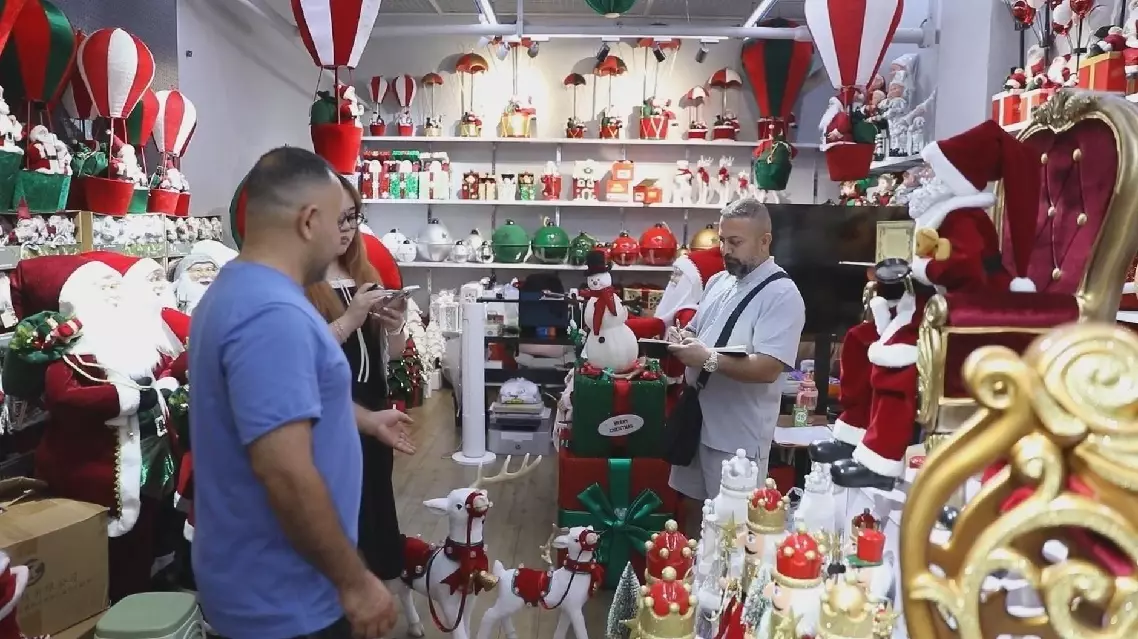
China’s Yiwu market experiences peak season for holiday goods exports
For more than 1,000 years, Jingdezhen, the “porcelain capital” in east China’s Jiangxi Province, has shaped how the world understands porcelain, with even discarded shards preserving a living tradition.
Weng Yanjun, president of the Jingdezhen Imperial Kiln Institute, reflected on the scale and challenge behind Jingdezhen’s historic creations.
“When I look at this gigantic dragon jar, I couldn’t help going back to 600 years ago, when the emperor had this order to create something bigger than ever before. The failure rate of the dragon jar is so high. It could be nine out of 10. Even making failure products like this takes courage, takes techniques and takes commitment,” said Weng.
Those failed attempts, once discarded, now preserve the evidence of how Jingdezhen pursued perfection.
For more than 1,000 years, Jingdezhen’s porcelain industry has endured through the Song, Yuan, Ming and Qing dynasties (960-1911). What has survived is not only its porcelain, but also a living heritage of raw materials, workshops, kilns and specialized craftsmanship.
Those firings produced masterpieces as well as failures, with the discarded pieces forming another kind of archive.
At the Jingdezhen Imperial Kiln Institute, Weng told archaeology students that fragmented specimens sometimes provide more information than complete artifacts.
Weng leads the development of the world’s first Ancient Ceramics Gene Bank, which extracts and catalogs the defining characteristics of each ceramic shard.
“For our institute alone, we have excavated more than 20 million pieces of shards for the past over 1,200 years. Among those shards, we do sorting, we do restoration, and we do scientific tests. And then we find, wow, a small shard can tell us much more information than even a whole piece,” said Weng.
Using a standardized sample library and unified data framework, the project records each piece’s shape, decoration, body material, glaze, color, firing marks and inscriptions, creating a valuable resource for authentication and research around the world.
“The whole city is a wonderful lab and space range makes Jingdezhen uniquely a wonderful example of how the handicraft ancient industry with porcelain as the focus survived even to today,” Weng added.
Jingdezhen once helped establish benchmarks for how porcelain was made. Now, the gene bank is turning fragments into a language that can be read beyond the city. For French artist and researcher Yann Colleu, learning to read that language has also changed the way he creates.
“Since my childhood, my parents had these teapots, tea sets, plates and cups. I was very curious about the pattern, like the meaning, what was behind it? Actually when I discovered in Jingdezhen that it was a bat, because of ‘fu’ and ‘fu’ is fortune, but also you have the ‘wufu,’ like the five blessings. I was like a child with stars in the eyes, discovering the world for the first time,” said Colleu, PhD candidate at Jingdezhen Ceramic University.
What once seemed abstract became part of Yann’s own visual language. In his work, traditional Jingdezhen motifs and production scenes are reimagined through a contemporary, cross-cultural lens.
“Jingdezhen is a timeless city. The past, the present and even the future are tied together. This is one of illustration of 72 traditional steps developing during the Ming Dynasty (1368-1644). The difference is, instead of using Chinese characters, I use foreigners. I want to use the past to talk about the present and even the future with Jingdezhen,” said Colleu.
The Jingdezhen Handicraft Porcelain Industry Sites were inscribed on the UNESCO World Heritage List on Saturday. The inscription recognizes not just a single kiln or masterpiece, but an entire production system, from its archaeological remains and traditional craftsmanship to its industrial knowledge and global influence.
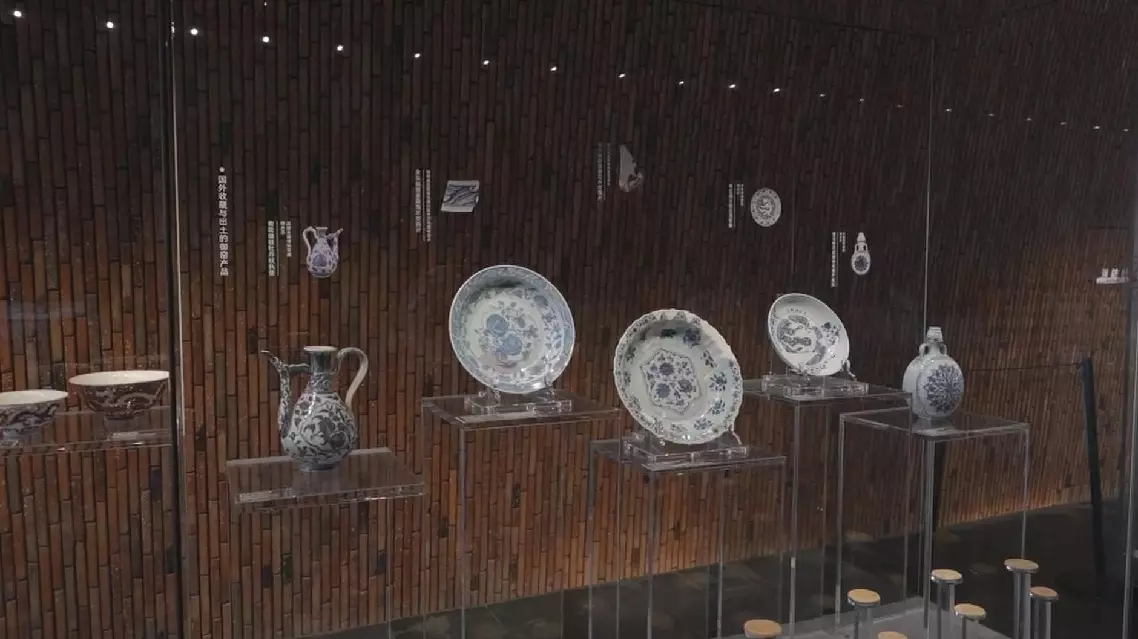
Porcelain shards preserve Jingdezhen’s timeless legacy