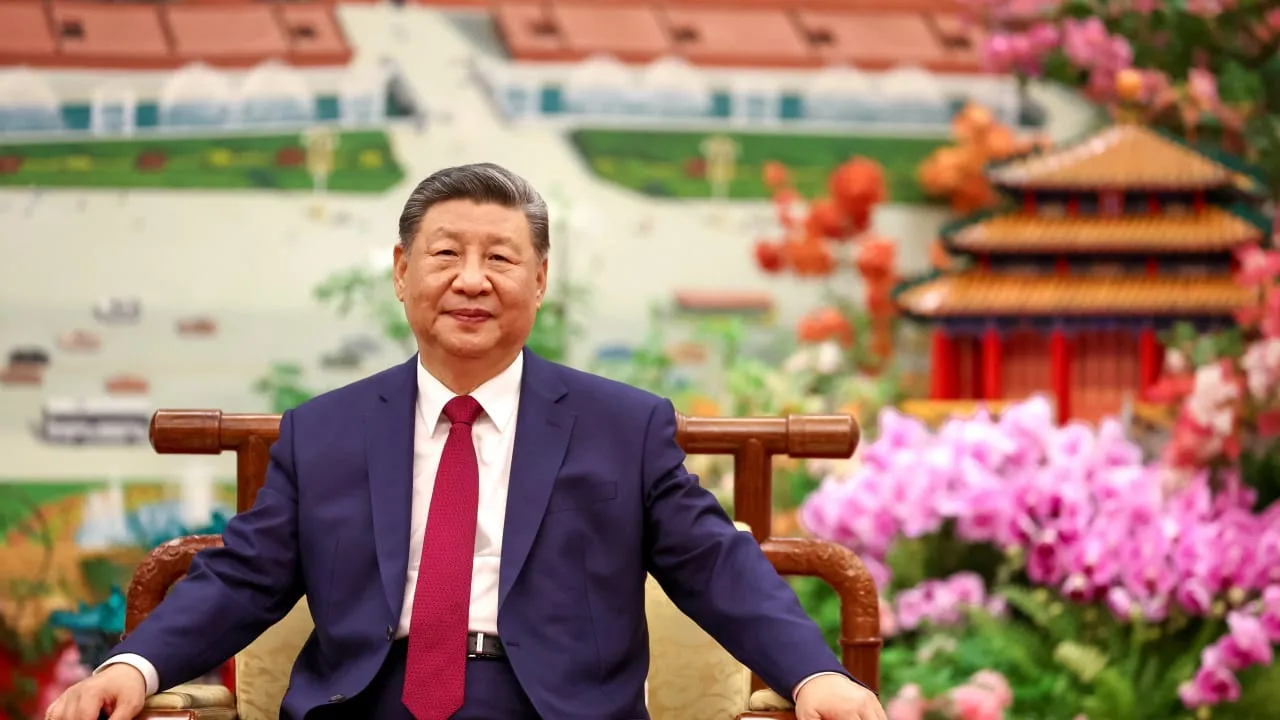
China said on Friday that President Xi Jinping would visit North Korea on a two-day trip from June 8, his first in nearly seven years as Beijing looks to reassert ties with Pyongyang, its only formal treaty ally.
Beijing has worked to draw Pyongyang back into its fold after the COVID-19 pandemic froze exchanges and its leader, Kim Jong Un, deepened ties with Moscow by sending troops and weapons to support Russia’s invasion of Ukraine.
“The message implicit from the Chinese side is … we are still the principal actor when it comes to North Korea,” said John Delury, a senior fellow of the Asia Society. “One of the audiences is Russia.”
Friday’s announcement by the international department of the ruling Chinese Communist Party follows Xi’s summits in Beijing last month with US President Donald Trump and Russian President Vladimir Putin.
Xi is visiting North Korea at the invitation of Kim, state news agency KCNA said.

Kim was a guest at a massive military parade in Beijing last September, traveling to the Chinese capital on his signature green armored train.
Passenger train services between the capitals resumed in March, after a six-year suspension ushered in by the pandemic, while Air China later restarted flights between them.
Bookings, however, have been limited to some business travelers and exchange students, with Chinese tourists still excluded.
Xi’s first overseas trip of 2026
Xi’s visit to Pyongyang will be his first overseas this year. The 72-year-old, who makes fewer trips abroad, last traveled internationally in late October to South Korea, where he also met Trump.
“At the symbolic level it is important for Xi to keep tabs on what’s going on in Pyongyang,” said Delury, who said Xi visiting both Koreas within a year would be a “big win” for the peninsula.
“There’s a kind of symmetry that the Chinese like to keep up” regarding the two Koreas, he added.
Trump, who met Kim three times in his first term, has previously said he would be open to meeting the North Korean leader again.
Since Xi became China’s top leader in 2012, he has visited North Korea once, and its southern neighbor twice. He also visited Pyongyang in 2008 as vice president, meeting its then leader Kim Jong Il, the father of the current leader.
Kim called for an “exponential” expansion of Pyongyang’s atomic arsenal this week when he visited a new factory to make nuclear material, KCNA said.
Experts have linked Kim’s site visit to the impending meeting with Xi. Before his September visit to Beijing, Kim inspected plans for a new intercontinental ballistic missile, the “Hwasong-20.”
North Korea’s Kim calls for ‘exponential’ nuclear expansion after inspecting new plant, KCNA says
Kim called for an “exponential” expansion of the country’s atomic arsenal during a visit to a newly operational nuclear material production factory, state media agency KCNA said on Thursday.
Kim said production capacity for weapons-grade nuclear material had reached more than double its previous level over the past five years and instructed officials to further increase output to meet long-term strategic goals.
During the visit, he was briefed on new production processes incorporating more advanced technology and reviewed current output targets and future plans, KCNA reported.
Photographs published by state media showed Kim walking between rows of cylinder-shaped equipment inside the facility, which some analysts said could indicate the location is at the country’s main nuclear complex in Yongbyon.
Kim said the expansion was necessary given what he called worsening security threats and long-term confrontation with “the most ferocious enemies” and reaffirmed the country’s policy of increasing its nuclear deterrence.
KCNA said a key consultative meeting on bolstering nuclear forces was held the same day, at which Kim outlined guidelines for accelerating both the qualitative and quantitative expansion of North Korea’s nuclear arsenal.
The country has set out the sequence and safeguards for executing an “ambitious future plan designed to beef up our state’s nuclear forces at an exponential rate,” KCNA quoted Kim as saying.
This is a “historic event that has set up an epochal milestone in rapidly upgrading our nuclear capabilities,” he added.
The nuclear facility North Korea unveiled on Thursday was a uranium-enrichment site, an official at South Korea’s Joint Chiefs of Staff said at a briefing in Seoul.
Satellite images published last year by Jeffrey Lewis, distinguished scholar of global security at Middlebury College, identified a suspected location for the Yongbyon plant, with a large central hall about 95 meters (103.89 yards) in length and 24 meters in width surrounded by office and support spaces.
Images seen by Reuters of the site from May show the surrounding area of the facility has been paved.
Analysts said Kim’s visit appeared aimed at reinforcing North Korea’s negotiating position ahead of potential diplomatic engagement while justifying an acceleration of its nuclear build-up.
Chad O’Carroll, founder of North Korea-focused website NK News, said the site visit could be linked to a potential trip by Chinese President Xi Jinping to Pyongyang, noting that before traveling to Beijing in September 2025, Kim inspected plans for a new intercontinental ballistic missile, the “Hwasong-20.”
“The logic would be to demonstrate absolutely that denuclearisation is not possible, right on the eve of contact with the PRC,” O’Carroll said, using China’s formal name, the People’s Republic of China.
Lim Eul-chul, a professor at South Korea’s Kyungnam University’s Institute for Far Eastern Studies, also linked Kim’s latest visit to Seoul’s pursuit of a nuclear-powered submarine and its talks with Washington over uranium enrichment rights, which he said Pyongyang may be using to justify accelerating its weapons program.
“Even if South Korea does not proceed, the North will follow its own path, but such developments provide a convenient pretext to push its nuclear build-up faster and on a larger scale,” Lim said.
North Korea is estimated to possess around 50 nuclear warheads, according to international assessments, though it has never disclosed the size of its arsenal.