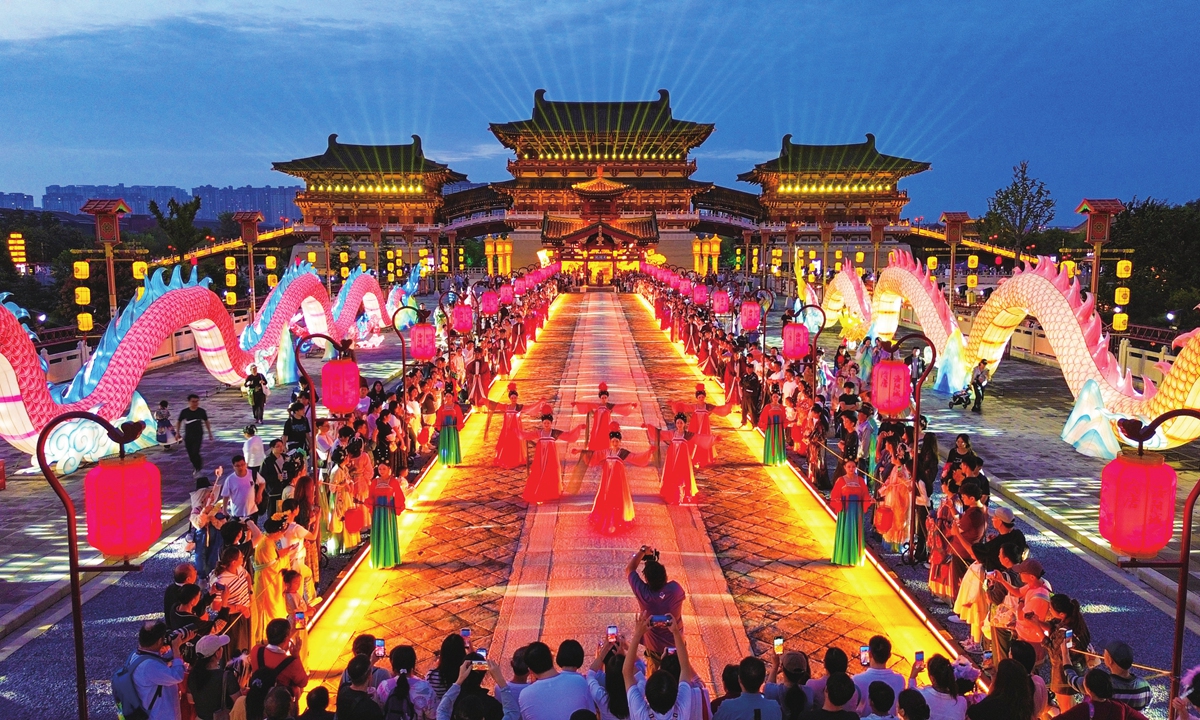
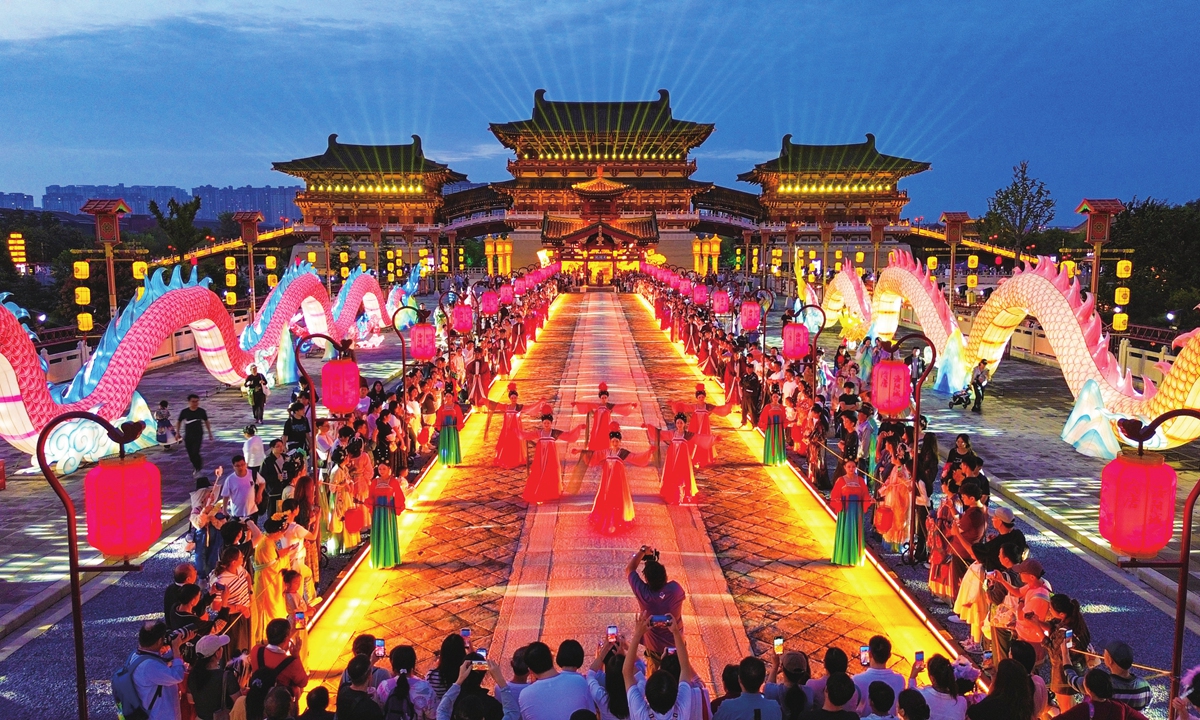
Tourists dressed in traditional hanfu enjoy nighttime at the National Archaeological Site Park of Sui-Tang Luoyang City in Luoyang, Central China’s Henan Province on September 26, 2026, during the Mid-Autumn Festival holiday. Photo: VCG
Railway stations and roads nationwide are packed, as people head home from their travel destinations on the last day of the three-day Mid-Autumn Festival holiday on Sunday. That traffic will add up to the estimated total inter-regional trips of 650 million passenger-trips, or about 220 million a day, during the Mid-Autumn Festival break. Average inbound and outbound passenger trips were projected to reach 2.2 million.
These scenes were typical of the country’s holiday travel season. Travelers dragged suitcases through crowded entrances and exits of train stations while announcements urged passengers to leave the platforms quickly. Volunteers held up signs and guided people through the densest points, videos posted on social media showed.
China’s railways are expected to carry 16.86 million passengers on Sunday alone, with 1,398 additional trains added to handle the passenger traffic, the Global Times learned from China Railway.
Civil aviation is expected to handle 2.1 million passengers on the final day, with passenger flows concentrated in routes between big cities such as Shanghai, Beijing, Hangzhou, Guangzhou, Shenzhen and Chengdu. Meanwhile, water transport is expected to carry another 813,000 passengers, according to statistics from the Ministry of Transport.
Festive reunion
The Mid-Autumn Festival is one of China’s most important traditional holidays, falling on the 15th day of the eighth lunar month, usually in September or October. At the time, the full moon is at its brightest, and families gather to eat mooncakes, admire the moon and celebrate togetherness. The round shape of the mooncake echoes the full moon and symbolizes family unity.
That cultural weight is visible in catering data and orders of mooncakes. The group-buying orders for catering services during the festival rose about 80 percent on Douyin, with orders related to “Mid-Autumn Festival reunion feast” up 105 percent year-on-year.
Meanwhile, searches for mooncake and festival gift boxes surpassed 6 million on Douyin. Sales of mooncakes rose 157 percent, while sales of pastry gift boxes increased 246 percent.
Consumption patterns are shifting in parallel. On one e-commerce platform, searches for low-sugar mooncakes jumped 320 percent. Shoppers are paying more attention to taste and health than to elaborate packaging.
Going home remains central, yet a growing number of Chinese consumers are also using the holiday to travel for pleasure – and the way they travel is changing. Nearly 60 percent of bookings during the holiday were for local or short-haul trips. Many people first returned home for a reunion dinner, then took a short break nearby, according to a report provided by domestic platform Tongcheng Travel to the Global Times on Sunday.
Ticket booking orders for local sightseeing and scenic spots grew by 17 percent year-on-year, with lantern shows, ancient town parades and cultural museums popular choices among young people and family outings.
According to media reports, tickets to many museums during the holiday had been fully booked before the Mid-Autumn Festival, while many scenic spots introduced visitor limits.
Apart from museums, night tourism bookings rose sharply. Routes marketed for autumn scenery and “Chinese-style romance” proved especially popular. Traditional Chinese theme parks outperformed some international IP-themed destinations in search interest, according to a report sent to the Global Times from Trip.com.
Cultural experience is steadily replacing simple photo-taking as the core of many trips, analysts said.
Longer holidays ahead
The Mid-Autumn break is only the opening act. The National Day holiday (October 1-7) that follows is expected to release even greater spending power, analysts pointed out. This year only three working days separate the two holidays. By taking three days off, many travelers can create a continuous 13-day holiday.
As of Sunday, China sold 155 million railway tickets for both holidays, according to China Railway.
Domestic flight bookings for the combined period had already exceeded 8.58 million tickets by mid-September, up more than 10 percent, while bookings for routes over 2,000 kilometers rose about 14 percent.
Local governments have planned more than 20,000 cultural and tourism events during the National Day consumption month – from mid-September to late October – and will distribute over 310 million yuan ($46.2 million) in coupons, according to the Ministry of Culture and Tourism.
“The fourth quarter is already the traditional peak season for consumption. This year’s Mid-Autumn Festival and National Day holidays will further release concentrated travel demand. During the National Day period, cultural and tourism consumption will play a significantly stronger role in supporting the added value of the service industry and the total retail sales of consumer goods,” Hu Qimu, a professor at the Maritime Silk Road Institute of Huaqiao University, told the Global Times.
The key to fully unlocking the potential of cultural and tourism consumption is to increase the supply of high-quality products and upgrade offerings, supporting both higher-quality and sustained growth in consumption, Hu said.
Chinese goods gain ground abroad
Apart from domestic consumption, the festival is also becoming an export opportunity.
Before the Mid-Autumn Festival, European platform Joybuy showed that the sales of Chinese mooncakes increased more than 16-fold.
Meanwhile, Cantonese-style mooncakes are expanding beyond traditional Southeast Asian markets into Australia, New Zealand and Europe. One producer in Zhongshan, South China’s Guangdong Province, shipped more than 600 tons to over 40 countries and regions; products bound for Spain sold out early and a new market opened in Sweden.
Another Zhejiang-based brand exported more than 750,000 mooncakes, more than double the previous year, according to media reports.
The customer base is changing too. While overseas Chinese still form the core buyers, the number of non-Chinese customers has grown noticeably, many producers said.
Besides China, several Asian countries including Vietnam also celebrate the Mid-Autumn Festival, though with different emphases. In Vietnam, the festival has a strong “Children’s Day” character, and colorful lanterns sell especially well.
In Yiwu, East China’s Zhejiang Province – China’s leading wholesale hub for festive goods – Mid-Autumn Festival decorations and lanterns have seen strong export demand this year. Products that blend traditional festival motifs with handicraft techniques have proved popular with both domestic and overseas buyers, the Global Times learned.
Sun Lingjuan, a shopper in Yiwu, said she was busy checking orders bound for Southeast Asia. Her new jewelry series with designs related to the Mid-Autumn Festival sold quickly after the launch and attracted overseas traders.
“Handcrafted lanterns featuring classic images such as the jade rabbit gazing at the moon or autumn blossoms under a full moon have also become bestsellers,” Sun told the Global Times.
Analysts pointed out that China’s traditional festivals continue to revolve around family reunion and cultural ritual, yet they increasingly double as engines of domestic consumption and channels for the country’s products to reach the wider world.