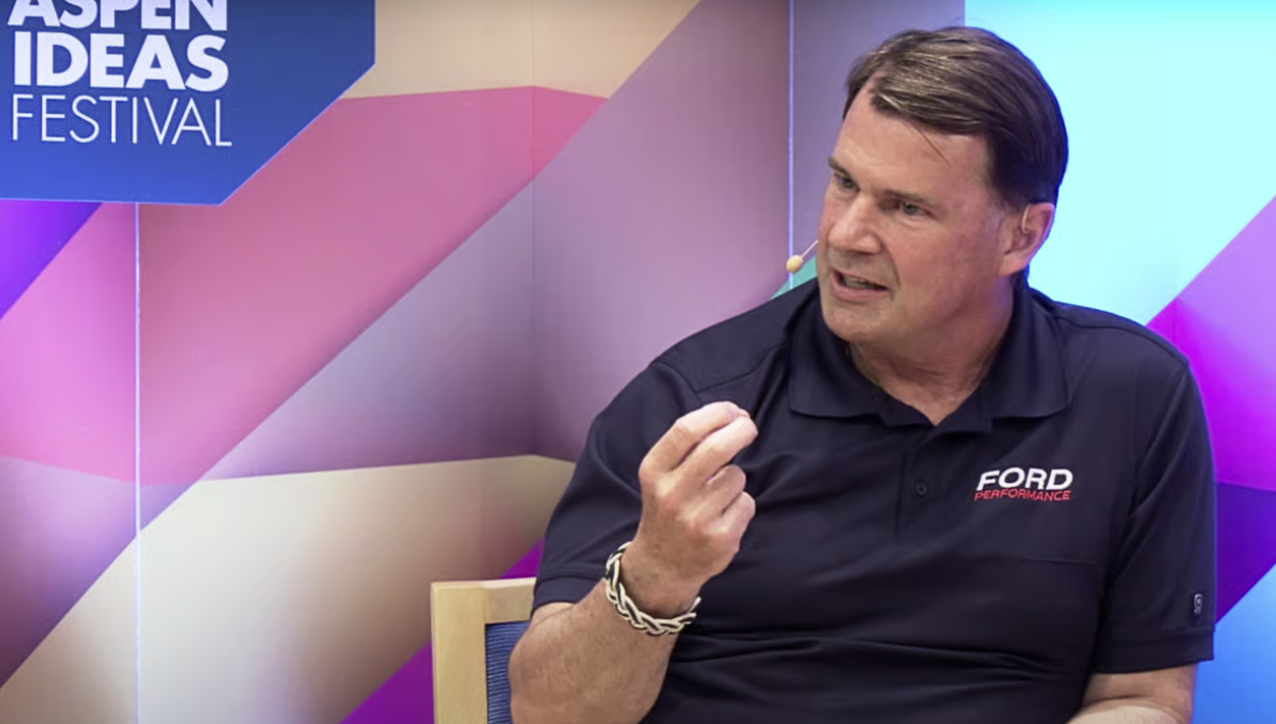
Ford’s affordable EV project faces Chinese competitors with 20 years of experience and intense government backing.
“Far Superior” Cars
Car Dealership Guy quotes Ford CEO Jim Farley China’s EV costs, tech, and quality “far superior” to the West
Ford found that Chinese EVs integrate with technology seamlessly. Drivers get in the car and their phone pairs automatically, and an AI companion equivalent to ChatGPT handles everything from navigation to entertainment. The vehicles also have facial recognition that knows which seat someone is in and adjusts media preferences.
“Their cost, their quality of their vehicles is far superior to what I see in the West,” Farley said. “We are in a global competition with China, and it’s not just EVs.”
Between the lines: China built massive overcapacity that creates export power.
- The country has 20 million units of domestic demand but 40 million units of manufacturing capacity, meaning they can flood global markets without building additional plants.
- That manufacturing base also gets government support American companies don’t receive.
And that dependence on Chinese suppliers is already causing problems. Ford shut down plants for three weeks recently because they couldn’t source high-power magnets that go into speakers, seat motors, wipers, and door systems.
“We cannot get any high power magnets without China,” Farley said.
Ford’s answer: Three years ago, Farley created a Skunkworks facility in Southern California, completely separate from Ford’s traditional operations. The team includes Alan Clarke, who was the chief engineer of the Model Y and Model 3 at Tesla before joining Ford. And the group has one goal: building the “Model T of EVs” for the super-affordable segment.
Bottom line: Ford’s affordable EV project will need to internalize lessons from global competition, and build domestic capabilities that can genuinely compete on cost and quality.
The opening paragraph says it all.
To repeat “Drivers get in the car and their phone pairs automatically, and an AI companion equivalent to ChatGPT handles everything from navigation to entertainment. The vehicles also have facial recognition that knows which seat someone is in and adjusts media preferences.“
The Western manufacturers do not have that at any price.
BYD Pricing
In China, BYD offers a range of electric vehicles (EVs) at various price points, with some models starting under $10,000. For example, the BYD Seagull EV has a starting price of 69,800 yuan (approximately $9,555) and can be found with discounts down to 55,800 yuan (about $7,780). The company also offers more premium models like the Han EV, which starts at around $32,800.
- “God’s Eye” Technology:BYD has equipped many of its models with advanced driver-assistance systems, including its “God’s Eye” technology, even on lower-priced vehicles.
- Price War Concerns:BYD’s aggressive pricing has triggered concerns about a potential price war in the Chinese EV market, prompting warnings from industry associations.
- Model Variations:BYD offers various trims and configurations for each model, allowing customers to choose options that fit their budget and needs.
- BYD Seagull: Starts at 69,800 yuan (around $9,555) and has been discounted to 55,800 yuan (~$7,780).
- BYD Seal 06 EV: Launches at 109,800 yuan (approximately $15,300).
- BYD e7 EV Sedan: Priced at $14,400, according to CarNewsChina.com.
- BYD Han EV: Extended-range version starts at 229,800 RMB (approximately $32,800).
- BYD Atto 2 (Yuan Up): Starts at around 100,000 yuan (approximately $20,000) in China.
The above pricing details from AI.
Imagine buying a car for about $7,780 or a luxury EV for around $32,800.
Why Is BYD So Cheap in China?
Given that both BYD and Tesla are manufacturing in China, with the same labour costs and similar public subsidies, the explanation for BYD’s lower manufacturing costs is all about manufacturing process, product design, and vertical integration. BYD just straightforwardly sets up cheaper manufacturing processes
Technology
BYD leads in battery tech with its LFP Blade Battery, which is safer, more durable, and supports ultra-fast charging (400 km range in 5 minutes). Its 10C charging rate outpaces Tesla’s Superchargers (~275 km in 10 minutes).
The BYD Blade Battery
BYD explains the Blade Battery and its Impact on the EV Industry.
Unrivaled Safety – The Most Secure EV Battery Ever Built
Extreme Fire Resistance – Unlike traditional batteries that can overheat and explode, the Blade Battery remains stable even under extreme conditions.#Puncture-Proof Protection – Passed the nail penetration test without catching fire.
Longer Lifespan & Superior Durability
4X the lifespan of traditional lithium-ion batteries.Lasts over 1 million km (3,000 charge cycles), making it one of the most durable EV batteries ever created.
Does Tesla Use BYD Batteries?
Yes, Tesla does use BYD batteries in some of its vehicles, specifically the Model Y produced at the Berlin gigafactory. These batteries are BYD’s Blade Battery, which are lithium iron phosphate (LFP) cells. This partnership allows Tesla to increase charging speeds and diversify its battery supply chain.
The above answer from AI.
Blade Batter Pros and Cons
- Pros:
- Cost-effective: LFP batteries are generally cheaper to produce than NCM batteries.
- Safer: LFP batteries are more thermally stable and less prone to thermal runaway.
- Longer lifespan: LFP batteries can typically handle more charge cycles than NCM batteries.
- Cons:
- Lower energy density: LFP batteries have a lower energy density compared to NCM batteries, meaning they store less energy per unit of weight or volume.
- Potentially lower performance: Lower energy density can lead to reduced range or the need for larger battery packs.
BYD Europe
- Sales Surge: BYD’s EV sales in Europe saw a significant increase, with registrations jumping by 169% in April compared to the previous year, according to Electrek.
- Outpacing Tesla: In April, BYD’s EV registrations (7,231) surpassed Tesla’s (7,165), marking a notable shift in the European EV market.
- European Headquarters: BYD is establishing its European headquarters in Budapest, Hungary, with plans to create 2,000 jobs.
- New Models: BYD is launching new models like the Dolphin Surf, a compact electric car, with a starting price of €22,990 in Germany.
- Partnerships: BYD is forming partnerships with European companies like voestalpine, a steel manufacturer, to support its European expansion.
- Market Penetration: BYD is outselling established European brands like Fiat, Dacia, and Seat in some countries.
- Overall: BYD’s rapid growth in Europe demonstrates the increasing competitiveness of Chinese automakers in the global EV market. While facing challenges like potential tariffs, BYD is aggressively expanding its presence through new models, partnerships, and investments.
Trump’s Tariffs
Trump’s high tariffs and regulation restrictions are so high there is no US BYD market.
Tariffs protect the weak and the inefficient.
Also America has a love affair with big cars.
Is that a Boomer thing?
I suspect but cannot prove Zoomers would love a $15,000 middle of the road BYD but Trump says no.
I love my Toyota 4-Runner and would not consider an EV. But for tens of millions of city drivers who seldom escape the city, a cheap BYD with safer battery technology would be the ticket.
EVs Will Eventually Win
I have correctly mocked the rate at which EVs would take over in the US. And Trump has set the rate of advancement back as I stated in advance may times.
But battery technology will get cheaper. Manufacturing costs will drop, and fewer people will be needed by the manufacturers.
China, not Tesla or the US is leading the way.
Ford’s CEO at least understands the issues.
But Trump’s tariffs inhibit innovation. And Trump’s tariffs on Steel and Aluminum are very counterproductive.
Unions costs are a big issue and they will fight the job losses that are guaranteed once the gasoline engine goes away.
Related Posts
February 10, 2025: Trump to Impose 25 Percent Tariffs on Steel and Aluminum, Expect Higher Prices
All US consumers of steel and aluminum will pay higher prices, especially the automakers.
February 11, 2025: Trump’s Steel Tariffs Now Will Work as Good as the First Time
Q: How’s that? A: Very poorly.
March 11, 2025: Hello Automakers, Trump Hikes Canada Steel and Aluminum Tariffs to 50 Percent
If Trump wants to clobber automakers, he sure knows how to do it.
Everything Trump does increases costs. And he expects to increase exports while making the US the high cost producer with consumers paying the price.
Trump’s model is fantasyland material.
