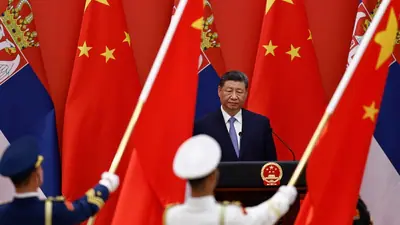
THE LAST TIME that Xi Jinping left China was in late October. Since then the world has come to him: a dozen heads of state have visited China. The foreign ministry’s protocol department has handled it flawlessly, setting up grand receptions for its visitors, lining up soldiers and schoolchildren to greet them and flying their national flags beside China’s on important boulevards.
Chinese President Xi Jinping attends an awarding ceremony for Friendship Medal of the People’s Republic of China, at the Great Hall of the People in Beijing, China Monday, May 25, 2026 (Tingshu Wang/Pool Reuters via AP)
The symbolism is not lost on anyone. A world adrift from its American anchor is looking to China. Even Donald Trump wants to work with it. China, meanwhile, has displayed remarkable dexterity. In May it has welcomed—in rapid succession—Iran’s foreign minister, Mr Trump, Vladimir Putin and Pakistan’s prime minister. Mr Xi’s trip in October was to South Korea; his next, expected soon, may be to North Korea. No other country has such ready access to leaders across such stark dividing lines.
What explains China’s ability to connect with so many? The two obvious answers are its own economic clout and the Trumpian chaos making it more attractive. But those forces explain the demand for China’s attention; they do not explain why China is so effective at converting it into relationships. For that, there is something else: China’s unremittingly thin approach to diplomacy. It desires partners, not allies. This crucial difference enables breadth while minimising depth in foreign involvements. China’s main requests of its partners are to say nothing about its internal affairs and do nothing to hinder its pursuit of its core interests. The corollary is that it offers less in return, a parsimony that reveals the narrower logic of China’s global ambitions.
These are partnerships-lite. Only North Korea is a formal military ally. But, according to Ketian Zhang of George Mason University, China classifies 109 countries as partners. The list features odd bedfellows: Ukraine and Russia; India and Pakistan; Israel and Palestine; Iran and Saudi Arabia. The list will lengthen. Scholars say expansion is “inevitable” as the country rises. Even places that have territorial disputes with China are welcome. It is, in effect, creating the world’s least exclusive club, but one that still offers a sense of closeness and pomp on visits to Beijing.
Flattery is powerful, especially for countries used to getting lectures from America or Europe. In Chinese terminology, there is a clear hierarchy: “all-weather strategic” partnerships with countries like Pakistan and Ethiopia outrank “co-operative” partnerships with, for example, Finland and Belgium.
Few foreign officials are bothered by these linguistic nuances. One Western diplomat likens it to a “word salad” that pleases China at no real cost. Indeed, countries sometimes drop the language of partnership, as both Canada and India did during stormy days with China, only to pick it up again as relations improve. China, for its part, never downgrades its partners. Instead, it waits for them to see their errors, sometimes helping the process by refusing to buy their wine, beef or timber. And the framing of partnership bakes in China’s preference for handling such contention. Disputes ought to be managed bilaterally and behind closed doors—which happens to suit China as much the stronger party in almost all of its bilateral relationships.
The hierarchy of partnerships reflects what China most wants from other governments. Its main interests are parochial, unless you are on the wrong side. To become an upper-echelon partner, foreign leaders must usually take a few points as given: that Taiwan belongs to the People’s Republic; or that China’s iron fist in Xinjiang, Tibet and Hong Kong is fully justified, for example.
This is in essence what China means in imposing “non-interference” as a core value in foreign policy. It should be allowed to do as it pleases, free of criticism, within its self-defined territorial remit (or where convenient, to quietly shelve the disagreement). Increasingly, there is also an economic dimension: that other countries should keep their doors open to Chinese exports and investments, even when their domestic companies are suffering. If alliances are traditionally a way for countries to magnify their clout, China’s partnerships are more conservative, aimed at stopping others from checking its power.
Close your eyes, free your mind
It is easy to see how countries seeking Chinese favour can endorse its language. Little else is imposed upon them. Yet that also constrains what partners get in return: formal military support is not on the table. The downfalls of Nicolás Maduro and Ali Khamenei this year underlined the limits to China’s backing. Close partnerships offered economic ties but no shield against American might.
Russia is another example. On several occasions its officials, including Mr Putin, have referred to China as an ally. China has steadfastly avoided such language. The closest it came was a joint declaration of “no limits” friendship in 2022, just before Russia invaded Ukraine. The partnership has enabled Russia’s war. China exports “dual-use” goods needed by Russia’s armed forces and imports its oil and gas. But in private Chinese officials insist, with reason, that if China truly threw its weight behind Russia, the war would be going far better for it. Mr Putin’s frequent supplications to China’s leadership suggest he wants even more support.
China is not about to call America a partner just yet, not least because most in Washington would balk. Mr Xi did, however, persuade Mr Trump to sign on to new terminology during his recent visit to Beijing. The two superpowers are now engaged in a “constructive relationship of strategic stability”. This confers no obligation on America but it means China has defined how things should proceed: any conflict is manageable and America ought to refrain from meddling in its internal affairs. If America sticks to the script, it might even be on the partnership track. That would be the crowning triumph of China’s thin diplomacy.