As the world’s largest crude oil importer, China has long relied on a double-insurance system to safeguard domestic oil supply.
The strategy combines two pillars: diversifying where its crude comes from, while simultaneously building vast strategic and commercial stockpiles.
Experts say that approach appears to have helped China absorb at least the initial shock after disruption to the Strait of Hormuz, one of the world’s most critical oil choke points.
Sources of oil cut off
China is second only to the United States in term of oil consumption, but it imports far more.
At least 70 per cent of its crude needs come from overseas, and until recently, much of that came through the Strait of Hormuz.
Chinese customs data shows the six Persian Gulf states accounted for about 40 per cent of those imports last year, excluding Iranian volumes, which have not been disclosed since 2023.
However, as the flow of oil through the strait began to dry up after the escalation in hostilities between US and Israeli forces and Iran in late February and early March, China was already finding sources to replace them.
Turning to Russia, Brazil and beyond
Official data shows China’s crude imports from the Gulf fell 25 per cent in March from a year earlier.
Yet China’s total crude imports declined by only 2.8 per cent to 49.98 million tonnes, equivalent to about 11.77 million barrels per day.
“To offset Middle Eastern supply losses, Russia, Africa and Latin America are all potential alternative sources,” said Bi Xinxin, a research analyst for energy and natural resources consultancy Wood Mackenzie.
Chinese customs figures show March crude imports from Russia, China’s largest supplier, rose 13 per cent from a year earlier.
China also bought a record amount of Brazilian crude in March, helping lift Brazil’s monthly crude exports to their second-highest level on record.
Imports from Indonesia also surged sharply, though experts say this was likely mostly re-routed Iranian crude.
While these are positive indications for Beijing, the complete picture of how the war with Iran is affecting China is not yet clear.
Erica Downs, a senior research scholar at Columbia University’s Centre on Global Energy Policy, said the full impact of the strait’s disruption would not have been felt there until April.
“It takes about three to four weeks for oil from the Persian Gulf to reach China,”
Dr Downs said.
Imports from the region may also have tightened further after the United States began blocking ships entering or leaving Iranian ports in mid-April.
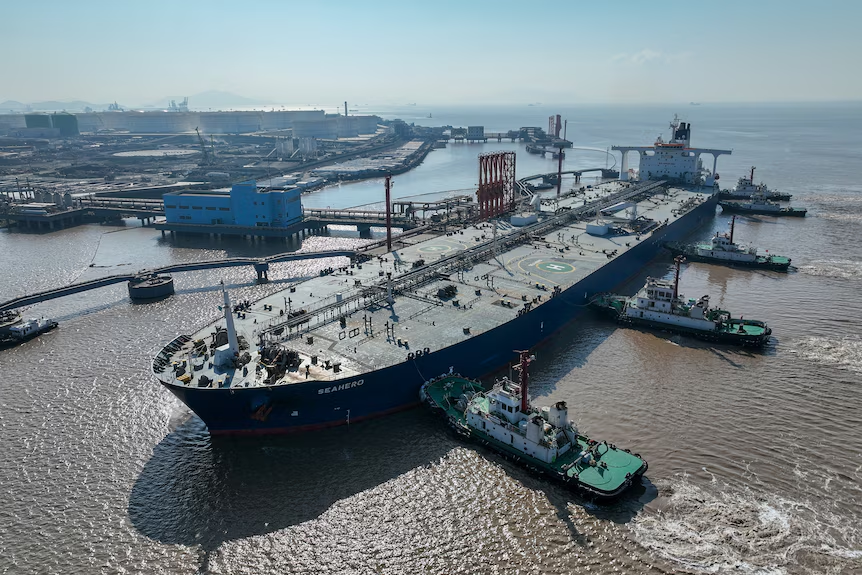
Zhoushan Port is China’s largest oil import and trans-shipment hub, handling about 40 per cent of the country’s oil transfers. ( Reuters: China Daily)
Global commodity analytics company Kpler estimates China’s seaborne crude imports in April at 8.7 million barrels per day.
That figure could rise as more late-arriving cargoes are confirmed, but it would still likely mark the lowest monthly arrival level since August 2022, when imports stood at 7.97 million barrels per day.
Meanwhile, Tianyue Hu, an analyst at energy research and business intelligence company Rystad Energy, said China’s crude import demand had weakened in April by around 2 million barrels per day compared to March.
She said this was due to elevated crude prices, weak domestic refining margins and an export ban on refined products.
Dr Downs said there was a supply shortage right now, but this lower demand was helping to balance it out.
She added China could also handle higher oil prices if needed, through a mix of higher costs for the refineries and some reduction in demand caused by the disruption.
“In general, the longer the disruption goes on, the more that the effects will be felt,” she said.
“But at the same time, so far, it seems like China’s been in a pretty good position.”
Oil storage tanks and facilities at a Sinopec refinery in Shanghai. (Reuters: Go Nakamura)
Building reserves for an emergency
China’s National Development and Reform Commission deputy director Wang Changlin said on April 17 that China would continue diversifying energy import channels.
Mr Wang also said it would increase reserves to strengthen its capacity to respond to “emergency situations”.
China’s store of crude oil was already substantial.
According to the latest US Energy Information Administration data, China held close to 1.4 billion barrels of crude reserves at the end of 2025, the largest stockpile in the world.
Based on China’s 2025 average crude imports of 11.55 million barrels per day, that would equal roughly 120 days of imports.
The International Energy Agency benchmark requires members to hold reserves equal to 90 days of the previous year’s net imports — a threshold China, though not a member, far exceeds.
Ahead of the Strait of Hormuz’s closure, China had stepped up crude buying.
In the first two months of this year, imports rose 15.8 per cent from a year earlier.
Official numbers indicate China ran a surplus of 1.24 million barrels per day in January and February.
March data also suggests that due to a decrease in demand, China was still able to add to inventories.
Dr Downs said that even if Middle Eastern supplies were completely cut off, China’s strategic and commercial reserves could likely sustain the country for up to six months.
However, Reid I’Anson, an economist at Kpler, said that a prolonged shutdown of the Strait of Hormuz would likely compel the Chinese government to draw on strategic reserves and potentially provide subsidy support to independent refinery facilities.
Oil from the six Persian Gulf countries accounted for around 40 per cent of China’s total imports in 2025. (China Daily via Reuters)
Decades of preparation
Energy security has been front of mind for Beijing’s planners for a long time.
China has five petroleum universities, established mostly in the 1950s and 1960s, to train talent in exploration, development and petrochemicals.
Each year, the number of graduates reaches tens of thousands.
China became a net crude importer in 1996, with import dependence rising steadily after that.
Dr Downs said China’s reserve system had been built gradually over more than 20 years.
“It was back in the early 2000s when there were debates going on in China about, do we build a strategic petroleum reserve or other types of reserves? If we do, how large do they become?” she said.
China’s crude oil imports in March fell only 2.8 per cent. (Reuters: Stringer/Files)
At the Chinese Communist Party’s 18th National Congress in 2012, energy security was elevated to an unprecedented level and formally incorporated into the broader national security framework.
Dr Downs said Chinese policymakers had long worried about vulnerability to maritime choke points such as the Strait of Hormuz and the Strait of Malacca.
“They’ve been planning … for a rainy day,”
she said.