| IN A NUTSHELL |
|
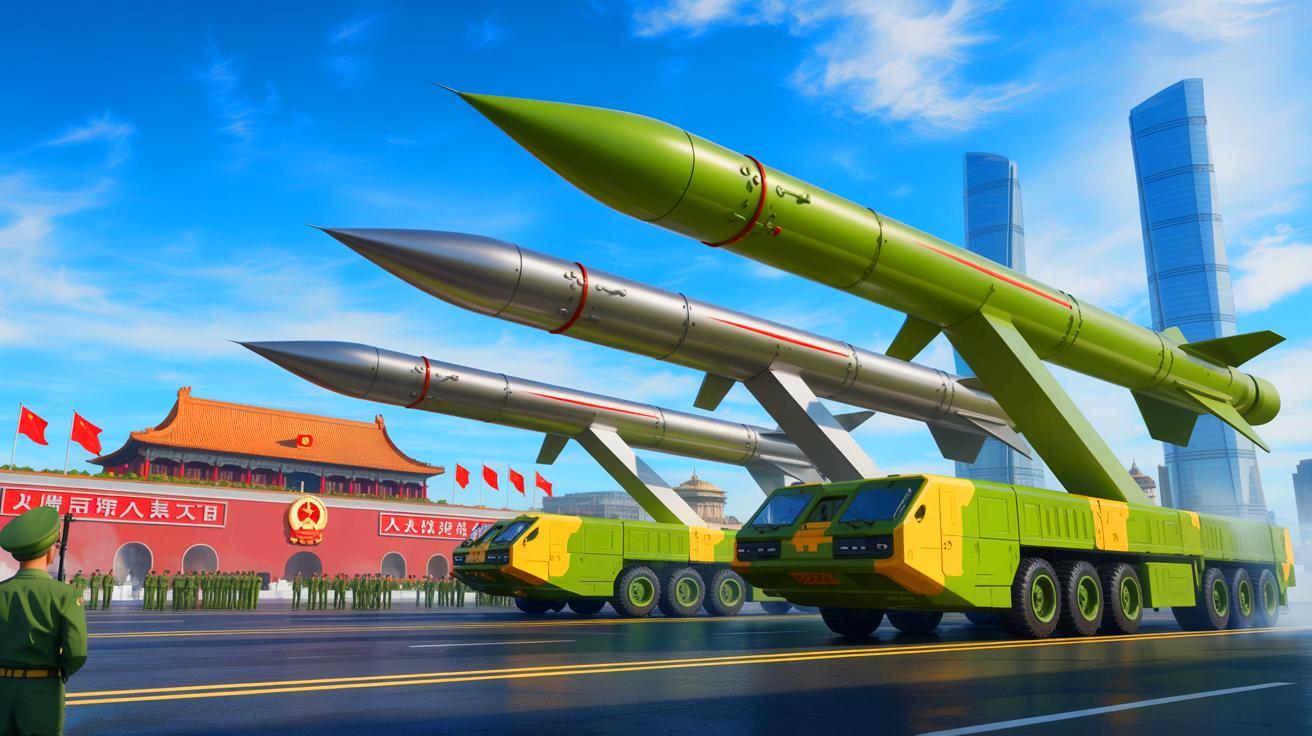
China’s upcoming Victory Day parade in Beijing is set to showcase the nation’s growing military prowess by unveiling advanced hypersonic missile technology. These new missile variants, including upgraded versions of the YJ-21 and DF-17, are expected to be the centerpieces of the parade. Such demonstrations not only celebrate historical victories but also serve as a powerful message to the international community about China’s expanding military capabilities. As global powers vie for dominance in hypersonic technology, China’s advancements could potentially shift the balance of power in the Pacific region, sparking renewed interest and competition in military innovation.
Air-Launched YJ-21: An “Aircraft Carrier Killer”
The YJ-21 missile, originally designed for sea launch, is expected to be a highlight of the parade in its air-launched form. This variant is anticipated to be deployed from bombers, allowing it to strike targets deep within enemy territory. According to military analysts, its ability to be launched from aircraft outside enemy air defense zones gives it a strategic advantage. The missile is designed to penetrate interceptors and destroy targets before swiftly returning to base, providing flexibility across various combat scenarios.
The YJ-21, referred to by some as the KD-21, can be carried by the H-6N strategic bomber. It boasts a range of approximately 1,860 miles and speeds between Mach 4 and Mach 6. Its capacity to carry both conventional and nuclear warheads enhances its threat profile. Often dubbed an “aircraft carrier killer,” this missile’s anti-ship capabilities are formidable. Observers suggest that the parade could reveal up to four new YJ-series missiles, showcasing the extent of China’s missile development.
China Firm Sparks US Fears: This New Battery Defies -40°F, Solar Industry Faces Potential Disruption
Evolving DF-17: Glide Paths and Decoys
The DF-17 missile, another anticipated debut at the parade, has captured global attention since its introduction in 2019. Experts suggest that the missile will continue to evolve, potentially featuring an enlarged glide body and decoy warheads. These advancements would complicate enemy defense systems’ ability to distinguish real targets, significantly enhancing the missile’s penetration capabilities.
The DF-17 travels in a non-standard trajectory, skimming the upper atmosphere like a stone across water. This unique path improves its ability to evade defenses and extends its range. Operating at altitudes between 12 and 62 miles, the DF-17 flies below the reach of most midcourse missile defense systems, making it exceedingly difficult to intercept. Such advancements position the DF-17 as a critical component of China’s military strategy, potentially altering the dynamics of global missile defense.
Mobility and Strategic Reach
Recent footage from China’s state media depicted the DF-17 being launched from a road-mobile vehicle, highlighting its operational flexibility. This capability allows the missile to be transported and launched from various locations, disguised as civilian vehicles, and operational within minutes. The DF-17’s range, spanning approximately 1,118 to 1,553 miles, places significant regional military installations within its reach.
These capabilities are particularly important given the strategic zones known as the “first island chain” and “second island chain.” The DF-17’s reach into these areas challenges the U.S. military’s Pacific containment strategy. As such, this missile not only signifies technological advancement but also represents a strategic shift in regional power dynamics.
Global Race for Hypersonic Dominance
Hypersonic flight, defined by speeds exceeding Mach 5, represents a new frontier in military technology. Capable of exceeding 3,836 miles per hour, hypersonic weapons transform strategic military capabilities. China’s advancements in this area place it at the forefront of the global race for hypersonic dominance, a position acknowledged by the Pentagon in a recent report.
In contrast, the U.S. has encountered setbacks in its hypersonic programs, struggling with delays and test failures. This disparity highlights the urgency for the U.S. to accelerate its development efforts to compete with China and Russia. The upcoming parade serves not just as a showcase of military might but as a signal that China is rapidly advancing in this critical technological domain.
As China prepares to unveil these new hypersonic missile variants, the international community watches closely. The anticipated parade will not only celebrate past triumphs but also underscore the country’s growing influence in global military affairs. How will other nations respond to China’s advancements, and what does this mean for future geopolitical dynamics in the Pacific and beyond?
This article is based on verified sources and supported by editorial technologies.
Did you like it? 4.5/5 (24)
