Toplines
Taiwanese Legislative Yuan (LY) Speaker Han Kuo-yu and a multipartisan Taiwanese delegation met with US members of Congress to advocate for Taiwan’s international participation and discuss trade and security issues. Han, a member of the opposition Kuomintang (KMT), visited the United States from June 21 to June 26 with a legislative delegation that included three other KMT members, three members of the ruling Democratic Progressive Party (DPP), and one Taiwan People’s Party member.[1] The delegation first arrived in Phoenix, Arizona to visit a Taiwan Semiconductor Manufacturing Company (TSMC) manufacturing plant and other Taiwanese investments.[2] The delegation then met with seven Democratic US Senators in Washington, DC, on June 24, including ranking Democratic member of the Senate Foreign Relations Committee Jeanne Shaheen.[3] The Senators subsequently released a statement that urged US President Donald Trump to advance a delayed $14 billion arms package to Taiwan that Congress had approved in January.[4] The senators said they were encouraged by Taiwan’s passage of a $25 billion special defense budget in May, which would fund the proposed arms package.[5] The $14 billion arms sale would be the largest ever US arms sale to Taiwan, but it currently appears to be stalled following the meeting between Trump and CCP General Secretary Xi Jinping in mid-May as well as the ongoing US conflict with Iran.[6]
Han’s delegation also met with 33 members of the US House of Representatives on the same day, including former House Speaker Nancy Pelosi.[7] Han gave a speech highlighting Taiwan’s accomplishments in semiconductor manufacturing, healthcare, business development, and democracy, but lamented Taiwan’s international isolation.[8] Han urged US lawmakers to support Taiwan’s participation in international organizations. Han also met with unspecified White House and US defense officials on June 25.[9] Han then met with US House Speaker Mike Johnson on June 26 to advocate for a bill to relieve double taxation for US and Taiwanese citizens working in each other’s countries.[10] The delegation returned to Taiwan on the first ever direct commercial flight between Washington and Taipei on June 26.[11]
Han’s delegation was likely intended to stabilize US-Taiwan relations amid doubts from both sides about the other’s commitment to the defense of Taiwan. Han’s meetings with dozens of US Congresspeople show that a high level of bipartisan support for Taiwan remains within the US government, especially in Congress. Han’s trip follows earlier visits by KMT Chairwoman Cheng Li-wun and Taichung mayor Lu Shiow-yen, who each met with smaller numbers of US congresspeople.[12] Han’s trip presents the image of a united front of all three major Taiwanese political parties, after partisan gridlock had significantly delayed the special defense budget and general budget.
Taiwan held tabletop exercises on June 25 to simulate its response to a potential PRC maritime ‘quarantine.’ Taiwanese President William Lai Ching-te’s administration is taking concrete steps to prepare for PRC maritime coercion threatening Taiwan’s international trade and critical imports. The exercises simulated the PRC attempting to force domestic and foreign ships sailing through Taiwanese ports to make customs declarations through the PRC customs system and simulated China Coast Guard (CCG) ships boarding, inspecting, and detaining vessels going to or from Taiwan, disrupting Taiwan’s maritime trade and supply lines.[13] The Taiwanese National Security Council (NSC), Ministry of National Defense (MND), Coast Guard Authority (CGA), and other agencies simulated their responses during the exercise.[14] The CGA simulated dispatching ships to respond to the CCG’s coercive actions, the Taiwanese Navy simulated conducting combat readiness drills, and the MND and Ministry of Foreign Affairs simulated conducting a public information campaign drawing attention to the PRC’s violations of international law and freedom of navigation.[15] Other agencies would caution commercial vessels on which waters to avoid and closely monitor Taiwan’s critical supplies stockpiles.[16] The PRC has increasingly used coercive maritime activity similar to that depicted in the tabletop exercises to erode Taiwanese sovereignty and pressure Taiwan to accept PRC rule. The PLA Navy (PLAN) and the CCG practiced instituting a maritime blockade around Taiwan during major joint drills in April and December 2025.[17]
Taiwanese President Lai ordered government agencies to strengthen Taiwan’s resilience to PRC maritime coercion on June 23. Lai directed the NSC, MND, CGA, and other agencies to strengthen Taiwan’s maritime and air intelligence, expand the use of drones for reconnaissance and escort missions, improve communication with commercial ships, and update energy and critical supplies stockpile plans after recent government tabletop exercises simulating a PRC maritime quarantine around Taiwan.[18] The Lai administration has recently taken concrete measures to prepare for a full or partial PRC maritime blockade and to reassure the Taiwanese public about Taiwan’s energy and supply resilience. Taiwan’s Ministry of the Interior announced in April that the government will hold interdepartmental drills to practice securing Taiwan’s foreign and domestic supply chains and escorting commercial ships through a PRC maritime blockade in July.[19] The Ministry of Economic Affairs also debunked an online PRC disinformation campaign in March claiming that Taiwan was facing severe power shortages due to disruptions in seaborne liquefied natural gas imports and presenting acceptance of PRC annexation as the best way to secure Taiwan’s energy supply.[20]
New details on a PLA ideological training camp indicate that CCP General Secretary Xi Jinping continues to purge PRC National People’s Congress Standing Committee military representatives. The PRC’s National People’s Congress Standing Committee stripped the seats and terminated the NPC delegate status of six PLA officers and nine other NPC delegates but gave no reason for their dismissals.[21] Those removed include the former head of the Central Military Commission’s (CMC) Equipment Development Department Xu Xueqiang, Lieutenant General of the PLA’s Eastern Theater Command (ETC) Wang Kangping, PLA Western Theater Command (WTC) senior commander Li Fengbiao, Political Commissar of the PLA’s STC Ground Force Yin Hongxing, PLA Air Force General Guo Puxiao, and Commander of the PLA’s Cyberspace Force Lieutenant General Zhang Minghua.[22] Most of these six officers served in critical organizations established after the 2015 military reforms or were elevated to leading positions after those reforms.[23] These officers were purged from across the PRC military system, indicating that the current anti-corruption campaign may be widening beyond previous areas of focus to include major institutions established under the post-reform military structure.[24]
PRC military newspaper PLA Daily released details of the PLA ideological training camp that ran from April 8 to June 12, including ideological studies, anti-corruption rhetoric, and military exercises.[25] PLA Daily stated that Xi personally decided to launch the exercise and delivered a speech at the opening ceremony, stressing that leading officers, especially senior cadres, must take the lead in building an atmosphere “where people speak the truth, offer advice candidly and fight against wrongdoings.” [26] ISW-CDOT has previously reported on the broader military purge campaign, which notably saw the removal of CMC members Zhang Youxia and Liu Zhenli in January 2026.[27] Xi may aim to further centralize power and ideology within the PLA as well as purge dissent.
Cross-Strait Relations
Taiwan
Taiwan’s Legislative Yuan (LY) is continuing to deliberate on how to fund Taiwanese domestic drone procurements. The ruling Democratic Progressive Party (DPP) is seeking to fund the bill through the special budget process and the opposition Kuomintang (KMT) and Taiwan People’s Party (TPP) are seeking to fund their versions of the procurement bill through Taiwan’s annual budget process. The DPP-led Executive Yuan proposed a special budget bill for domestic drone procurements totaling $210 billion NTD (approximately $6.5 billion) from August 2026 to 2031.[28] The opposition-controlled LY voted together to prevent the bill from being sent to committee review on June 26.[29] The KMT and TPP have since announced their own versions of the bill, and all versions will be submitted for committee review at the July 3 plenary session.[30]
A central point of contention between the parties is the role the special budget process should play in funding defense procurements. DPP spokesperson Michelle Lin argued that a special defense budget would provide more stable long-term funding, while relying on the annual budget instead would increase fiscal pressure that may affect other government spending in areas such as social services.[31]
KMT caucus whip Fu Kun-chi stated that the KMT fully supports developing Taiwan’s domestic drone industry, and the KMT announced its version of the bill on June 29 that would work through the annual budget process and designate the Ministry of Economic Affairs and Ministry of National Defense (MND) as lead agencies for building domestic drone capacity.[32] The KMT’s proposal entails $240 billion NTD (or $7.5 billion) over six years for drone research and development, production, and manufacturing.[33] The TPP proposal, by contrast, proposed a draft domestic drone procurement bill proposing zero spending dedicated to new initiatives—the provisions would establish a national drone database, overhaul Taiwan’s airspace management rules, separate military and civilian drone testing sites, and implement flight-test data collection to support research. [34] The TPP proposal aligns with TPP deputy caucus whip Wang An-Hsiang’s criticisms of the DPP proposal. Wang emphasizes the importance of fiscal discipline and not making special defense budgets routine.[35]
These drone procurement bills are in response to the Taiwan special defense budget bill’s omission of funding for the domestic defense industry. Drones provide an asymmetric cost advantage in that they are highly effective and relatively inexpensive, compared to traditional military platforms. These unmanned systems can be rapidly manufactured and produced at scale to strike enemy assets and monitor the battlefield.
Taiwan commissioned its new Littoral Combat Command (LCC) on July 1. The new command will integrate Taiwanese and US-produced missile systems and incorporate a new unmanned surface vessel (USV) unit, streamlining coastal defense. The LCC will unify mobile and coastal radar and anti-ship missiles into a single command encompassing all of Taiwan’s coastal defenses, including that of its outlying islands.[36] The unit will focus on maritime threats within 24 nautical miles of Taiwan.[37] The LCC will incorporate Taiwan-made Hsiung Feng missiles and US-produced Harpoon missiles.[38] Areas along the PRC coastline fall within range of the Hsiung Feng and Harpoon missiles.[39] These ranges may improve Taiwan’s deterrence prospects as it seeks to counter PRC short-of-war coercion along its coasts.
Taiwan’s efforts to create the LCC reflects its increasing responsiveness to PRC maritime threats. Chief of staff of the office of the Minister of National Defense Chien Shih-yuan will lead the LCC. Chien led a Taiwan Naval response to PRC vessels’ encroachment on Taiwan following former US House Speaker Nancy Pelosi’s visit to Taiwan in August 2022.[40] Chien will be promoted to lieutenant general for the position.[41] Taiwan’s decision to appoint Chien illustrates the ROC military’s efforts to prioritize experience in combating PRC short-of-war coercion.
The Taiwanese High Court on June 25 overturned one conviction and reduced the prison sentences of three former DPP staffers convicted in 2025 for leaking classified information to the PRC.[42] The High Court did not publish a rationale.[43] The KMT LY caucus held a press statement after the decision was released demanding transparency and release of the rationale.[44] TPP founding chairman Ko Wen-je accused the judiciary of providing preferential treatment to DPP members.[45] Prosecutors originally sought lengthier sentences and considered appealing the conviction when it was announced.[46] There is currently no evidence that the High Court’s decision was politically motivated, however. Freedom House’s 2025 index assesses that Taiwan has robust rule of law, with its judiciary independence and due process receiving the maximum rating.[47]
| Name | Position and Reason for Conviction | Original Sentence | New Sentence |
|---|---|---|---|
| Huang Chu-jung | Former assistant to a Taipei councillor who instructed Ho Jen-chieh to obtain information about the Foreign Minister and sent it to the CCP. Received almost $5 million NTD from the PRC. | Ten years | Six years |
| Chiu Shih-yuan | Former DPP staffer accused of working with Huang Chu-jung to gather information for the CCP and received over $2 million NTD from the PRC. Got information from Wu Shang-yu. | Six years and two months | Five years |
| Wu Shang-yu | Former aide to Lai Ching-te when he was Vice President, and briefly when he was President. Accused of leaking Lai’s travel itineraries. | Four years | Three years |
| Ho Jen-chieh | Former aide to then-Foreign Minister Joseph Wu who provided intelligence to PRC agents. | Eight years and two months | Acquitted |
https://understandingwar.org/research/china-taiwan/china-taiwan-weekly-update-april-11-2025/
https://understandingwar.org/research/china-taiwan/china-taiwan-weekly-update-april-18-2025/
https://www.bbc.com/news/articles/cp8w0j16pyno
A new PRC law on ethnic unity took effect on July 1, drawing Taiwanese concerns over the possibility of transnational repression. Taiwanese officials warned that the PRC could use the law to imprison dissidents overseas. The PRC’s new law on ethnic unity intimidates individuals whose activities, careers, and identities threaten the PRC’s conception of “ethnic unity.” Taiwanese national security officials have warned that the PRC‘s National Unity and Progress Promotion law could make a number of groups vulnerable to detention or sanctions, including overseas PRC ethnic minorities, overseas “Chinese” and dissidents, foreign lawmakers, journalists and researchers, Taiwanese officials and citizens, religious groups and followers, multinational companies, and online content creators over activities conducted outside of the PRC.[48] Taiwan’s Mainland Affairs Council (MAC) has further encouraged Taiwanese working in the PRC to exercise caution.[49] MAC Deputy Minister Liang Wen-chieh stated that the law did not clearly define acts which would threaten “ethnic unity,” meaning that broad interpretations of this law could include a wide variety of actions, including supporting Taiwan’s status quo.[50]
Taiwan’s envoy to the UK Vincent Chin-Hsiang Yao expressed concerns that the PRC’s new mega-embassy in London could be used to imprison dissidents and conduct espionage operations.[51] Yao said that he is concerned that Taiwanese politicians, some of whom had been officially blacklisted as “diehard Taiwan independence separatists,” could be kidnapped by PRC secret police and detained within the embassy.[52] The mega-embassy is reported to have 208 “secret rooms” below it as well as concealed bathrooms and showers, back-up generators, elevator shafts, and communications cabling.[53] Some of the clearest and highest-profile examples of PRC transnational repression have occurred in the UK, which is likely contributing to Yao’s assessment.[54]
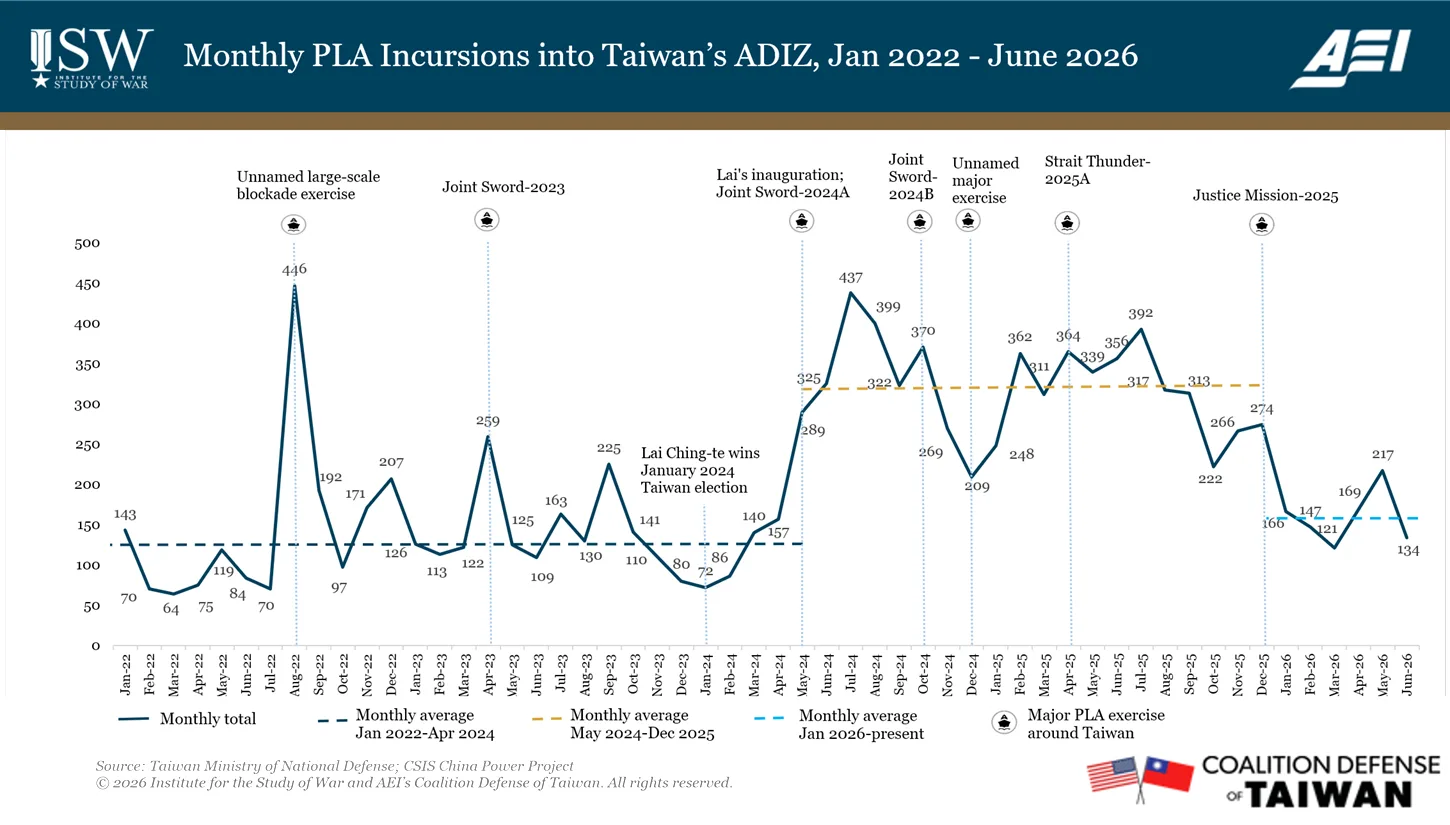
The PLA carried out a total of 134 aerial incursions into Taiwan’s Air Defense Identification Zone (ADIZ) in June. The PRC appears to have reduced its average monthly volume of ADIZ incursions to a level comparable to before President Lai’s inauguration. Taiwan’s defense ministry reported 12 days in June without any ADIZ incursions across the median line of the Taiwan Strait. The PLA doubled its monthly volume of incursions to over 300 per month after President Lai’s inauguration in May 2024 but appears to have reverted to the pre-Lai baseline since the start of 2026.[55] The PRC has not launched any high-altitude balloons into Taiwan’s ADIZ since February 2026.[56]
The decline in monthly PLA sorties around Taiwan since the start of 2026 likely reflects an adjustment in the PRC’s coercion strategy toward Taiwan, rather than seasonal fluctuations or other short-term factors.[57] ISW-CDOT has previously reported that the reduction from 300 to 200 incursions per month may free up PLA sorties and resources to focus on other military priorities and reestablish the utility of ADIZ incursions as a means of short-term political signaling.[58] The PLA may also have reduced the number of sorties to perform maintenance on its air fleet after an extended period of heavy use.[59] A consistently high volume of ADIZ incursions allows the PRC to degrade Taiwan’s threat awareness by desensitizing it to repeated aerial intrusions.[60]
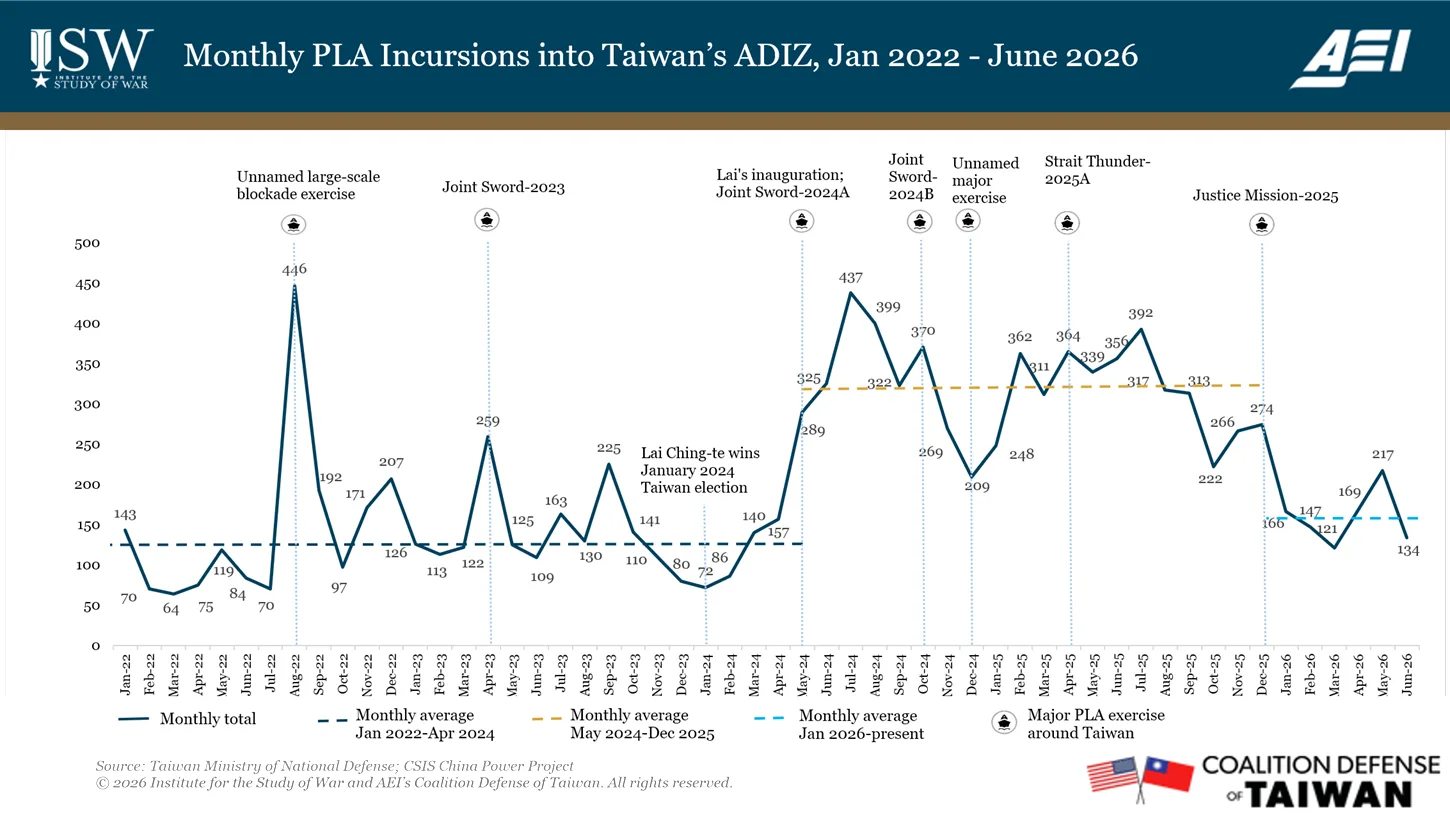
The CCG intensified its efforts to erode Taiwan’s control over the waters east of Taiwan and around Taiwan’s outlying islands in June. The PRC is trying to normalize an elevated military and paramilitary presence in waters on all sides of Taiwan. The CCG conducted three intrusive patrols in Taiwan’s restricted waters around Taiwan’s Pratas Island on June 5, 19, and 27, two more than usual average since it began the patrols in February 2025.[61] Taiwan’s Coast Guard Administration (CGA) said that a PRC research ship coordinated with the CCG for the first time during the June 5 patrol.[62] The CCG also carried out four patrols into restricted waters around Kinmen on June 3, 16, 18 and 29, consistent with the patrol frequency almost every month since February 2024.[63]
At least two CCG ships have continuously patrolled in Taiwan’s claimed eastern Exclusive Economic Zone (EEZ) since June 1, according to ship tracking data from Starboard Maritime Intelligence, ostensibly in response of Japan-Philippines boundary delimitation talks covering their EEZ claims in the same area.[64] The PRC claimed that Japan and the Philippines have no right to negotiate their maritime boundaries without including the PRC, which also claims an EEZ in the area through its claim to Taiwan. The PRC organized a civilian law enforcement patrol and a “marine environmental survey” to patrol the area, in addition to the CCG patrols.[65] The CCG and law enforcement ships hailed three passing cargo vessels during the five-day “law enforcement patrol” and claimed to have inspected 198 ships to assert Beijing’s jurisdiction.[66]
The PRC appears to be using the Japan-Philippines maritime boundary dispute to justify introducing a permanent paramilitary presence in the sea east of Taiwan. The patrols drill capabilities that the PRC would need to impose a blockade or quarantine around Taiwan to force political “unification,” including controlling the flow of traffic to and from Taiwanese ports and potentially seizing control of Taiwan’s outlying islands. The PRC has incrementally escalated its coercion of Taiwan in recent years to erode Taiwan’s sovereignty and set favorable conditions for a future blockade or invasion. The PRC began regular CCG patrols around Kinmen in February 2024 and regular patrols around Pratas in February 2025, with PRC state-affiliated media hinting that this “model” of asserting maritime jurisdiction could be extended to include all of Taiwan.[67] The Wall Street Journal reported on June 19 that the PRC has built a near-constant naval presence of five to six warships around Taiwan at any time in 2025, up from just one warship that patrolled the Taiwan Strait in 2020.[68]
China
The PRC’s Fujian aircraft carrier transited the Taiwan Strait on June 23 in what the PRC has described as “routine and standard training.”[69] PRC transits through the Taiwan Strait reflect PRC efforts to normalize military activity around Taiwan to erode Taiwan’s threat awareness. Fujian is the PRC’s newest aircraft carrier. commissioned in November 2025 and equipped with electromagnetic catapults.[70] This marked the Fujian‘s third transit: it previously transited the Taiwan Strait in September and December 2025.[71] Liaoning was the last PRC aircraft carrier to transit the Taiwan Strait in April 2026.[72]
The Fujian transit may have been in response to Taiwan’s annual Immediate Combat Readiness Exercises, as the transit happened one day after the military exercises began.[73] PRC Ministry of National Defense spokesperson Senior Colonel Zhang Xiaogang had described in December 2025, following the second Taiwan Strait transit by the Fujian, that these are “normal training exercises.”[74] Zhang confirmed the Taiwan MND report on the Fujian’s third transit and reiterated that this is regular training and that the PRC will continue organizing such trainings in the future.[75]
The PRC has increasingly normalized maritime and ADIZ incursions around Taiwan and regularized aircraft carrier transits through the Taiwan Strait may be an expansion of such activities. The transit also provides the Fujian crew members with practice operating and navigating the Taiwan Strait, and tests the equipment, much of which is “being put into practical use for the first time.”[76] This transit provides valuable experience that directly prepares the Fujian for future deployments.
Fujian’s transit may also indicate that the PLA will more frequently rotate its carriers between theater commands now that it has three in operation, potentially allowing for more frequent carrier deployments. Fujian commissioned with the Southern Theater Command (STC) in November 2025 but was stationed at the Northern Theater Command (NTC) Fleet headquarters during Liaoning’s exercises in the South China Sea and West Pacific that ended on June 22.[77] Liaoning returned to the NTC following the exercises, indicating Fujian’s transit south through the Taiwan Strait could be to ensure both the NTC and STC always have an operational carrier. PLAN carrier Shandong has been undergoing maintenance since January.[78] The PLA previously was unable to maintain two carriers on station year-round, but may be able to do so with three carriers. This could allow the PLAN to conduct more frequent carrier deployments, with one carrier undergoing maintenance, one in reserve at port, and a third at sea.