
China’s legislature has unveiled new economic blueprints that prioritize technological advancement and reducing dependence on foreign markets. The plans highlight Beijing’s push to compete with the United States in critical technologies like AI and semiconductors while addressing domestic economic challenges.
BEIJING — China’s national legislature has revealed two comprehensive economic strategies during its annual session, showcasing priorities that could significantly impact the worldwide economy.
The 2026 government blueprint identifies “establishing a strong domestic market” as its primary objective, followed by speeding up technological development. However, the longer five-year strategy places greater emphasis on achieving technological breakthroughs.
This distinction reveals Beijing’s careful balancing approach. The ultimate objective involves transitioning from low-cost production to a technology-focused economy.
However, more pressing concerns involve addressing an extended period of economic weakness that has undermined consumer and business confidence. Given China’s massive export presence, its decisions impact nations and employment worldwide.
These strategies, introduced during the National People’s Congress opening, provide insight into government priorities. The rubber-stamp legislature is expected to officially approve them when the eight-day session concludes Thursday.
Experts consider technological advancement the much more significant objective for Chinese President Xi Jinping and his vision of establishing the country as a major power capable of challenging the United States on matters from trade disputes to Taiwan issues.
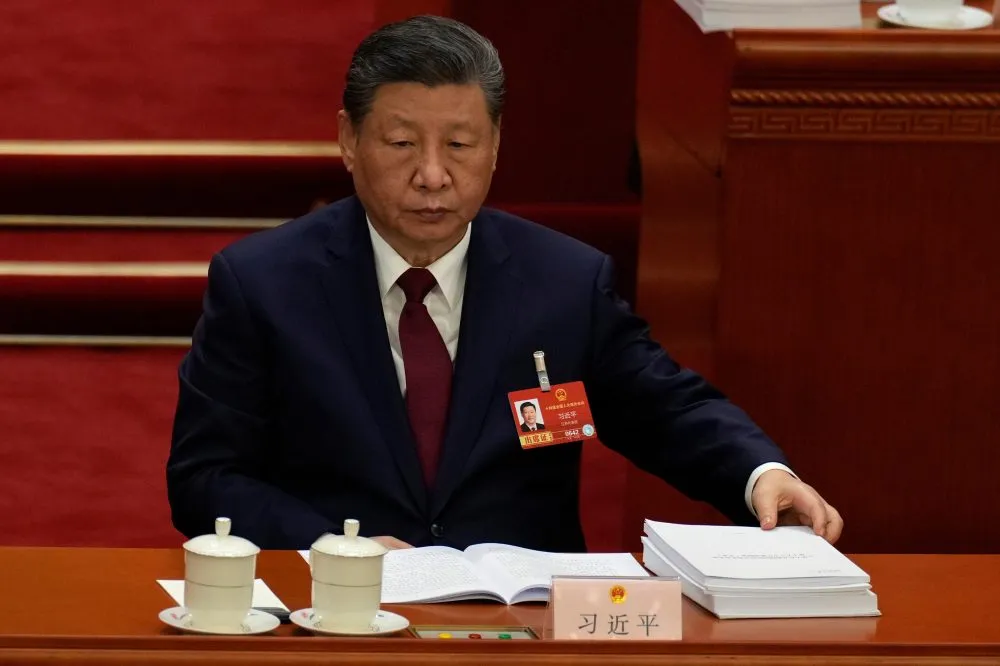
Addressing a provincial delegation during the National People’s Congress, Xi urged new developments, innovative breakthroughs and “seizing the strategic high ground of science and technology,” state media reported.
China’s dramatic expansion into becoming the world’s second-biggest economy has elevated it to middle-income status. To continue progressing, Xi has championed policies shifting the economy toward higher-value sectors.
Government support for electric vehicles, for instance, has transformed China into a rising force in the international automotive sector while aligning with national environmental objectives.
The five-year blueprint promises to “target the frontiers of science and technology,” accelerating progress in sectors including artificial intelligence, quantum computing, biotechnology and renewable energy.
This initiative has grown and evolved as technology has become a competitive arena with the United States carrying national security consequences.
Washington has limited Chinese companies’ access to cutting-edge technologies, including semiconductors powering AI systems. Officials justify this by stating these components could end up in military applications during a period when both nations are defense rivals.
Beijing has responded by investing heavily in developing these technologies domestically while finding methods to stay competitive using less sophisticated components.
China must “fight the battle for key core technologies,” the five-year strategy stated. Specific objectives, beyond AI, electric vehicles and robotics, include advancing semiconductors, batteries, biomedicine and 6G wireless networks.
The blueprint also committed to expanding production of China’s domestic passenger aircraft, the C919, and achieving progress in developing indigenous commercial jet engines. Washington temporarily blocked Western-supplied engines for the C919 last year during trade war escalation with China.
Rare earth elements — where China dominates globally — were emphasized as an area where it should preserve its competitive advantage as America and other nations work to develop their own sources of these essential materials for advanced technology and military equipment.
Despite China’s domestic economic cooling, increasing exports have maintained overall growth. However, tariffs imposed by President Donald Trump have revealed the dangers of depending too heavily on international markets.
China managed to redirect exports to alternative markets, but this faces obstacles as its record trade surplus approaching $1.2 trillion raises concerns about threats to manufacturing jobs and broader economies in other nations.
This has strengthened China’s drive to boost domestic consumer spending, making the economy less reliant on external factors.
“Facing a complex and challenging international environment, we must remain committed to the strategy of expanding domestic demand,” the annual economic blueprint stated.
Despite strong rhetoric, analysts suggest the effort appears designed to stabilize the economy rather than stimulate it. The annual plan establishes a growth target of 4.5% to 5% for 2026, allowing for potential decline from last year’s 5% increase.
Meanwhile, the government is prepared to provide substantial subsidies for high-tech manufacturing advances, analysts noted.
“Technological development and self-sufficiency remain central priorities, and industrial policy will continue to be deployed as an essential tool to achieve them,” Capital Economics researchers wrote in their analysis.
Similar subsidies to wind and solar sectors created manufacturing oversupply that was exported at extremely low prices, undermining international competitors. The outcome could be an even greater imbalance between China’s enormous manufacturing capacity and weaker domestic consumption, further increasing its exports.