BEIJING—China released from jail a prominent Christian pastor following pressure from the U.S., a surprise gesture of goodwill after President Trump’s visit to Beijing in May.
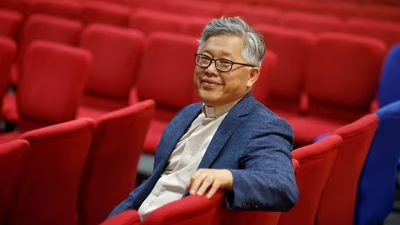
Pastor Ezra Jin in 2018.
led one of China’s most influential underground churches before his arrest in October, landed in Los Angeles on Friday, a day ahead of the celebration of America’s 250th birthday, according to his family. They said they were overwhelmed with joy that Jin, 57 years old, was free after nearly nine months of captivity.
“We hope this is a signal of a positive turn for people of faith in China and relations between our two nations,” a statement from the family said.
The State Department and China’s Foreign Ministry didn’t respond to requests for comment. Previously, the Foreign Ministry had criticized the U.S. for what it described as Washington’s attempt to use religious issues to interfere in China’s internal affairs.
The move comes as the U.S. and China seek to put their relations on more stable footing after years of tensions over trade, China’s military buildup and other issues. After meeting Chinese leader Xi Jinping in Beijing, Trump said “the relationship is a very strong one.” Xi is expected to visit the U.S. in September.
For years, Jin led Zion Church from the heart of Beijing. He persisted with his ministry even as the government cracked down on Christians who worshiped outside of China’s tightly controlled system of official churches.
The pastor’s arrest had drawn condemnation from the U.S. government and lawmakers of both political parties. Trump promised to personally raise Jin’s case with Xi at their May summit and said after the meeting that Xi was seriously considering releasing the pastor.
In Los Angeles, Jin was reunited with family members including his wife, Anna Liu, who had moved to the U.S. years earlier as safety concerns mounted in China. His daughter, Grace Jin Drexel, a U.S. citizen, had campaigned for her father’s freedom.
The family’s statement didn’t say why China released Jin or whether Beijing received anything in return. The statement thanked Trump and requested “prayers and patience with us as we navigate this critical time.”
Advocates for religious freedom celebrated the news of Jin’s release and called on the U.S. to continue putting China’s persecution of believers at the center of ties with Beijing.
“True progress in U.S.-China relations must include freedom for those imprisoned simply because they choose to believe,” said Bob Fu, the founder of ChinaAid, a U.S.-based organization that pushes for religious freedom in China, after Jin’s release.
At the time of Trump’s summit in Beijing in May, 18 people associated with Zion Church, including Jin, were in police custody. In addition to Jin’s traveling to the U.S., nine others from the church have been released on bail in recent weeks, according to Jin’s family and ChinaAid.
Jin embraced Christianity in the aftermath of the Tiananmen Square crackdown of 1989. He attended seminary in California before starting Zion Church. From rented space in a former nightclub in Beijing that Jin converted into a sanctuary, the church grew rapidly alongside growing interest in Christianity in China.
When authorities raided and shut down the church in 2018, Zion took its ministry online, using Zoom and other tools to reach more followers than ever. Jin’s refusal to back down despite intensifying pressure angered Beijing, culminating in his arrest.
From jail in recent months, Jin remained defiant.
“The Lord calls us to be overcomers, giving us the courage that David had when he faced Goliath,” Jin wrote in one letter after his arrest. “May this persecution, like the thorns that afflicted Paul, sharpen our courage and make our faith as solid as a rock.”