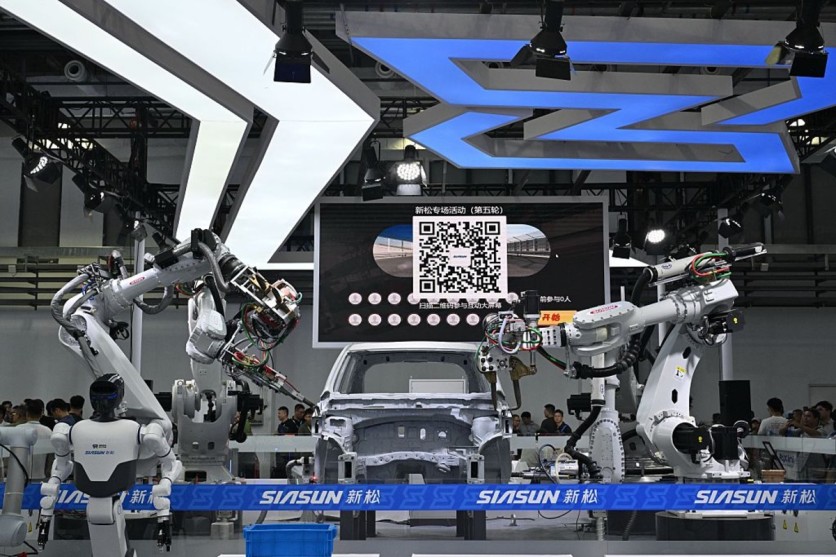
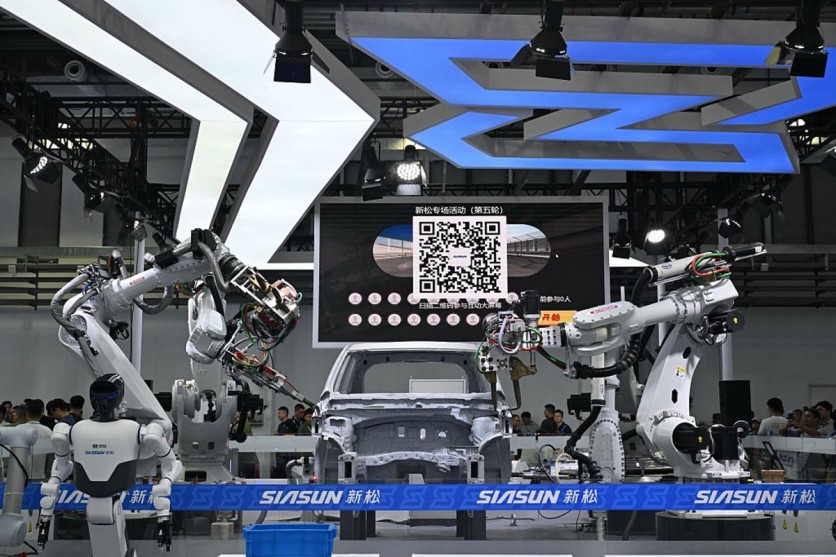
Adek BERRY/AFP via Getty Images
China’s official factory barometer rose to 49.8 in August, beating expectations but remaining below the expansion threshold for a second consecutive month — and buried inside that underwhelming headline was the most important number for anyone tracking the AI hardware supply chain: the high-tech manufacturing sub-index held at 52.9, well into expansion, even as the broader economy contracted. The divergence between China’s AI hardware belt and its consumer-services economy has now persisted long enough to be structural, not seasonal.
China’s National Bureau of Statistics reported Monday that the official manufacturing PMI climbed to 49.8 in August from 49.2 in July. The reading beat the Reuters consensus forecast of 49.6 but marked the second consecutive month the index has sat below the 50-point line dividing growth from contraction. The non-manufacturing PMI — which covers services and construction — held unchanged at 49.0, matching July’s reading and its lowest level since December 2022.
How Purchasing Managers Index Works: What 49.8 Actually Means
The PMI is a diffusion index, meaning it does not measure output volumes or dollar amounts — it captures direction. Each month, NBS surveys purchasing managers at roughly 3,200 Chinese manufacturing enterprises on five factors: new orders (weighted at 30 percent of the headline index), output (25 percent), employment (20 percent), supplier delivery times (15 percent), and stocks of items purchased (10 percent). Managers answer with “better,” “same,” or “worse” compared to the prior month. The index formula is: (percentage reporting better) plus one-half of (percentage reporting no change). A reading of exactly 50 means conditions were unchanged; above 50 means more managers reported improvement than deterioration; below 50 means the reverse. The NBS PMI survey methodology covers 3,200 manufacturing enterprises across 31 industry divisions.
This structure matters for interpreting August’s data. A headline reading of 49.8 does not mean China’s factories shrank by a specific measurable amount — it means that, on balance, more purchasing managers reported conditions worsening than improving, but by a smaller margin than in July. The direction is still downward; the pace of deterioration narrowed.
Separately, the private-sector RatingDog/S&P Global manufacturing PMI — which surveys roughly 430 to 650 firms, with a structural tilt toward smaller and export-oriented private companies rather than the larger state-linked enterprises that dominate the NBS sample — had registered 50.9 in July, suggesting mild expansion in that slice of Chinese industry. August’s RatingDog PMI is scheduled for release on September 1 and is expected to edge up to 51.0, which would widen the gap between the two gauges and add another interpretive layer for economists.
Where the AI Hardware Signal Lives
The headline PMI is an average. Inside that average, China’s industrial economy looks nothing like a single coherent unit.
The high-tech manufacturing sub-index reached 52.9 in August, and equipment manufacturing registered 51.4. Both stayed in expansion while the headline figure remained in contraction. Consumer goods and high-energy-consuming industries, by contrast, remained below 50.
This divergence is not new, and its persistence is the signal. In June 2026, when the headline PMI was 50.3, high-tech manufacturing posted 53.5. In July, when the headline fell sharply to 49.2, high-tech held above 51. In August, the pattern continued. The AI hardware supply chain — semiconductor packaging, server assembly, advanced robotics components, AI accelerator manufacturing — has now maintained consistent expansion across a period in which the broader Chinese economy has both expanded (March through June) and contracted (July and August).
“Domestic demand seems to be coming back, although it’s more likely to have been driven by AI and exports than by policy expansion,” said Xu Tianchen, senior economist at the Economist Intelligence Unit.
What drives the high-tech PMI’s independence from the headline? Global AI infrastructure investment. Official NBS data showed that exports of automated data-processing equipment jumped 60 percent year-over-year in May 2026. The appetite from cloud providers, hyperscalers, and AI model developers for servers, chips, and robotics components has created a demand signal for Chinese high-tech manufacturing that is partially decoupled from Chinese domestic consumption — which remains deeply weak.
For supply-chain managers at technology companies, this sub-index divergence matters more than the headline PMI: the manufacturing capacity that produces AI hardware components is operating in a fundamentally different demand environment than the consumer-goods factories or construction companies that drag the headline into contraction.
What Improved in August
Sub-index data released by NBS showed meaningful improvement across several key components.
Production returned to expansion at 50.4, up from 49.9 in July. New orders climbed to 50.6 from 48.5, moving back above the threshold. New export orders also returned to expansion at 50.16, compared with 49.6 in July. Procurement activity reached 50.5, and supplier delivery times shortened for the first time in seven months.
NBS statistician Huo Lihui described the data as showing production and demand expanded in the manufacturing sector, while noting that certain sectors — specifically steel production and chemical materials — saw “weak market activity.”
On pricing, raw material costs surged to a purchase-price index of 56.6, while ex-factory prices climbed to 50.4, both rising sharply from July, driven by upward movements in crude oil and non-ferrous metal prices. Rising input costs without a commensurate lift in final demand could squeeze factory margins in coming months, particularly for manufacturers not operating in high-tech segments where pricing power is stronger.
Where Weakness Persists: Employment, Small Firms, Services
Employment stayed subdued at 48.7, down from 49.0 in July, meaning factories were still trimming headcounts on net. By enterprise size, large companies returned to expansion at 50.6, but medium-sized firms slipped to 49.4 while small enterprises registered only 47.9. Small firms are a chronic pressure point: they employ the largest share of China’s workforce and are the most exposed to weak domestic demand.
Services were the article’s plainest negative finding. The non-manufacturing PMI held at 49.0 — unchanged from July and the weakest reading since December 2022, when China was still navigating the final months of its COVID-era restrictions.
“Because China’s services sector is primarily domestically focused, this suggests domestic demand remained relatively sluggish in August,” said Lynn Song, ING’s Greater China chief economist. “For now, the PMI data suggests that we are due for another month of relatively sluggish domestic activity data in August, with any potential rebound likely to be limited.”
Within the non-manufacturing breakdown, the construction sub-index fell to 46.9, down 0.1 percentage points, with Huo attributing part of the softness to extreme weather, including heavy rains and typhoons — among them Typhoon Dolphin and Typhoon Narra — that disrupted construction activity across several regions. Service sub-sectors that bucked the trend included telecommunications, internet and information technology services, and broadcasting — all posting above 55, suggesting that digital infrastructure services remained robustly active.
The Composite PMI, blending manufacturing and services, edged up to 49.5 from 49.3 in July — but remained below 50, meaning the Chinese economy contracted for the second consecutive month.
Is Beijing Going to Act?
The backdrop is an economy growing below its own official floor. China’s second-quarter GDP came in at 4.3 percent, below the lower boundary of Beijing’s 4.5-5 percent annual target range — the softest target Beijing has set since 1991. Zhiwei Zhang, president and chief economist at Pinpoint Asset Management, said after Monday’s data that it was “too early to conclude the economy had rebounded.”
Beijing has moved on stimulus, but cautiously. The finance ministry expanded loan interest subsidies for small private firms and consumers. The central bank signaled that measures were coming but stopped short of announcing explicit cuts to policy rates or the reserve-requirement ratio. An 800 billion yuan ($119 billion) infrastructure financing facility for local government projects began accepting applications, though its economic impact is expected to materialize gradually.
ING’s Song said the positive impact from interest subsidies “may be relatively marginal” and expects more measures in the weeks ahead.
In a notable signal that large-scale stimulus is unlikely, an article published in the People’s Daily — the Communist Party’s official newspaper — signaled China can hit targets without heavy policy support, stating it is not excessively reliant on stimulus and is capable of achieving its annual economic growth target. The Communist Party’s Politburo had pledged in late July to deploy counter-cyclical support measures, and Zhang Liqun, an analyst with the China Federation of Logistics and Purchasing, called for “continued government investment in public goods” to drive business orders and stabilize confidence.
A third consecutive sub-50 reading in September would substantially increase pressure on Beijing to act more decisively.
What This Means for Global Commodity and Technology Markets
China’s factory data functions as a leading indicator for commodity demand and supply-chain activity globally. A headline PMI stuck below 50 puts downward pressure on industrial metals — copper and iron ore are particularly sensitive to Chinese factory output, and Australia, which sells roughly 60 percent of its iron ore to China, tracks the PMI closely. The “upbeat” August PMI data had limited immediate market impact, with the Australian dollar falling 0.04 percent on the day, suggesting markets viewed the beat as insufficient to meaningfully shift the demand outlook.
For the technology sector, the more relevant read is the high-tech manufacturing sub-index at 52.9. Companies with hardware supply chains routed through Chinese advanced electronics manufacturers — server boards, AI accelerator components, semiconductor packaging — are operating in a sub-sector that has remained in consistent expansion even as headline China economic news has shifted negative. The risk that matters for those companies is not the headline PMI contraction but the concentration of AI hardware manufacturing within a single jurisdiction subject to geopolitical trade restrictions and U.S. export controls, which block advanced chip access for Chinese fabs at the most critical technology nodes.
What to Watch Next
The RatingDog/S&P Global manufacturing PMI for August is scheduled to publish on September 1 and is expected to edge up to 51.0 from July’s 50.9. Trade data and retail sales figures for August will follow later in the month.
Whether Beijing moves to deepen its stimulus response — through rate cuts, additional fiscal spending directives, or expanded subsidy programs — will be the primary policy watch for markets. The August PMI offered a cautious signal: contraction is easing, but the expansion China’s official target requires remains just out of reach.
Frequently Asked Questions
What does China’s manufacturing PMI reading below 50 mean for US companies?
A sub-50 NBS manufacturing PMI signals that Chinese factory conditions worsened on balance compared with the prior month — but the impact on US companies varies sharply by supply-chain exposure. Companies sourcing AI hardware components, semiconductor packaging, or server equipment from China’s high-tech manufacturing sector face a different environment from those relying on Chinese consumer goods or construction materials. High-tech manufacturing has remained in consistent expansion throughout the July-August contraction. For commodity-intensive companies, a sustained China contraction puts downward pressure on industrial metals like copper and iron ore, which can reduce input costs but also signals weaker global growth.
What is the difference between the NBS PMI and the RatingDog (Caixin) PMI, and why do they often diverge?
The NBS manufacturing PMI surveys roughly 3,200 enterprises with a structural emphasis on larger, state-linked companies, using five weighted sub-indices. The RatingDog/S&P Global PMI (formerly branded as the Caixin PMI) surveys 430 to 650 firms with a tilt toward smaller, privately owned, and export-oriented companies. Because state-owned enterprises often benefit from government contracts and credit access that private firms do not, the two gauges can diverge when conditions are uneven across company types. In August 2026, the NBS registered 49.8 (contraction) while July’s RatingDog PMI was 50.9 (expansion) — reflecting that the state-enterprise-weighted economy is weaker than the private/export-oriented segment.
Is China’s economy entering a recession?
Not in the standard definition. A recession typically refers to two consecutive quarters of negative GDP growth. China’s GDP grew 4.3 percent in the second quarter of 2026 — below its 4.5-5 percent target but still positive. The PMI measures monthly direction of change versus the prior month, not the level of economic activity or year-over-year growth. Two consecutive months of a sub-50 manufacturing PMI means factory conditions deteriorated for two months running, not that the economy as a whole shrank. That said, the services sector matching its weakest reading since December 2022, combined with a below-target GDP figure, signals genuine economic stress, and a third consecutive month of sub-50 readings would intensify pressure on policymakers.
Who makes AI hardware components in China, and are they affected by US export controls?
China’s AI hardware manufacturing ecosystem includes both domestic chip designers — companies like SMIC, Huawei HiSilicon, and the “Four Little Dragons” (Biren, Enflame, MetaX, and Moore Threads) — and contract manufacturers producing server boards, advanced packaging, and robotics components for global customers. US export controls prohibit TSMC and other leading foundries from producing advanced AI chips (at 7nm and below) for Chinese companies, and cap sales of NVIDIA’s most advanced chips to China. These constraints mean China’s high-tech manufacturing expansion is occurring within a restricted technology ceiling — the sector is growing, but the most advanced AI accelerators remain off-limits from the dominant global suppliers.