By Swann Collins, investor, writer and consultant in international affairs – Eurasia Business News. August 15, 2026. Article n°3095

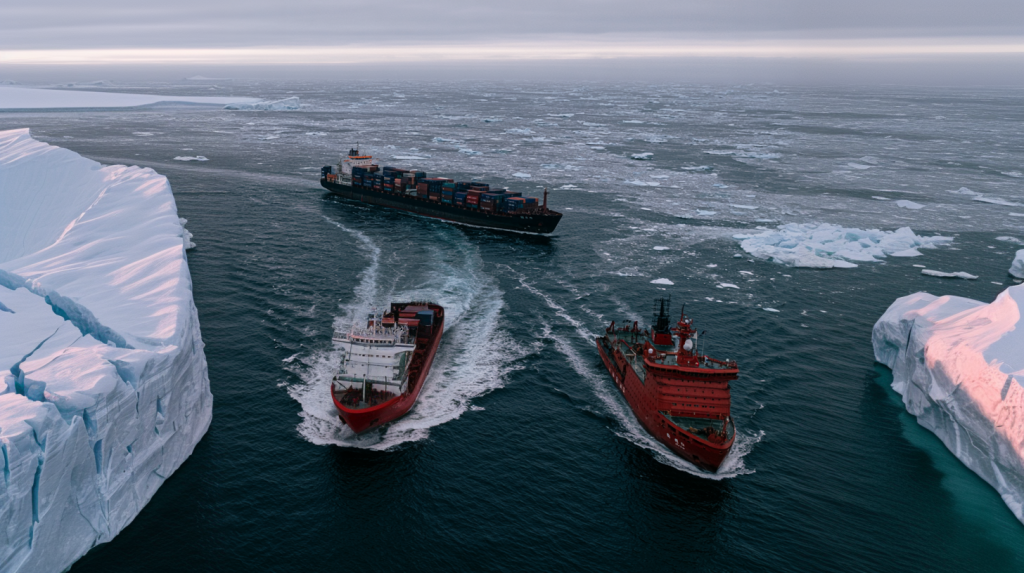
China is opening the first regular container shipping route between Asia and Europe through Arctic waters, marking a significant development for global trade, Russia-China cooperation and the future of the Northern Sea Route. Chinese shipping line Sea Legend is launching a seasonal service from China to Europe via Russia’s Arctic coastline, using a route that could cut transit times by roughly half compared with conventional shipping through the Suez Canal.
Rosatom has already issued permission to the Chinese Sealegend Shipping for the passage of seven ships along this route
The first voyage is scheduled to depart in mid-August 2026, carrying Chinese-made electric and hybrid vehicles, lithium batteries, solar equipment and other goods to European markets. Sea Legend expects the route from Ningbo to Felixstowe in the United Kingdom to take about 20 days, compared with around 40 days via the Suez Canal.
New Shipping Line Co., one of the route operators, said the total travel time on the Arctic route is less than on traditional sea routes. So, a flight from Shanghai to St. Petersburg through the Suez Canal takes from 38 to 45 days, while through the Arctic, travel time is reduced to 23-25 days, they specified there.
The Northern Sea Route Opens to Regular Trade
The service will use the Northern Sea Route, also known as the Northeast Passage, which follows Russia’s Arctic coastline from the Bering Strait to the Barents Sea. It connects ports in East Asia with northern Europe through the Arctic Ocean.
The route has been used previously for individual commercial voyages, trial shipments and Russia-China cargo operations. However, Sea Legend’s plan is notable because it aims to establish a regular, scheduled container service between China and Europe rather than a one-off or irregular passage.
The company has advertised the route as an “Ice Silk Road,” reflecting China’s broader effort to diversify supply chains and develop transport corridors that reduce dependence on the Suez Canal, the Red Sea and other geopolitical chokepoints.
Sea Legend reportedly plans eight Arctic voyages to Europe during the 2026 navigation season. The service will operate only during the summer and early autumn, when Arctic ice conditions are less severe.
High Oil Prices Improve Arctic Economics
The financial case for Arctic shipping improves when fuel prices are high. A shorter route reduces voyage distance, fuel consumption, crew time and the capital cost associated with containers remaining at sea for weeks.
Read also : The Million-Dollar Retirement Blueprint for U.S. citizens in 2026
The route from China to northwestern Europe via the Northern Sea Route can be thousands of nautical miles shorter than the traditional passage through the Malacca Strait, Indian Ocean, Red Sea, Suez Canal and Mediterranean Sea. The reduction in distance can translate into meaningful savings for fast-moving cargoes, including electronics, vehicles, batteries and high-value industrial components.
The economic calculation remains complex. Shipping through Arctic waters requires specialised planning, ice forecasts, navigation permits, insurance, contingency arrangements and, in some conditions, icebreaker escorts. Russian state nuclear company Rosatom controls navigation permits and the organisation of vessel traffic along the Northern Sea Route.
Russian icebreakers are expected to provide support where conditions require it. Russia operates the world’s largest fleet of nuclear-powered icebreakers, giving Moscow a decisive infrastructure advantage along the route.
Climate Change Extends Navigation Season
The growing commercial use of the Northern Sea Route is directly linked to climate change. Arctic warming is occurring substantially faster than the global average, reducing sea-ice coverage and extending seasonal navigation windows.
Read also : Gold : Build Your Wealth and Freedom
The commercial shipping period currently runs broadly from mid-July to mid-to-late October, although the exact window varies each year according to weather, ice thickness and vessel capability.
Reduced ice cover makes Arctic navigation more feasible, but it does not eliminate risk. Sea ice can shift rapidly, weather conditions can be severe and rescue, repair and port infrastructure remain limited across much of the Russian Arctic.
China-Russia Strategic Partnership
The route strengthens the economic and geopolitical relationship between China and Russia. China gains a potentially faster and more resilient link to European markets, while Russia gains transit fees, infrastructure investment, port activity and strategic relevance in global supply chains.
For Russia, the Northern Sea Route is a core element of its Arctic development strategy. Moscow sees the route as a future alternative to southern shipping corridors and a means of increasing its influence over Eurasian trade.
For China, the Arctic service helps reduce exposure to disruptions in the Red Sea, Suez Canal and Strait of Malacca. It also supports Beijing’s long-term Polar Silk Road strategy, which aims to connect Chinese industry with Arctic resources and northern shipping infrastructure.
Limits of Arctic Container Shipping
Despite its potential, the Northern Sea Route is not yet a full replacement for the Suez Canal. The route is seasonal, has limited port infrastructure and faces environmental, insurance and operational constraints.
Environmental groups also warn that increased Arctic shipping could accelerate damage to an already fragile ecosystem. Black-carbon emissions from ships can settle on snow and ice, reducing reflectivity and contributing to further warming.
Read also : Tax Management strategies for Digital Nomads
China’s new service is therefore best understood as a strategic supplement to established maritime corridors. If the 2026 season proves commercially successful, it could become an important niche route for high-value, time-sensitive cargo between China and Europe—but Arctic shipping will remain dependent on climate conditions, Russian icebreaker support and geopolitical stability.
Last year, China officially launched the world’s first Arctic express route linking China and Europe. Then the container ship Istanbul Bridge departed from the port of Ningbo-Zhoushan to Felixstowe, the largest container port in the UK.
Our community already has nearly 310,000 readers!
Subscribe to our Telegram channel
Follow us on Telegram, Facebook and Twitter
© Copyright 2026 – Eurasia Business News. Article no. 3095