Thank you for opening your Chartbook email.

Hedda Sterne, New York, NY, No X, 1948
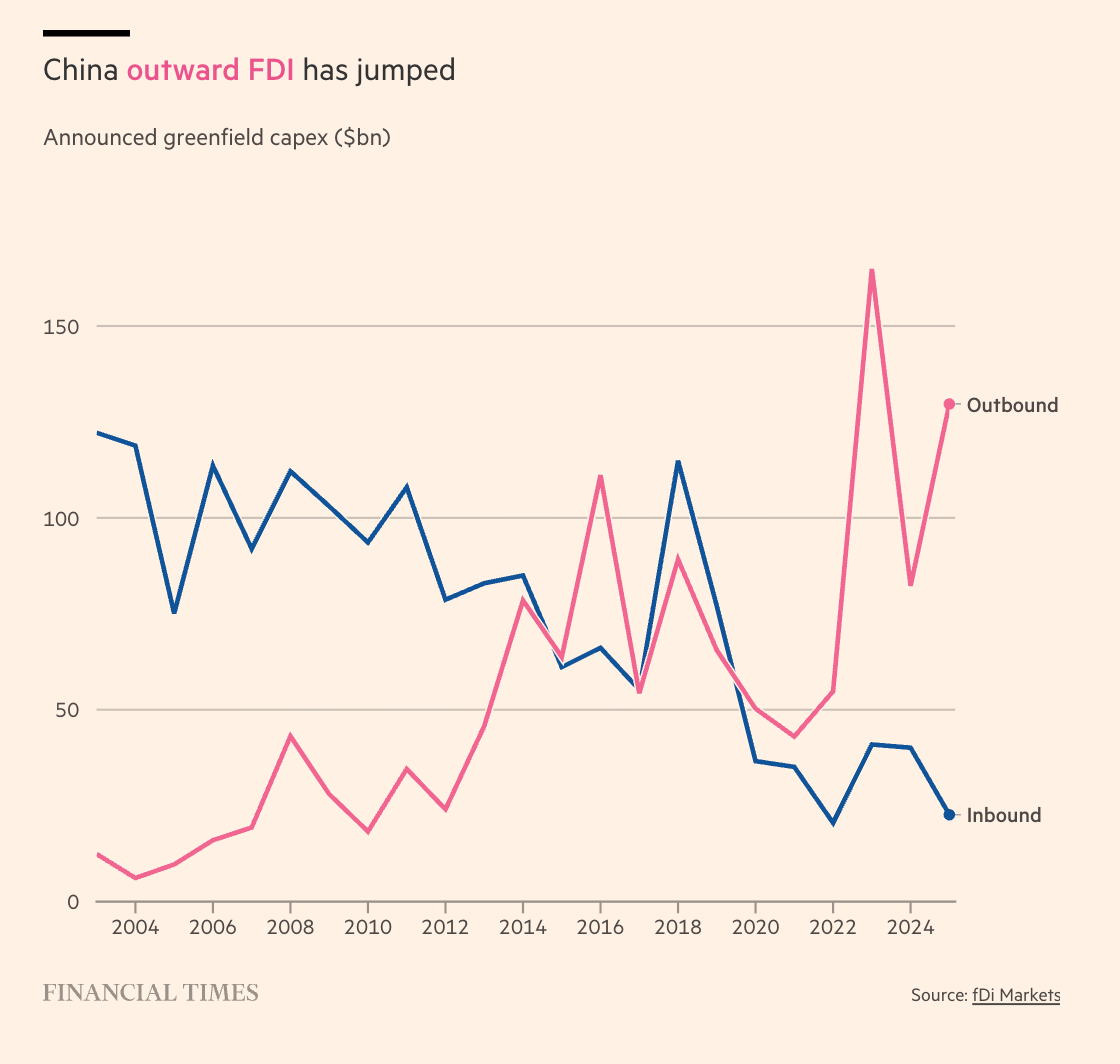
China’s FDI has come roaring back
And China is spreading its battery bets across much of Europe
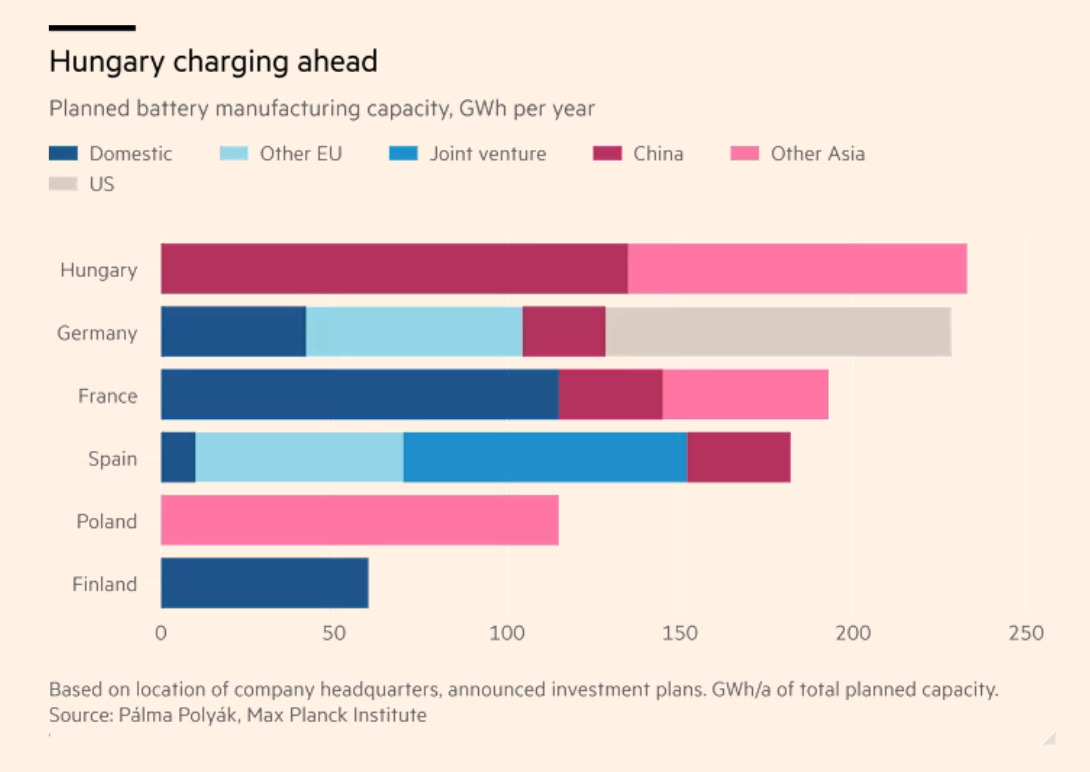
Source: Financial Times
HEY READERS,
THANK YOU for opening the Chartbook email. I hope it brightens your day.
I enjoy putting out the newsletter, but tbh, what keeps this flow going is the generosity of those readers who clicked the subscription button.

If you are persuaded to click, please consider the annual subscription of $50. It is both better value for you and a much better deal for me, as it involves only one credit card charge. Why feed the payments companies if we don’t have to.
Microsoft to offer 7% of US staff voluntary redundancy for the first time
Microsoft is offering voluntary redundancy to about 7 per cent of its US workforce, in a first for the 51-year-old tech giant as it wrestles with headcount amid an expensive AI bet. The cloud giant on Thursday told employees that it would offer the option to long-serving employees whose years of service plus age total 70 or more. More than 8,000 employees will be eligible out of the group’s 125,000-strong American workforce. “Many of these employees have spent years, and in some cases, decades, shaping Microsoft into what it is today,” Amy Coleman, Microsoft’s chief people officer, wrote in a memo seen by the FT. She said the offer was intended to give these employees “the choice to take that next step . . . with generous company support”. The scheme follows the company’s decision to dismiss more than 15,000 employees last year and comes as it has committed to spend $140bn in capital expenditure in its fiscal year, which ends in June.
Source: Financial Times
Meta to Cut 10 Percent of Work Force in A.I. Push, Mike Isaac
Meta plans to cut 10 percent of its work force, or roughly 8,000 employees, and close another 6,000 open roles, according to an internal memo on Thursday, as the company spends heavily on developing artificial intelligence. Meta, which owns Facebook, Instagram and WhatsApp, employed more than 78,000 people at the end of 2025. Mark Zuckerberg, Meta’s chief executive, has said he expects much of the work being done in the technology industry to eventually be overtaken by A.I. powered systems, including coding assistants that help engineers write software. “We’re doing this as part of our continued effort to run the company more efficiently and to allow us to offset the other investments we’re making,” Janelle Gale, Meta’s chief people officer, said in the memo to employees. “This is not an easy trade-off and it will mean letting go of people who have made meaningful contributions to Meta during their time here.”
A spokesman for Meta confirmed the cuts and declined further comment. Mr. Zuckerberg is reorganizing his company around A.I. products amid a fierce race to lead in the technology against rivals like OpenAI, Google and Anthropic. Meta has made progress in fits and starts, but has lagged behind competitors in developing foundational A.I. models. To catch up, Mr. Zuckerberg has spent more than $70 billion on A.I. investments like data centers, semiconductors and real estate to enable Meta to do the costly work of developing cutting-edge A.I. In a call with investors in January, he said the company expected to spend $115 billion to $135 billion this year, nearly twice the $72 billion it spent last year, much of which will be earmarked for A.I. development.
Source: New York Times
A chart for the new world in which you care about when American farmers apply fertilizers to their fields!
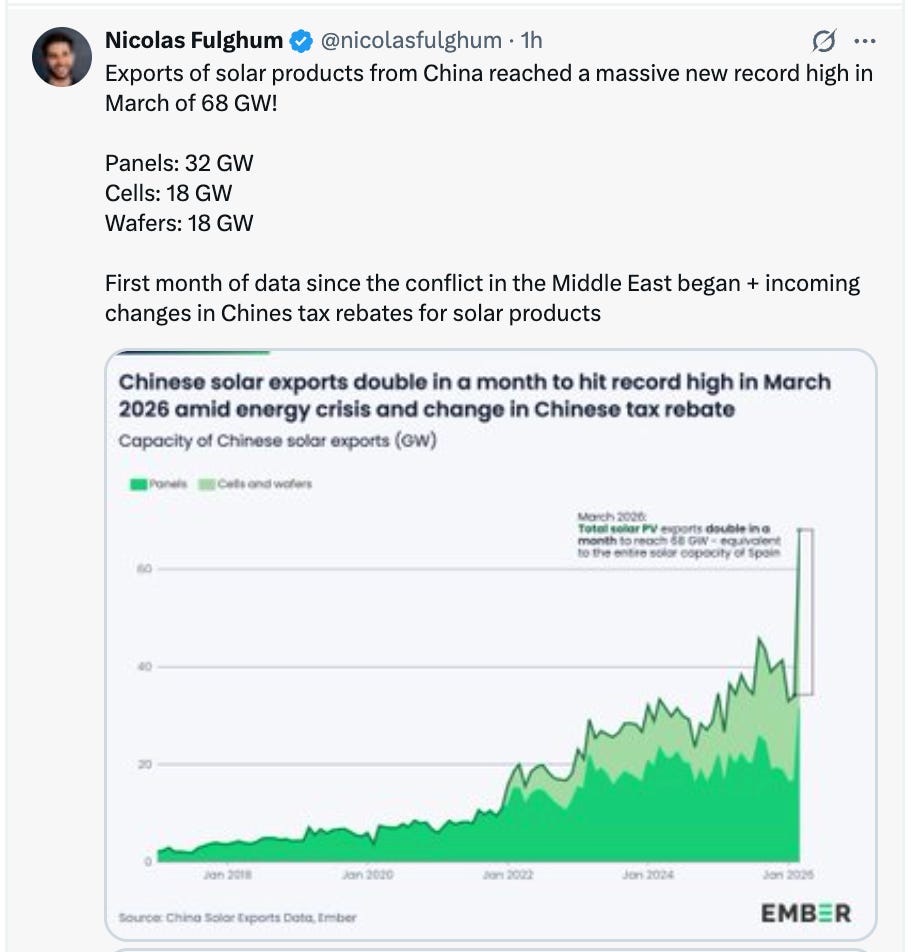
Further evidence for the fact that coal was not straight forwardly substituted by oil and gas in the postwar boom. Coal production could not keep up and so the search was on for other possible sources of fuel.
Hedda Sterne, Six Cylinder Engine, 1961

China Was Once Buying Up Sri Lankan Ports. Now It’s India’s Turn. The Indian Ocean has no shortage of distressed strategic assets: financially stressed yards, ports, and logistics infrastructure in small states that cannot sustain them independently.
Nearly 20 years after China stirred fears about “debt trap diplomacy” with its construction and takeover of the Hambantota Port in Sri Lanka, India is stepping into the fold, acquiring a majority stake in Sri Lanka’s largest commercial shipyard. Last month, Mazagon Dock Shipbuilders Limited (MDL), India’s leading defense public-sector undertaking, responsible for the construction and repair of Indian warships, acquired a majority 51 percent stake in Colombo Dockyard PLC (CDPLC). CDPLC is Sri Lanka’s largest commercial shipyard, located inside Colombo Harbor on one of the world’s busiest east-west shipping lanes. The transaction, valued at $26.8 million, marks the first international acquisition ever made by an Indian shipyard, public or private. It also suggests India’s strategic calculus in its own maritime neighborhood has structurally evolved.
CDPLC is not a greenfield project. It is a functioning, 52-year-old commercial yard with four graving drydocks, capacity to handle vessels up to 125,000 deadweight tons, and a client base spanning Asia, the Middle East, and Africa. In November 2025, before the acquisition closed, CDPLC secured the largest shipbuilding contract in its history (valued at $150 million) from France’s Orange Marine for two advanced cable-laying vessels. The yard services more than 200 vessels annually. Its location matters, as over a third of global bulk cargo and two-thirds of the world’s oil shipments pass through the Indian Ocean. MDL now controls the shipyard infrastructure at that crossroads, with Indian nominees reconstituting the board, and the Dredging Corporation of India signing an MoU with CDPLC for drydocking and ship repair services. …
The context for this acquisition dates back to the mid-2000s, when the Rajapaksa government in Colombo sought financing from India and the United States to develop Hambantota’s deepwater port. At the time, both nations declined, as the financial viability of the project was questioned. China stepped in … In 2017, unable to service its foreign debt, Colombo signed a 99-year lease and concession agreement with China Merchants Port Holdings for $1.12 billion, giving away 70 percent stake in the 1.4 billion port along with operating rights. By contrast, the CDPLC acquisition is structured more like a business acquisition. … Colombo formally requested that New Delhi encourage Indian investors to consider the asset. MDL was selected based on its shipbuilding record and financial strength. …
The current Dissanayake government in Colombo came to power on the platform of non-alignment, and it’s telling that India was first choice for the shipyard. Further, in April 2025, India and Sri Lanka signed their first-ever formal Defense Cooperation MoU, and Sri Lankan President Anura Kumara Dissanayake publicly assured that Sri Lanka “will not permit its territory to be used in any manner inimical to the security of India.” … A defense ministry-owned Indian company, deploying commercial capital through a transparent legal mechanism, has secured controlling interest in strategically located maritime infrastructure at the host country’s request. China spent over $1 billion in construction loans to build a port on a secondary shipping lane that then required a 99-year lease to a Chinese state owned enterprise to stay solvent. India paid $26.8 million for a controlling stake in a functioning yard at the region’s primary transshipment hub. The return on strategic investment per dollar spent is not comparable.
Source: The Diplomat
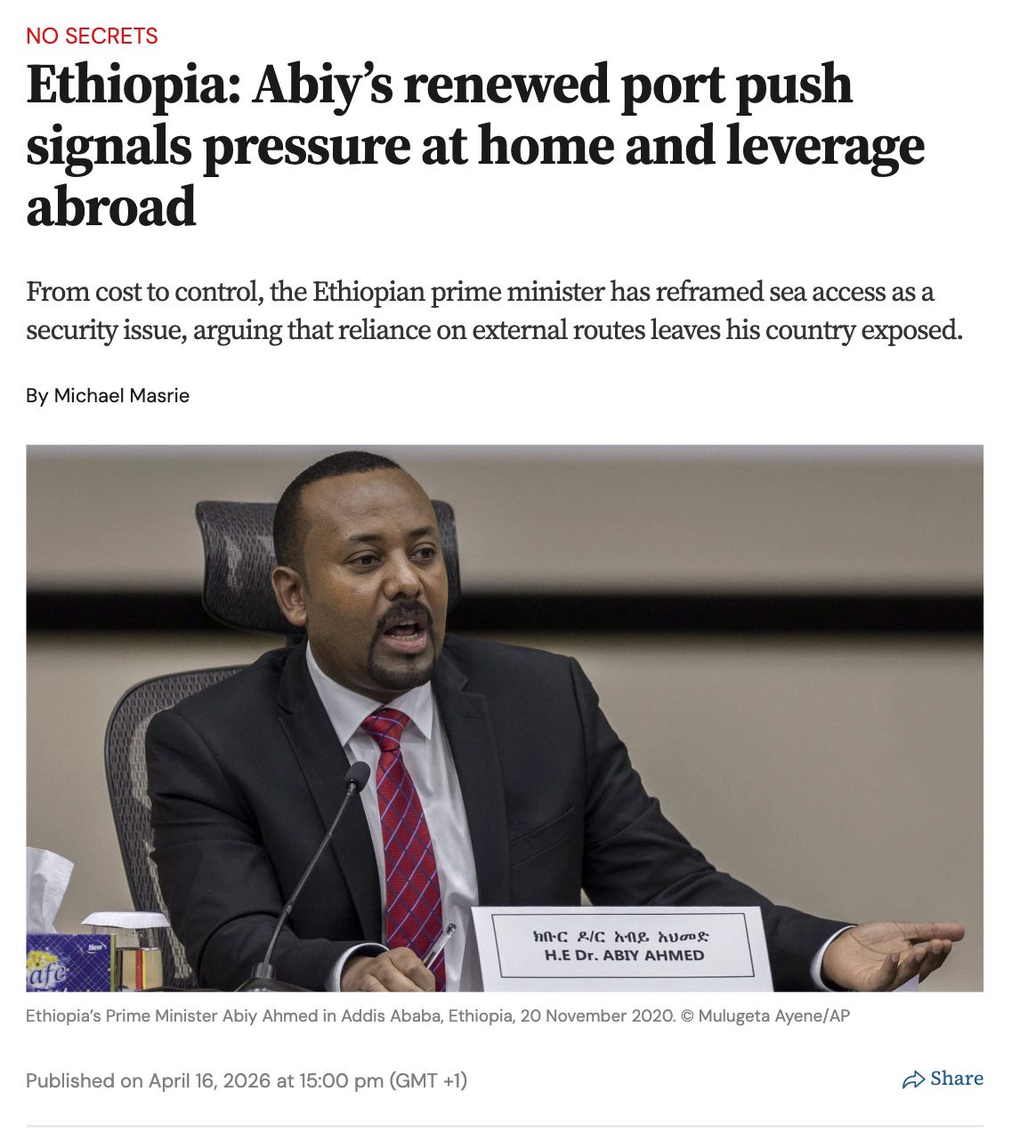
Prime Minister Abiy Ahmed has long argued that Ethiopia needs access to the sea. This week, he returned to that message on state television, but it landed differently. Though the issue wasn’t new, his tone was. What stood out was how much more pointed and loaded his framing has become. In a follow-up interview with state broadcaster ETV on 15 April, Abiy moved beyond the long-standing argument about transport costs and competitiveness. He reframed Ethiopia’s landlocked condition as a structural vulnerability affecting state security, information control and digital sovereignty. “To be without a sea outlet is to be without privacy,” he said, using the Amharic concept of gemena (my secret) to describe exposure across information flows, trade routes and decision chains.
He extended the argument to digital infrastructure, linking undersea cables, satellite dependence and cross-border data routing to what he described as constrained national confidentiality. Ethiopia seems to be seeking operational control rather than passive investment. The concern is no longer only economic exposure but limited control over communications and state systems. The same logic was applied to trade. Imports and exports, Abiy said, become externally visible and therefore vulnerable. “It brings import ‘secret-less-ness’ … export ‘secret-less-ness’,” suggesting that even routine commerce is shaped by external observation and potential disruption. This is not how Abiy has usually framed the issue. Earlier speeches focused on cost and efficiency. His argument has shifted towards control, exposure and strategic vulnerability. …
The timing becomes more consequential alongside remarks by Lieutenant General Tsadkan Gebretensae, former Ethiopian army chief during the 1998-2000 war with Eritrea. Tsadkan revived a long-standing claim that Ethiopia held a battlefield advantage but failed to convert it into a political outcome. “Our superiority emerged while their weakness grew,” he said in a rare interview with state media televised on 13 April. “We had built the strength to do whatever we wanted.” He locates the constraint not in military capacity but in political decision-making. “The army is fully prepared and can do anything, but the next decision is a political decision.” Tsadkan also recalled that the discussion of Assab was politically constrained at the time. “This agenda was taboo,” he said. What matters is not the novelty of the claim, but its reappearance at a moment when executive discourse is expanding the definition of maritime access beyond economics into sovereignty and security. The effect is not convergence of positions, but parallel narrative activation: one from state leadership, the other from military memory.
Source: Michael Masrie in the Africa Report
Only a little way into these conversations between John Gerassi and Sartre, but the exchanges between them about their families and relationships, Sartre’s childhood, projects and the meaning of life (sic) are fascinating.

Hedda Sterne, New York, N.Y., 1955
Source on Hedda Sterne: Ideel Art